 Recompeted
Your Account Plan Doesn't Cover the Services Pipeline
We rebuilt the expiring pipeline by issuing office this morning. Three contracting offices hold half of the $301B in product work coming off contract by August 2028. The $99B services half is spread across 186 offices, and 85 of those have exactly one contract on the board.
Ask a capture shop where its customers are and you get a list of names. NAVAIR, NAVSEA, AFLCMC, ACC Redstone.
Somebody owns each one, the relationships are real, and the account plan gets reviewed every quarter.
That list is correct for platforms. It covers almost none of the services work coming off contract.
We refreshed the expiration pipeline this morning: 1,203 DoD prime contracts above $50M whose current period of performance ends between February 12, 2027 and August 4, 2028, worth $432.82B obligated to date. Then we grouped every row by the office that issued it.
That grouping is free. FAR 4.1603(a)(1) puts the issuing office's activity address code in positions 1 through 6 of every PIID, orders included, so N00019 on the front of a contract number is Naval Air Systems Command at Patuxent River whether the instrument is a multibillion-dollar production contract or a task order somebody placed last Tuesday.
Three Doors, and Then Everybody Else
Split the file the way the desk has split it since the PSC census: leading digit is product, A is research, B through Z is services.
The product half is $301.23B across 529 contracts and 104 issuing offices, and it is about as concentrated as federal buying gets. Half of it sits in three:
N00019, Naval Air Systems Command at Patuxent River: $88.59B across 92 contracts, 29.4% of the product segment by itself.N00024, Naval Sea Systems Command in Washington: $45.39B across 76.FA8625, Air Force Life Cycle Management Center at Wright-Patterson: $38.39B across nine.
Seven offices get you to 75%. Twenty get you to 90%.
The services half is $99.30B across 548 contracts and 186 offices, and the curve is a different animal (chart below).
Four offices to reach a quarter. Eighteen to reach half. Ninety-three to reach 90%.
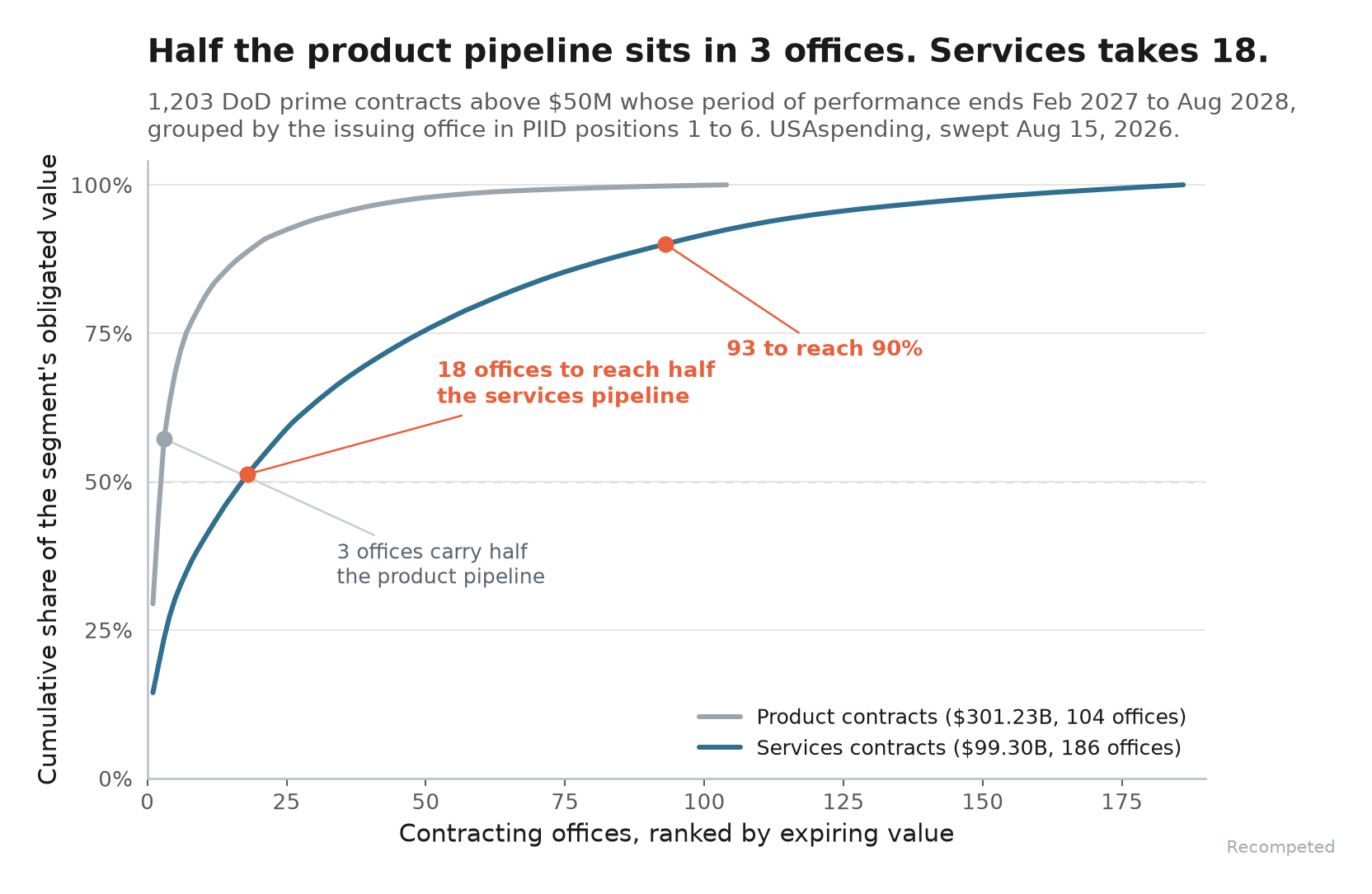
85 of those 186 offices have exactly one contract above $50M coming off period of performance in the entire eighteen-month window. The median services office on this board has two. And 138 of the 186 hold under $500M each, $25.29B between them.
The Top of the Services List Isn't Services
Here's the catch, and it makes the dispersion worse rather than better.
The largest services office in the pipeline is W52P1J, Army Contracting Command at Rock Island Arsenal, at $14.33B, 14.4% of the services segment. Nine rows.
Two of them are Bechtel: $9.57B of chemical demilitarization at Blue Grass, PSC F108 under NAICS 562211, running to October 2027 and January 2028.
Nobody's services capture team is pursuing that.
Rock Island's next five rows are the LOGCAP V performance orders, $3.84B to KBR, Fluor and V2X, all coming off between March 2 and March 29, 2027. Competable, and already the most-watched cluster in Army logistics.
The number two services office, FA8205, is $4.61B and every row on it is Lockheed F-22 sustainment.
Strip Rock Island out and it takes 23 of the remaining 185 offices to cover half of what's left. The head of the services list is demil and platform sustainment, so the part you can actually bid is flatter than the curve already looks.
What Ninety-Three Offices Does to a Pursuit List
The customer-coverage model that works for platforms doesn't transfer, and no version of it scales. You cannot staff ninety-three contracting-office relationships, and eighty-five of those offices would pay off exactly once in eighteen months.
Now pair that with what we found on August 7: 58.3% of the pipeline is task orders under vehicles somebody already won, and FAR 16.505(a)(1) says the contracting officer does not synopsize orders under indefinite-delivery contracts, so most of them never surface on SAM at all.
Two coverage strategies, both leaky:
- Watch the customer, and you cover the eighteen offices holding half the services money, most of which is demil and sustainment you were never going to bid.
- Watch SAM, and you miss the majority that never posts.
What's left is the boring instrument. FPDS carries an end-of-performance date on all 1,203 of these rows whether the follow-on ever gets synopsized or not, and the six characters at the front of the PIID tell you which office you'll be dealing with when it comes.
Final Thoughts
None of this says relationships stop mattering. Get in front of a Rock Island or a NAVFAC Pacific contracting officer and it counts for as much as it ever did.
It says the map is wrong. Services dollars at DoD are issued by a long flat tail of offices that each buy one or two big things a year, and a pipeline built by walking down a customer list finds the same six or seven offices everybody else is already sitting in front of. The uncrowded work is in the ninety-third office, and the only thing that will tell you it's there is a date.
Thanks for reading.