How Seven Years of Options Hide Inside a 2027 End Date
We put the option runway at 30% of expiring services work nine days ago. On the desk's standard segmentation it is 20.3%, and it concentrates in two families. The named programs whose 2027 dates are decisions rather than deadlines.
DISA's Telecommunications Division signed two contracts on the same day in May 2024, one with Verizon and one with T-Mobile Secure Federal Operations, both for National Security Emergency Preparedness priority service.
Both award records end March 31, 2027.
Both also carry a potential end date of March 31, 2034.
Seven years of difference, on two awards one office signed the same day, sitting in somebody's pipeline right now as a 2027 recompete.
What We Got Wrong on August 6
We ran this measure nine days ago and put the services share of expiring contracts carrying unexercised option time at 30.0%. That number was computed on a narrower definition of "services" than the desk settled on two days later, when the PSC convention (a leading digit is a product, a leading letter is a service) became the standing segmentation.
On that convention the same measure is 20.3%, and here is the version that holds.
Every DoD prime contract above $50M whose period of performance ends between February 2027 and August 2028: 1,203 contracts, $432.8B obligated. 172 show a potential end date later than their current one, against $32.8B. Median runway 550 days, down from 645 across nine days of sweeps.
The part we could not see on August 6 is where it sits (chart below). Services families run 20.3% (137 of 674) and products 6.6% (35 of 529), and inside services the spread is enormous: IT and telecom at 41.9%, professional and management support at 36.6%, construction at 3.7%.
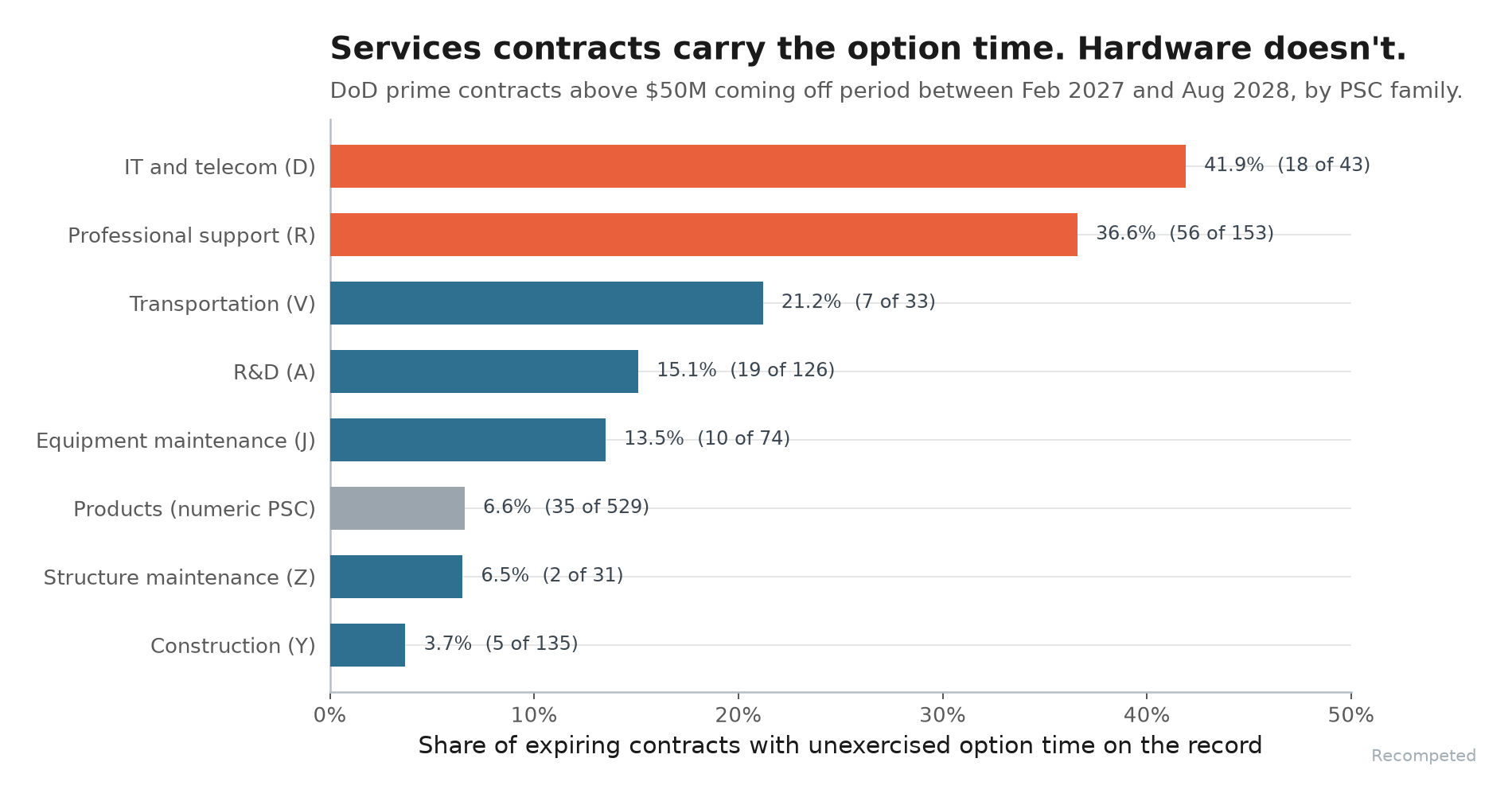
Construction sits with the hardware. That is the finding.
One caveat, once: USAspending mirrors the current end date into the potential-end field when an award never reported one distinctly, so every share above is a floor. The third contract in that DISA family, the AT&T award, shows it. Its potential-end field is blank where its two siblings say 2034.
Why the Split Runs This Way
Exercising an option costs the government a memo. Under FAR 17.207(c) the contracting officer determines that funds are available, that the requirement still fills an existing need, and that exercise is the most advantageous method of filling it, then writes that determination to the file under 17.207(f).
No synopsis. No new competition. No protest.
FAR 52.217-9 asks only for a preliminary written notice of intent to extend at least 60 days out, and the clause says outright that the notice does not commit the government to an extension. So a program office gets to signal, wait, and still walk.
Deliveries end, which is why products sit at 6.6%, and a building finishes, which is why construction sits at 3.7%. Level-of-effort services are continuous requirements funded a year at a time, so options come standard.

The rest of this brief is for subscribers.
The specific solicitations, dockets, and dates to act on sit past this line.
$50 a month, or $500 a year.
Already a subscriber? Sign in