 Recompeted
Five German Builders and a Company From Elkridge
The Army awarded its Germany-wide facilities SRM MATOC on Aug. 14 to six firms sharing a $249 million ceiling. Five of the addresses are German. The sixth belongs to a Maryland contractor that spent its first two decades on 8(a) work inside the Beltway.
The award notice that posted to SAM.gov on Saturday morning carries six contract numbers, W912PB26DA026 through W912PB26DA031, and six street addresses.
Goldbach. Neumarkt. Neuburg. Amberg. Kaiserslautern.
And Elkridge, Maryland.
That is the Army's Germany-wide facility sustainment, restoration and modernization MATOC, awarded Aug. 14 by the 409th Contracting Support Brigade. Six firms share a $249,000,000 programmatic ceiling.
Seven proposals came in and six were selected, so the only bidder who went home empty-handed was the seventh.
The Pentagon's Aug. 14 contract board announced exactly one of the six: Tidewater, Inc., Elkridge, Maryland, W912PB-26-D-A027, out to Aug. 13, 2031.
The other five names did not surface until the award notice went up the next morning.
What the seat actually buys
Regional Contracting Office Bavaria at Grafenwoehr ran this one, and its January sources sought is unusually specific about the ground.
Directorate of Public Works work at USAG Ansbach, across nine kasernes: Katterbach, Bismarck, Shipton, Urlas, Barton, Bleidorn, Storck Barracks at Illesheim, Oberdachstetten and Franken. Then USAG Bavaria: Tower Barracks, Rose Barracks, Hohenfels.
Five ordering periods, performance starting September 2026, firm-fixed-price task orders off an IDIQ, NAICS 236220. Minimum guarantees get satisfied on the initial task order, which means the seat is worth something the day it is issued rather than the day the first real project competes.
One number moved between the market research and the award. That January notice priced five years of level of effort at $121.71M. The ceiling landed at $249,000,000, a little over double.
And the whole thing ran unrestricted. No set-aside, in a NAICS where a set-aside would have been unremarkable.
The book without the program
Tidewater's federal record opens on Sept. 15, 1999. Maryland incorporation, SAM registration in October 2001, and $427,884,418 obligated across 3,605 FPDS transactions since.
Most of the first two decades of that is 8(a) money. Through 2017 the company took $107,241,055 in 8(a) set-aside obligations, about 61% of everything it had booked to that point.
The work behind those years is Naval District Washington repair and renovation, one task order at a time: a third chiller in Building 2805, first-floor HVAC at Washington Navy Yard 57, a SCIF security upgrade in the Fremont Building, a turnstile gate, a test pond restoration.
The last 8(a) obligation lands on Sept. 18, 2017. Nothing after it (chart below).
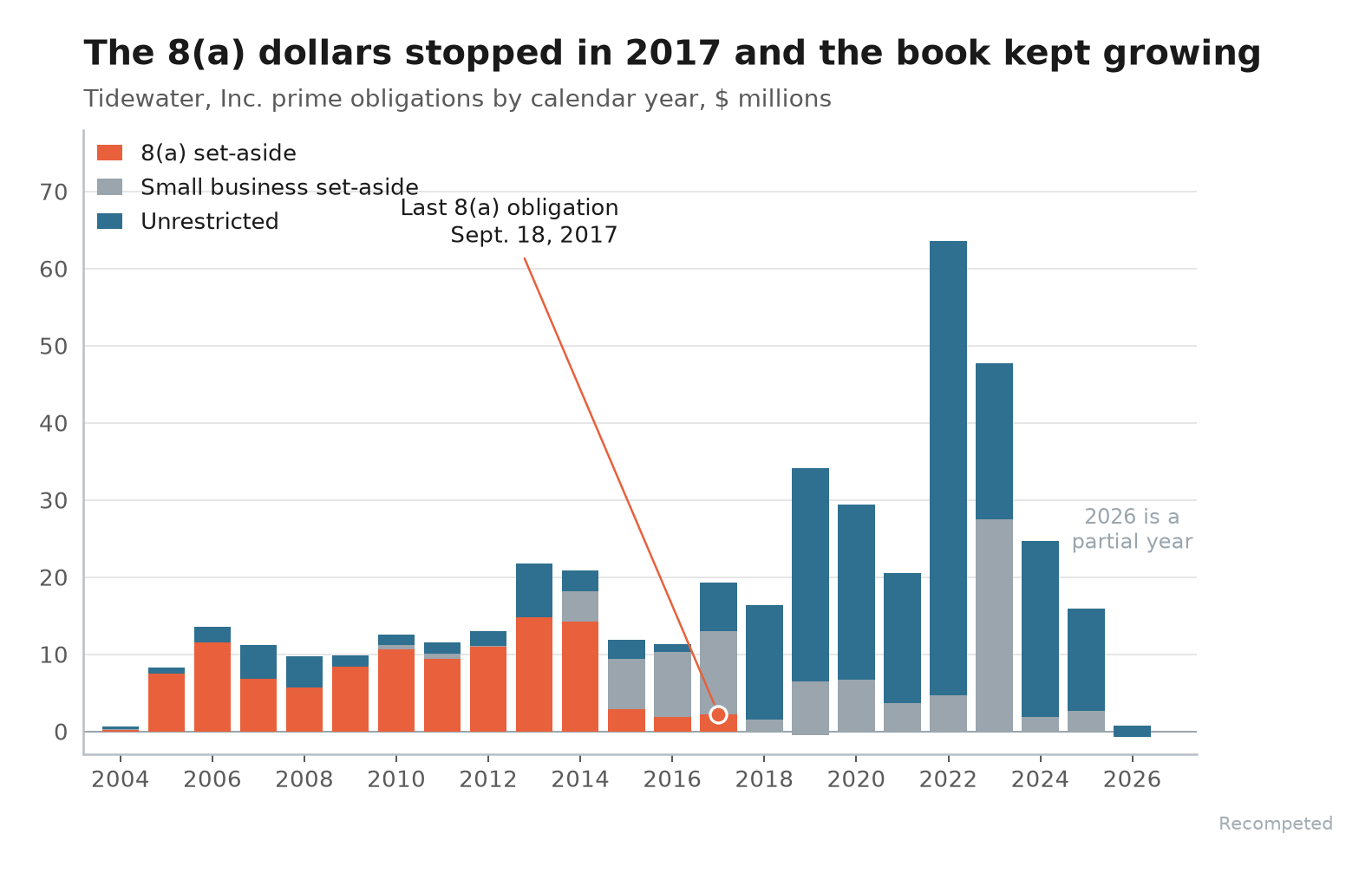
What happened next is the part worth reading. From 2018 through this month the company obligated $251,464,552, more than the whole nineteen years that preceded it, and $195,793,237 of that came off unrestricted competitions.
The 8(a) years built the past performance. The years after them spent it.
Germany was not a cold call
Here is the detail that makes the Aug. 14 seat legible rather than surprising.
Tidewater has been working in Germany, and on overseas installations generally, for a decade already. It just has not been working for the garrisons.
- US Consulate Frankfurt, construction and repair services, State Department contract SAQMMA16F4586, running from December 2016.
- Hamburg lease fit-out, 19AQMM19F1430, $4,430,758 obligated from August 2019.
- USAMMCE in Germany, facility support through USACE Huntsville, option period exercised in September 2015.
- Yokosuka, Japan: construction quality management from 2016, then facility support under W912DY20F0593 from August 2020 through option year four in 2024, and a new US Naval Hospital facility support award in August 2025.
So the firm that showed up to an unrestricted Bavarian construction competition arrived with a decade of OCONUS delivery, half of it inside Germany, all of it for federal customers who were not IMCOM-Europe. That is exactly the relevancy argument a DPW evaluation is built to reward, and it is the kind of past performance that takes ten years to assemble and cannot be bought in a teaming agreement.
Final Thoughts
The clock on this one is worth a note in your own capture calendar.
Sources sought Jan. 23, responses due Feb. 11. RFP on the street Jun. 15, proposals due Jul. 16. Award Aug. 14.
That is 203 days from market research to award and 29 from proposal close to selection, on an overseas MATOC with six winners to document.
The honest caveat: none of this has reached FPDS yet, so the ceiling, the offer count and the six contract numbers all come from the SAM.gov award notice and the Aug. 14 board rather than from a contract record.
Seven bidders, six seats. On a requirement performed entirely in Bavaria, the government found almost nobody it wanted to turn away, and the scarce thing was never evaluation capacity. It was firms willing to price the work at all. If you have ever looked at an OCONUS DPW requirement and decided the mobilization math did not close, the Elkridge address on that notice is the counterargument, and it took the company about ten years of quieter overseas orders to earn the right to make it.
Thanks for reading.