 Recompeted
Who Wins When Price Isn't in the Ranking?
USACE Kansas City ran its civil works A-E recompete under the Brooks Act, reserved four of seven seats for small business, and weighted knowledge of Iowa, Kansas, Missouri and Nebraska above almost everything else. Sixteen firms submitted, four regional shops took the reserved seats, and two of them had been holding the vehicle it replaced.
On May 17, 2019, five small engineering firms took seats on a $36,000,000 architect-engineer vehicle at the Army Corps of Engineers Kansas City District. Fourteen firms had submitted for it. The contract was a total small business set-aside under NAICS 541330, and it ran seven years, to May 16, 2026.
Two of those five are now on the vehicle that replaced it, sharing $95,000,000 with AECOM, HDR and HNTB.
Same district, same C219 work, same four-state stretch of levees and pump stations. The new one was never set aside.
A Reserved Seat Is Only Worth the Orders It Draws
Over the seven years the 2019 vehicle ran, the five seat-holders booked $13,038,248 across 27 Kansas City District task orders. That is 36.2% of the shared ceiling, which tells you the pool was sized generously and used moderately.
Where it gets interesting is the distribution. Affinis Corp of Overland Park took $4,925,685 of it and Water Resources Solutions-Intuition & Logic JV of Prairie Village took $4,196,716, so two of the five seats account for 70.0% of everything the pool booked (chart below). Those are the two firms back on the unrestricted successor.
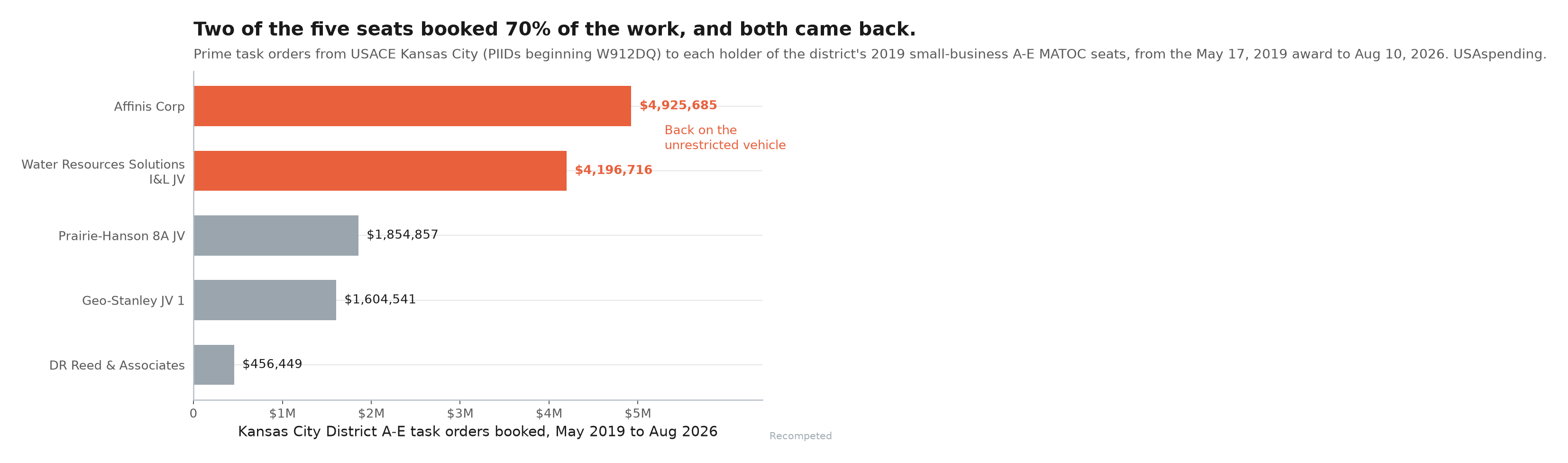
The work behind those bars is unglamorous and repetitive in the way that builds a record: periodic levee inspections at South Topeka Oakland, O&M manuals for multiple levee systems, comprehensive stormwater design at Mission, Kansas, a sewage upgrade design, the Prairie Band Potawatomi Nation feasibility study. Small orders, most of them under half a million, arriving every year without a gap.
Seven years of that is what a CPARS record looks like when it is working.
Price Arrives After the Ranking
The successor competition, W912DQ26RA006, ran under 40 U.S.C. Chapter 11 as implemented in FAR Subpart 36.6, the qualifications-based selection the rest of the industry keeps forgetting exists.
Firms submit an SF 330, a board ranks them on competence, and price shows up afterwards in negotiation with whoever is standing at the top.
So the ranking criteria are the whole competition, and Kansas City published them in descending order:
- specialized experience in flood risk management, operations support, water resources, civil works planning and ecosystem restoration
- professional qualifications across ten named key disciplines, one lead resume each
- past performance, with CPARS queried on every firm that submits
- knowledge of local conditions
- capacity to initiate and finish on schedule
Now, look at the fourth one. The synopsis splits it into knowledge of Iowa, Kansas, Missouri and Nebraska, versus knowledge of the other ten states in the Northwestern Division, and says the first is "significantly more important" than the second. Rivers, soils, local construction methods, what the local climate does to a cost estimate.
That is a criterion a national firm can staff for and a firm headquartered forty minutes from the district office already has.
The tie-breakers say something too. Small Business Participation is a secondary criterion, and the synopsis marks it "not applicable to small businesses," so it is a burden the large firms carry and the small ones skip. The last tie-breaker asks every firm to list its DoD A-E awards from the past twelve months, which the synopsis says will "assist in effecting an equitable distribution of DoD AE contracts among qualified firms."
Volume of recent work as a tie-breaker cuts against whoever has the most of it.
Seven Seats, Four of Them Spoken For
The January synopsis committed to the outcome in writing: "The government has a target to award seven (7) contracts, four (4) of which are intended to be reserved for Small Businesses that will share $95 million in total contract capacity." An unrestricted pool with a reserve inside it, open to all firms regardless of size.
SF 330s were due at 10:00 a.m. CST on January 15, and sixteen came in.
Award was anticipated in June and landed on August 6, 203 days after the deadline and 82 days after the old vehicle stopped taking orders.
The board matched the plan exactly. AECOM, HDR and HNTB took the open seats, and the four reserved seats went to Affinis Freese and Nichols JV, Great River Associates of Springfield, Missouri, Prairie-GEO JV of Columbia, Illinois, and Water Resources Solutions-Intuition & Logic JV.
Five-year base, one two-year option, everything running to August 6, 2033.
Two of those names are worth pausing on. Great River Associates and Prairie-GEO JV have no prime federal award record in USAspending at all.
They are on a seven-year federal ceiling in the same pool as AECOM because a board read their SF 330 and their knowledge of the Missouri basin, and because four seats were held open for firms their size.
Affinis went the other way and added scale, teaming with Freese and Nichols for the JV that holds its seat. Water Resources Solutions kept the same joint venture it has used since 2019 and needed nothing else.
Final Thoughts
Qualifications-based selection is a narrow channel. It covers architect-engineer work and little else, there is no price shootout to lose, and the offer counts the desk uses everywhere else in the pipeline mean something different here.
What it does give you is a clean read on what an agency actually values, because the criteria are the entire competition and they get published months in advance. Kansas City said it wanted people who know what the Missouri does in spring, and it reserved most of the room for firms small enough to be from there. Sixteen firms answered, seven got seats, and the two that had used the last vehicle hardest are still in the pool.
Thanks for reading.