 Recompeted
How Cost Realism Rewrites the Number You Bid
We pulled the FPDS contract type on all 1,189 contracts in the expiration pipeline this morning. Cost-reimbursement covers 57% of the expiring services dollars, and on those recompetes the evaluated figure is the government's estimate of your costs rather than the price you proposed.
If you are building a price-to-win for a services recompete that lands next year, the contract type on the incumbent's award decides how much of that work survives the evaluation.
We refreshed the expiration pipeline this morning and pulled the FPDS pricing code on all 1,189 DoD prime contracts above $50 million with periods of performance ending between February 2027 and July 2028. Of the 661 that buy services, 296 are cost-reimbursement.
Call it 44.8% of the contracts and $74.5B of the $130.1B sitting on the services side of the window. On the product side, cost-plus covers 22.4% of the dollars.
"If the government replaces your proposed cost with its own estimate, what is the price volume doing?"
Whose number gets evaluated
FAR 15.404-1(d)(2) is one sentence and it governs the whole exercise. Cost realism analyses "shall be performed on cost-reimbursement contracts to determine the probable cost of performance for each offeror."
Probable cost, two lines later, "may differ from the proposed cost and should reflect the Government's best estimate of the cost of any contract that is most likely to result from the offeror's proposal." Then the line that does the work: "The probable cost shall be used for purposes of evaluation to determine the best value."
The evaluated figure is an output of the government's analysis. Your proposed cost is one input to it.
That inverts the usual instinct on a recompete. Thin the staffing plan to buy the price down and the evaluators adjust it back toward what they believe the work costs, score you on the adjusted number, and treat the gap as evidence about your understanding of the requirement.
The same analysis that reprices you reads back onto your technical volume.
On the fixed-price side that tool is discretionary. FAR 15.404-1(d)(3) permits cost realism on competitive fixed-price incentive contracts and, "in exceptional cases", on other fixed-price types where the requirement is new or past performance says proposed costs have produced shortfalls.
Discretionary is a different planning assumption than mandatory.
Where cost-plus actually lives
Contract type tracks the kind of work closely enough to predict from the product service code alone (chart below).
Research and development runs 88.8% cost-reimbursement across its 125 expiring contracts. Professional and management support runs 60.4%, equipment maintenance and rebuild 52.9%, IT and telecom 44.2%.
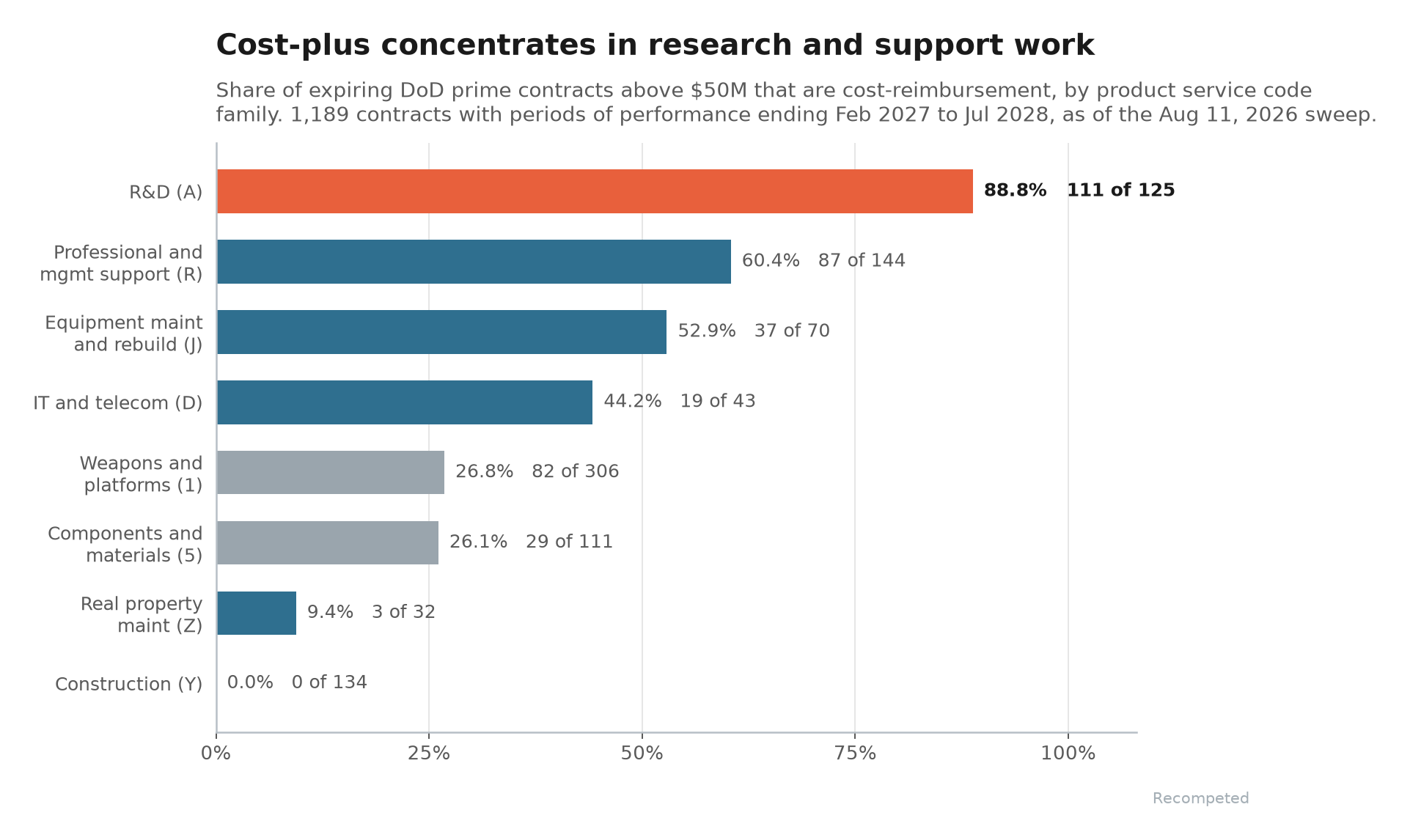
Construction is the floor, and it is a clean one: 134 expiring contracts worth $21.8B, zero of them cost-reimbursement. Real property maintenance sits just above it at 9.4%.
The middle of that chart is where a capture plan gets surprised. Professional and management support and IT services both land close enough to even that only the incumbent's own award tells you which rules apply, and on IT the dollars lean further fixed-price than the contract count does: 44.2% of those contracts are cost-type, carrying 33.7% of the family's money.
The gate before the evaluation
There is a second filter, and it closes earlier. FAR 16.301-3(a) allows a cost-reimbursement contract only when four conditions hold, one of which is that "the contractor's accounting system is adequate for determining costs applicable to the contract or order."
So the bidder list is pre-screened before anyone writes a proposal. The offer counts on the expiring cost-type awards look like it:
- LinQuest, FA8808-19-C-0006, MILSATCOM systems engineering and integration, cost plus incentive fee, $678.0M obligated, ends February 26, 2027: 2 offers.
- Torch Technologies, W31P4Q-21-F-0038, hardware-in-the-loop engineering for the Army's Aviation and Missile Center, awarded off an OASIS small-business pool, cost plus fixed fee, $602.8M obligated, ends May 10, 2027: 3 offers.
- KBR, W52P1J-19-F-0394, the LOGCAP V task order for EUCOM, cost plus fixed fee, $2.31B obligated, ends March 29, 2027: 6 offers.
Six offers puts LOGCAP in the top tenth of this population. Of the 209 cost-type services awards in the window that report an offer count, the median drew 2, a full 104 of them drew exactly one, and 80.4% drew three or fewer.
And 167 cost-type services contracts worth $38.2B reach their current end date inside the next twelve months, each drawing from a field whose indirect rates are already documented well enough for a contracting officer to sign.
Final Thoughts
None of this changes which recompetes are worth chasing. It changes what the price volume is for.
On the fixed-price half of the pipeline, the number you write is the number that gets scored, and the discipline is arithmetic. On the cost-reimbursement half, the number you write is a claim about how the work gets done, and the government is required to check that claim and allowed to overrule it in writing before anyone ranks you.
The pipeline tells you which half you are in. It tells you roughly two years before the RFP does.
Thanks for reading.