What Happens When 24 Protests Land on One Solicitation
Eighteen companies have filed twenty-four pre-award protests against the Army's $50B MAPS solicitation. Ten are still open, their statutory clocks run to October 19, and that date, not the Army's September target, is the earliest a clean award can happen.
Eighteen companies. Twenty-four filings. One solicitation number.
Since April 23, every one of those protests has gone to GAO against W15P7T26RA006, the Army's Marketplace for the Acquisition of Professional Services. MAPS carries a $50 billion ceiling and swallows two vehicles a lot of you live on: ITES-3S and RS3.
Fourteen of the twenty-four are closed. Nine dismissed, five withdrawn, none decided on the merits.
Ten are still open.
"Who actually sets the award date on a $50 billion vehicle?"
Not the program office. Every open docket runs its own statutory clock, the clocks were started by whoever filed and when, and the Army cannot award while any of them is pending.
Two Waves, Both on a Deadline
Pre-award protest timing runs on a rule.
Under 4 C.F.R. 21.2(a)(1), a challenge to a solicitation impropriety apparent on the face of the solicitation has to be filed before the closing time for receipt of proposals. Miss the close, lose the ground.
So the filings pile up where the rule puts them (chart below).
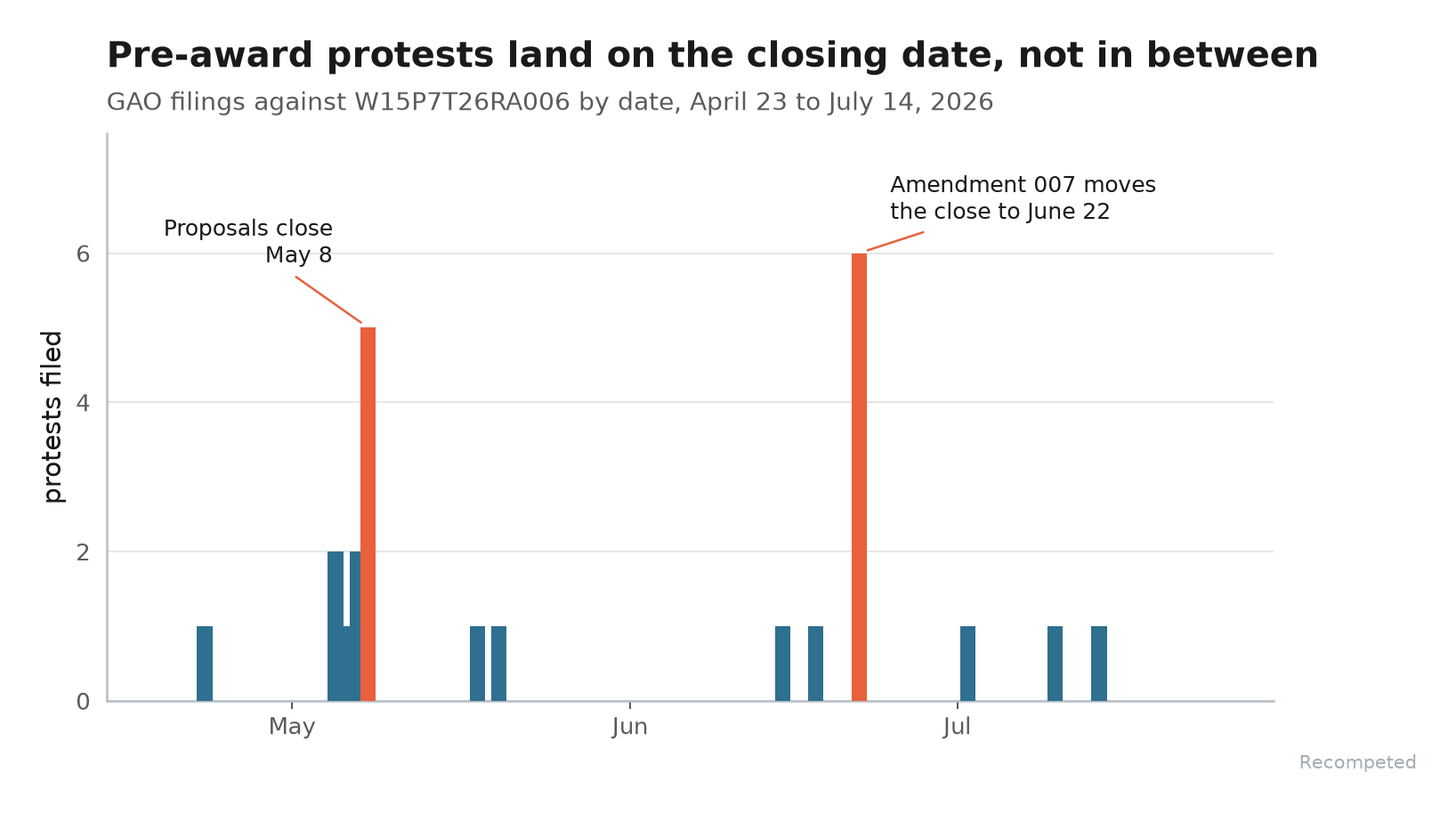
The RFP hit the street April 1 with offers due May 1, then slid to May 8. Ten of the twenty-four filings land in the four days ending on that date, five of them on May 8 itself.
Then the Army moved the goalposts. Amendment 007, issued May 20, did nothing except push the close to noon on June 22, and told industry a substantive Amendment 008 was coming.
Amendment 008 delivered. It reworked evaluation criteria, qualifying-project requirements, the scorecard and gate criteria, and how CPARS ratings score.
Submitted proposals had to be rebuilt rather than tweaked.
New scorecards went out with four calendar days, one of them a business day, left on the clock.
Eight more protests followed between June 15 and June 22. Six of them on the closing date.
That is the whole shape of the docket: two amendment cycles, two closing dates, two clusters of filings sitting right on top of them. The grounds people are actually arguing (scoring ambiguity in the self-scoring scorecard, restrictive qualifying-project criteria, how small business credits apply, a 5MB submission cap smaller than the scorecard files themselves) matter for who wins. The timing was never discretionary.

The rest of this brief is for subscribers.
The specific solicitations, dockets, and dates to act on sit past this line.
$50 a month, or $500 a year.
Already a subscriber? Sign in