 Recompeted
The Hardest Line on a Capture Plan Is a New Customer
Yorktown Systems Group has booked $538M of federal prime work since 2008 by staffing other people's schoolhouses, and almost none of it was Air Force. On Monday the Academy handed the company a five-year training contract at $51.6M, against eleven other bidders.
In July 2009, a contracting office at Grand Forks Air Force Base bought a suitcase antenna system from a one-year-old company in Huntsville for $3,883,419. That December the same office bought a $6,139 navigation part from them.
Those two purchase orders are the complete history of the Air Force buying anything from Yorktown Systems Group. Both hardware. Both closed by January 2010.
On Monday the Air Force Academy gave the company $51,565,132.
"What does eighteen years of past performance with somebody else's customer actually buy you?"
What Yorktown Actually Sells
Instructors.
The company was founded in 2008 by a service-disabled veteran and has booked $537,963,675 of federal prime obligations since. Four customers carry effectively all of it: Special Operations Command at $172.1M, the Missile Defense Agency at $161.5M, the Army at $132.7M, and the State Department at $67.7M.
Read down the task-order descriptions and the same business keeps surfacing. Language instructors for 1st Special Forces Command. LREC curriculum and immersion training for SOF schools. 91-series MOS instructor support at the Fires Center of Excellence. Dismounted counter-IED mobile training teams for the Army. Language instruction, curriculum development, and testing support for State, which is a $67.7M line all by itself under NAICS 611630, Language Schools.
The remainder is program and administrative support, mostly at MDA: $115.5M of office administration support from 2016 to 2022, then a $46.0M bridge that ran to November 2025.
So the profile is a schoolhouse staffing shop with a program-support sideline. No platform, no system, no software product.
The Air Force Column Was Empty
Sort those obligations by customer and the shape of the capture problem is right there (chart below). Four bars between $67M and $172M, then the Air Force at $3.9M, all of it from 2009, none of it a service.
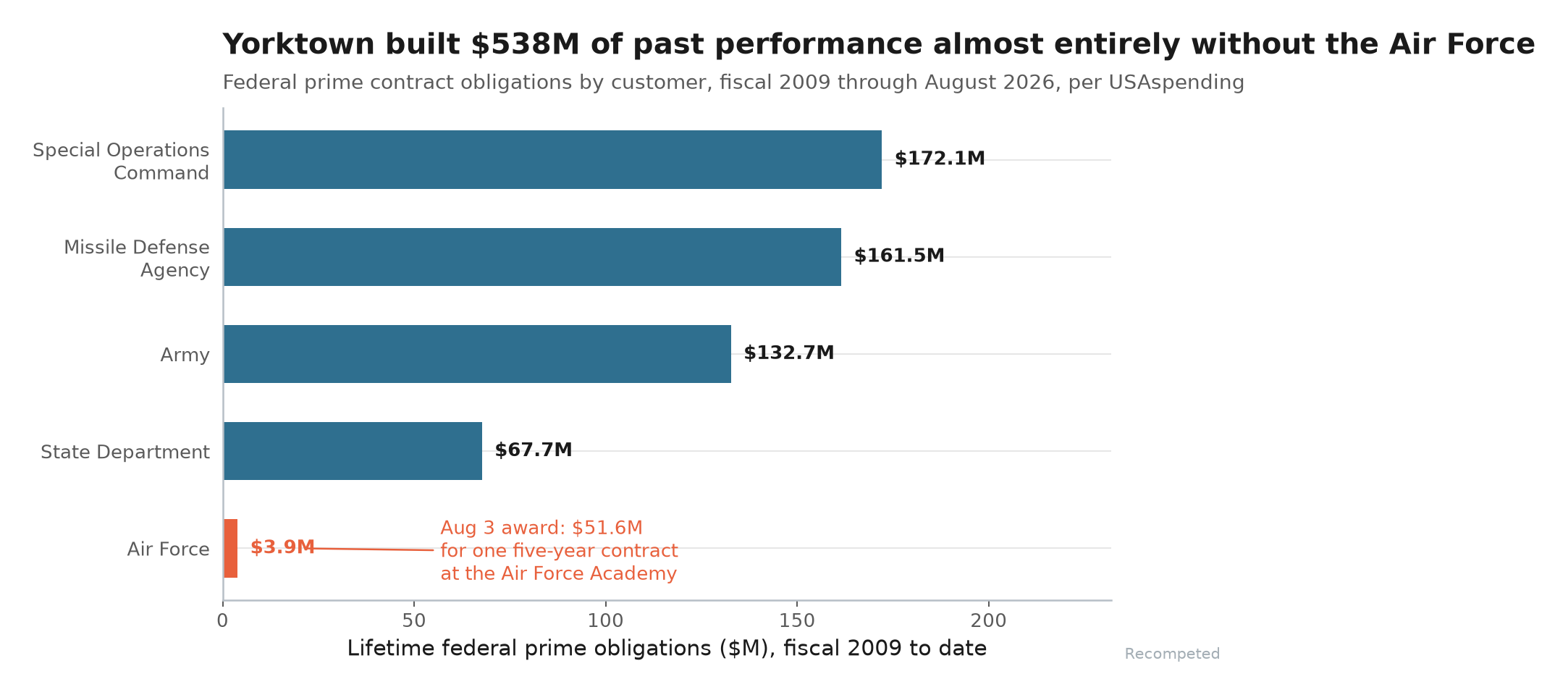
Monday's award is 13x that entire column, in one contract.
The announcement runs four lines. $51,565,132 firm-fixed-price for Warfighter Training Support Services at the U.S. Air Force Academy, complete by August 2, 2031, a competitive acquisition with twelve offers received, and $3,510,540 of fiscal 2026 operations and maintenance funds obligated at award.
Contracting activity is the 10th Contracting Squadron at USAFA, FA7000-26-C-0016.
Twelve offers is a genuine field for a base-level services requirement of that size. Eleven other teams looked at a five-year firm-fixed-price training contract in Colorado Springs and priced it.
Why That Line Is Expensive
Every capture shop has run this play. Most have lost it, and the reason is structural.
Past performance gets scored on relevancy, and relevancy runs on two axes: what the work was, and who you did it for. A bidder carrying identical scope from a different service is arguing the first axis and conceding the second. Winnable, and the price of winning it is everything the second axis would have handed you for free:
- The CPARS record an evaluator can pull without asking. Yorktown has years of ratings, and none of them sit in the Air Force's own file drawer.
- The customer's memory of your last transition. A program office that has watched you stand up a schoolhouse before does not need to be convinced you can.
- Site knowledge priced into the bid. The incumbent knows the actual headcount, the actual absenteeism, the actual surge weeks.
Firm-fixed-price sharpens all of it. On an FFP services competition the incumbent prices against its own labor actuals while everyone else prices against a PWS, a site visit, and whatever the Q&A gave up. That gap is where challengers either buy the work or walk, and twelve offers means eleven teams read the gap as crossable.
Now the interesting part for anyone tracking this vertical. The contract runs to 2031.
Whoever the Academy talks to about warfighter training support for the rest of this decade is talking to Huntsville, and the past-performance line that was empty on Monday morning is a five-year Air Force reference by Tuesday.
That is the compounding piece. The first award into a new customer is priced like a loss leader because the second one is the actual prize.
Final Thoughts
The public record makes a lot of things visible, and new-customer entries are among the least remarked and the most instructive. Award announcements read as dollar figures and completion dates; the thing worth noticing is which column on the awardee's ledger just stopped being empty.
Yorktown spent eighteen years building past performance at SOCOM, MDA, the Army, and State. None of that record was Air Force services, and it turned out to be enough anyway, against a field of eleven.
Congratulations to the team in Huntsville. We will be watching what they do with the reference.
Thanks for reading.