How a Protest You Withdrew Still Sends the Bill
Abacus Technology dropped its protest of an Air Force network operations award, then filed for costs and waited 319 days. GAO has now told the Air Force to pay for two grounds and not the other two, and the line between them is a due date rather than a ruling.
Abacus Technology withdrew its protest last August. Yesterday GAO published a decision telling the Air Force to pay for it anyway.
"What actually decides whether the government covers your protest bill?"
Being right is half of it. The other half is a date on the agency's own calendar, and this decision puts that date on the record twice, once on each side of the line.
The Order Two Companies Were Left Bidding On
On December 10, 2024, the Air Force issued fair opportunity proposal request RS3-24-0025 to small businesses holding RS3 multiple-award IDIQ contracts. The work is IT support for Air Force Central Command's Network Operations and Security Center.
Sixty-day phase-in, ten-month base, five one-year options, estimated over the $25 million that puts a task order inside GAO's jurisdiction.
Ten offerors proposed. Two cleared the pass/fail gates.
Abacus came in at $237,693,967. SMS Data Products Group came in at $146,571,969. Abacus rated Good on technical solution where SMS rated Acceptable, and the source selection authority took SMS anyway, writing that the technical edge did not justify a 62 percent price premium. In the SSA's words, "[t]he magnitude of this premium massively outweighs the relative value of the merits associated with the higher-evaluated proposal."
CACI held the work going in.
The Arithmetic That Decided It
The FOPR promised a price realism check built on the mean and standard deviation of every technically acceptable price. With two prices left standing, that check does nothing, and the agency's own evaluators wrote it into the record: "Mathematically with two technically acceptable proposals, the standard deviation would be -1 and +1 regardless of TOEP."
So the Air Force reached for the incumbent's costs instead.
The last option year of CACI's contract was funded at $32,891,006, with $31,704,318 of it already spent, and the contracting officer confirmed on the record that $32.9 million was the expected final cost. The agency then divided that figure by the number of people CACI had proposed, multiplied the result by the number CACI actually employed, and produced $25,717,944 as "the actual cost of the requirement."
SMS's first full year of performance was priced at $21.9 million. Against $25.7 million, that is a bid a shade under the benchmark.
Against the $32.9 million the agency already knew, it is a third below what the work costs today (chart below).
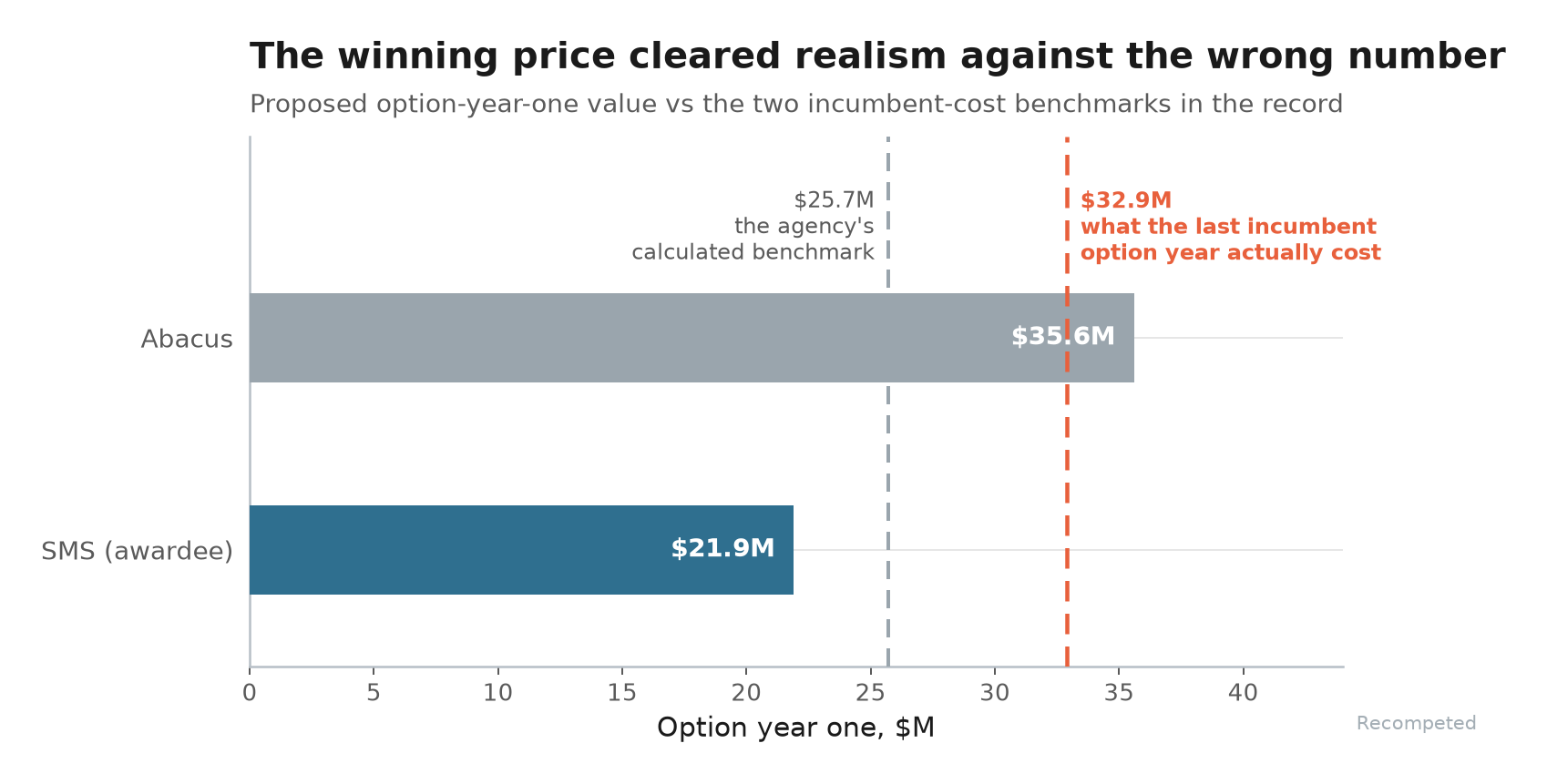
GAO was not gentle about it. The Air Force "conducted an unnecessary and flawed calculation," and when the agency was asked to defend the denominator it chose, it "offered no response nor a defensible legal position to the allegation, and we find none."

The rest of this brief is for subscribers.
The specific solicitations, dockets, and dates to act on sit past this line.
$50 a month, or $500 a year.
Already a subscriber? Sign in