 Recompeted
If It Was Full and Open, Where Was Everybody?
We pulled the offer count on all 1,207 contracts in our expiration pipeline. Of the 533 DoD coded as competed, 115 drew exactly one bid, and the single-bid rate is worst on the vehicles built to make bidding cheap.
The Army Field Directorate Office at Fort Eustis put $800 million of ceiling on the street Tuesday and drew one bid apiece.
Chitra Productions took $450M for instructor-writer, training support and training development services through Aug 2032 (W911S0-26-D-A008). BeaverFit North America took $350M for fitness and human performance structures through Aug 2033 (W911S0-26-D-A009).
The Pentagon's announcement uses the same sentence for both: "One bid was solicited via the internet with one received."
Read that phrasing twice. One solicited.
"When the award record says the work was competed, how often did anybody actually show up?"
We stopped guessing and counted.
Twenty-two percent
Our expiration pipeline holds every DoD prime contract over $50M obligated whose period of performance ends six to twenty-four months out. This morning that is 1,207 rows.
We went back to the FPDS record behind each one and pulled the offer count.
839 of them report one. Of those, 533 are coded competed: full and open, full and open after exclusion of sources, or competed under simplified acquisition procedures.
115 of the 533 drew exactly one offer (chart below).
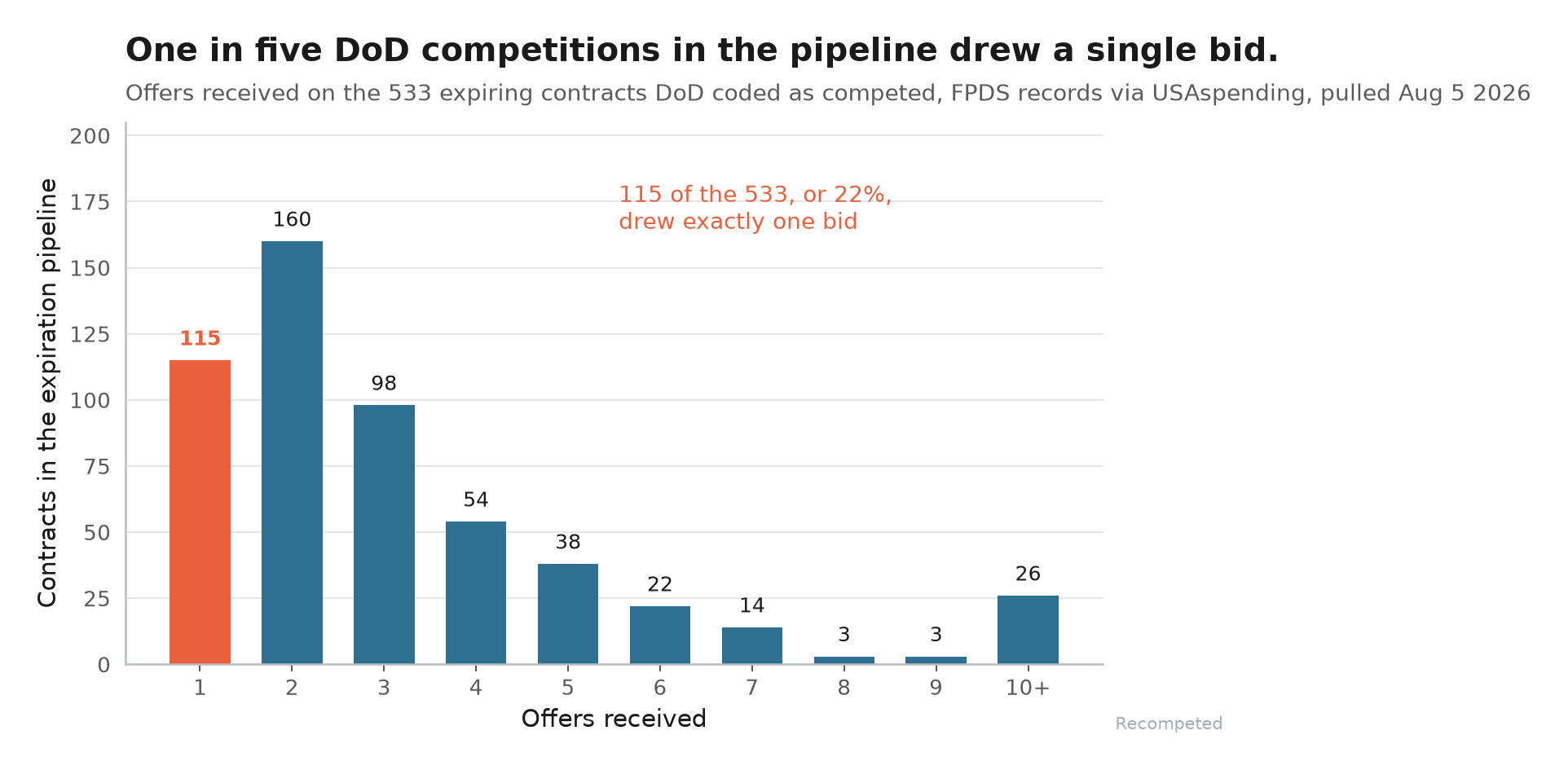
That is 22% of the competed pipeline and $21.9B of the $164.9B obligated across it. Two bids is the most common outcome at 160, three at 98, and the tail is real: 26 contracts drew ten or more offers.
So the market still competes. On better than one in five of the contracts you would flag as a live recompete, the incumbent's last win was uncontested.
Set aside the 250 rows coded not competed and the 54 coded not available for competition. Those drew one offer by construction and they carry $204B between them.
The ones worth your morning are the awards that ran a competition and still ended with a single envelope.
The thinnest competition is on the vehicles built for competition
Split the 533 by structure and the rate moves:
- Orders placed under a parent IDV: 277 competed, 72 of them single-bid (26%).
- Standalone contracts: 256 competed, 43 single-bid (17%).
Fair opportunity is supposed to be the cheap competition. Everyone is already on the vehicle, the proposal is short, the past-performance file is already in the customer's hands.
It produces a one-bid outcome half again as often as an open-market procurement does.
By service the spread is wider still. Air Force runs 39 of 118, or 33%.
Navy is 22%, Army 14%.
What that looks like at scale, all coded full and open competition, all one offer received:
- L3Harris, Combat Mission Systems Support for the Air Force's SDA and Combat Power office, $675M obligated, current end date Jan 31 2027 (FA881919C0002).
- Northrop Grumman, BACN E-11A platform maintenance, $211M, ends Aug 18 2027, placed under a GSA Alliant vehicle (FA872623F0028).
- Torch Technologies, technical and engineering support at ACC-Redstone, $202M, ends Apr 25 2027, placed under GSA OASIS (W31P4Q24FC001).
What a one-bid incumbency is actually telling you
Two things produce a single offer on a real competition, and the solicitation file usually says which. Either the requirement was drawn tight enough that nobody else could clear it, or nobody else bothered to try.
The first is a wall. Check the corporate-experience floor, the key-personnel clearances, the incumbent-shaped past-performance relevancy language.
The second is an opening. A one-bid history means the customer has no recent evidence that anyone else can do this work, and that cuts both ways: their file on you is empty, and their file on the incumbent's pricing has nothing to compare against either.
307 of the 533 competed rows come off contract inside twelve months. 64 of those drew a single bid last time.
One honest limit on all of it: 368 of the 1,207 pipeline rows carry no offer count on their latest transaction, so every rate here describes the 839 that do.
Final Thoughts
DoD's competition statistics count Chitra's $450M award as competed, and by the rulebook they are right to. The competition happened.
The market just did not attend.
That gap is where a capture plan lives. A recompete nobody contested is not a fortress, and the record telling you so is public, free, and sitting in FPDS under the incumbent's own PIID.
Thanks for reading.