 Recompeted
The Program Office That Told You What It Wanted 16 Months Early
Kessel Run's Flight Ops office named the legacy programs it wanted to replace in a March 2025 market-research notice, showed industry its draft strategy that August, and took whitepapers in January. The $100M award reached the Pentagon's contract board on July 28, 508 days after that first notice.
On March 7, 2025, a program office at Hanscom posted a request for information on SAM.gov asking industry how it would build one application to replace Patriot Excalibur and Puckboard.
It named both products in the notice. It said what the replacement had to carry: scheduling, training, and stan/eval, for Mobility Air Force and Combat Air Force sorties, plus Space Force and joint users.
On July 28 the Pentagon's daily contract board carried a $100,000,000 other transaction agreement for the Aerospace Readiness Enterprise System, competitively awarded against three offers.
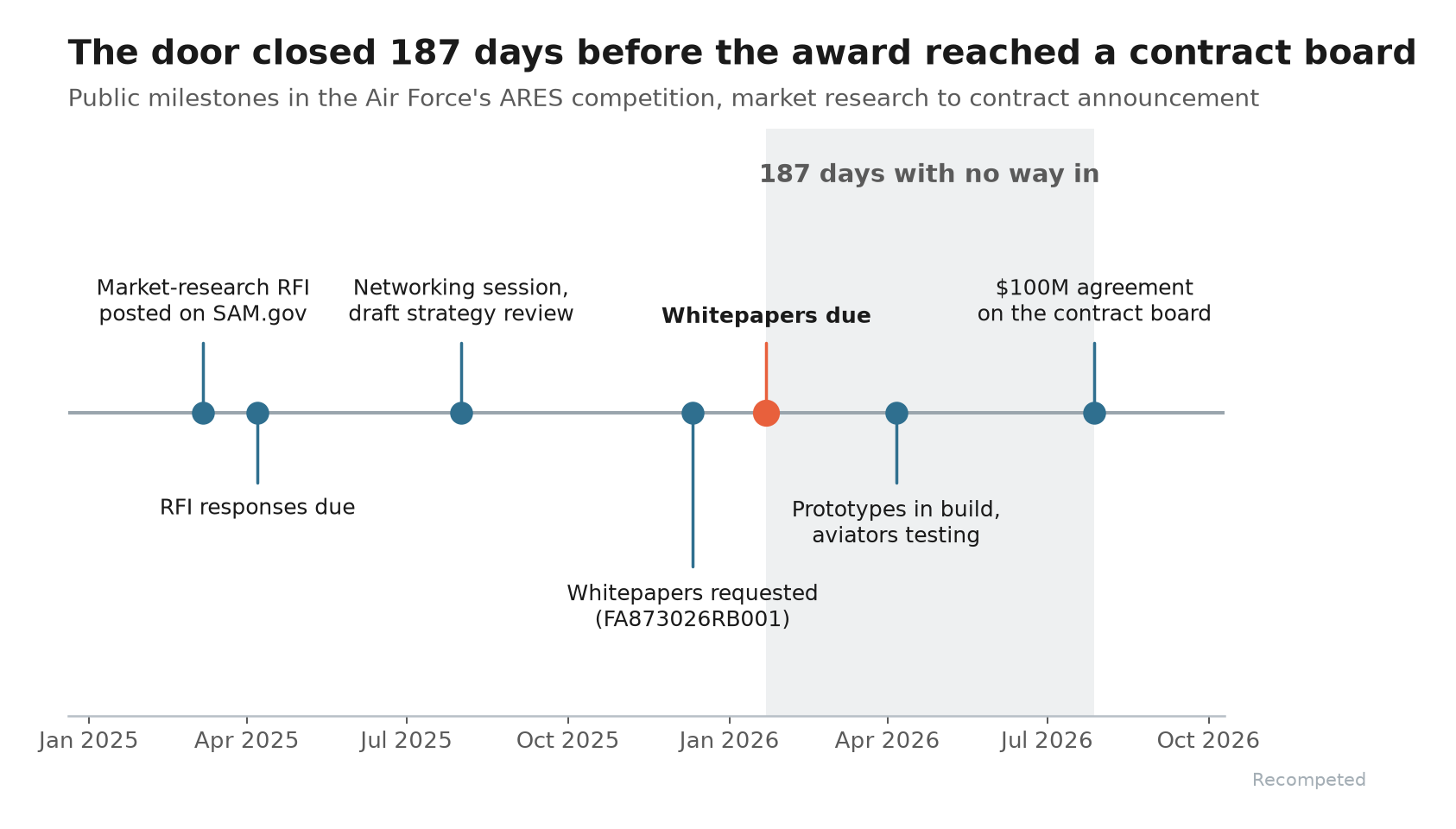
Everything between those two dates was public, and it is worth walking (chart below).
"Where in that sequence was the last moment a new bidder could still get in?"
January 22, 2026. Six months and six days before the announcement printed.
What Kessel Run Was Actually Buying
ARES is the Air Force's enterprise replacement for three fielded programs at once. The solicitation says so in a single sentence, by name: Patriot Excalibur, Puckboard, and the Graduate/Training Integration Management System.
Scope is aircrew scheduling, standardization and evaluation, and training management, and Air Combat Command funds it.
AETC's requirements are the baseline for the first build, and AETC by itself is roughly 45% of Air Force flying hours across an enterprise of about 149,000 Airmen.
It deploys into the IL4 partition with a path to IL6, and the office asked for commercial software "to the greatest extent possible."
So the shape is a three-for-one consolidation at whole-of-service scale, run out of the Kessel Run Flight Ops PMO at AFLCMC with AETC's Command Integration Center holding the requirements.
The Gates, in Order
Each of these sat on SAM.gov or a public affairs page, free, months before anyone had a contract number to search:
- March 7, 2025. The market-research RFI, naming the legacy products and the target scope. Responses closed April 7.
- August 1, 2025. An invitation to a networking session and a draft strategy review, responses due August 15. The office put its acquisition strategy in front of industry while the strategy could still change.
- December 11, 2025. Whitepapers requested under FA873026RB001. No set-aside, NAICS 541519, questions taken through December 19, bidders library released on request.
- January 13, 2026. Amendment: the deadline moves from January 9 to January 22, and the industry Q&A gets attached to the notice for everyone to read.
- January 22, 2026. Whitepapers due. That is the door.
Ten and a half months of runway, and three separate moments where a firm that had never heard of the program could raise its hand.
Prototypes the Aviators Could Break
Now, the structure underneath is the part worth stealing.
The solicitation's own framing is that prototyping is "a low-cost, rapid risk mitigation approach," and that the first ARES use case would be built as a prototype before anyone bought the enterprise. Whoever took a prototype agreement had 90 calendar days to deliver something "completed and available for inspection and use."
By early April the prototypes were in build, with user groups from 19th Air Force squadrons queued to evaluate them over the summer.
Col. Brian Benton, who leads AETC's Command Integration Center, set the standard in plain language: "Every pilot's first impression of the Air Force is how we manage our aircrew, and we see an opportunity to modernize that experience."
What got evaluated was working software that aviators had actually used. On a $100M enterprise consolidation, that is a genuinely well-built gate.
Who Cleared It
The winner is VivSoft Technologies, of Herndon, an 8(a) small business whose seats on 8(a) STARS III and the OASIS+ 8(a) vehicle are both visible in the public award record.
Its first DoD money was an Air Force open call for dual-use technology in December 2019, worth $49,990. Its largest award to date is a $14,974,902 STRATFI SBIR Phase II that ran out on August 3, three days ago. Along the way it built AETC's Decision Support System and took Air Force flight-operations software work under TIMES, which is to say it was already inside the customer and the mission area.
Across fiscal 2020 through fiscal 2026, USAspending records $69,256,760 of federal prime contract obligations to the company, every agency and every award combined. The ARES ceiling is $100,000,000.
One agreement is worth more than six years of the rest of the book. That is what a long run of small, adjacent, on-the-customer's-ground past performance is for.
Final Thoughts
There is a reading of this where a small company got lucky on an OTA, and the record does not support it.
An other transaction carries no GAO protest path worth planning around, so the whitepaper was the only bite anyone got, and the firm that took it had been doing AETC and Air Force flight-ops software since 2023.
Frankly, the more useful lesson runs the other way. Nothing about the ARES sequence was hidden, it was just early, and the office went out of its way to be legible: it named the incumbent products it wanted to retire, published its draft strategy for comment, extended its own deadline, and posted the industry Q&A where everyone could see the same answers.
If the first you hear of a program is its line on a contract board, you are reading a result. The office that produced it said what it wanted 508 days earlier, to anyone who was looking.
Thanks for reading.