How the Osprey Line Closes Without the Money Leaving
Naval Air Systems Command bought the V-22 loads and dynamics model data on Monday, sole source, for work it describes as happening prior to and concurrent with production cessation. Bell Boeing's obligations fell 61 percent when the line wound down and then stopped falling. There is $7.83 billion of V-22 work on the expiring board and 99 percent of it has never been competed.
"What do you buy from a prime whose production line is about to stop?"
Naval Air Systems Command answered that on Monday's board. It bought the math.
Bell Boeing Joint Project Office took a $29,674,990 cost-plus-fixed-fee order, N0001926F2168, issued against a basic ordering agreement it already held. The scope is loads and dynamics model data for every V-22 variant, and the announcement says why in the government's own words: the data supports "future sustainment decisions, mishap investigations, transition to post-production sustainment," and it is being bought "prior to and concurrent with V-22 production cessation."
A second Osprey order landed on the same board. Raytheon took $34,364,909 (N0001926F1166) to sustain the V-22 Tactical Software Suite for the Air Force, Marine Corps and Navy.
Neither was competed. The board says so about both, in the same five words: "This order was not competitively procured."
The line wound down. The money stayed.
Bell Boeing JPO obligated between $1.7B and $2.9B a year from FY2011 through FY2022, averaging $2.27B. FY2023 came in at $947M and FY2024 at $871M, a fall of 61% against that run rate (chart below).
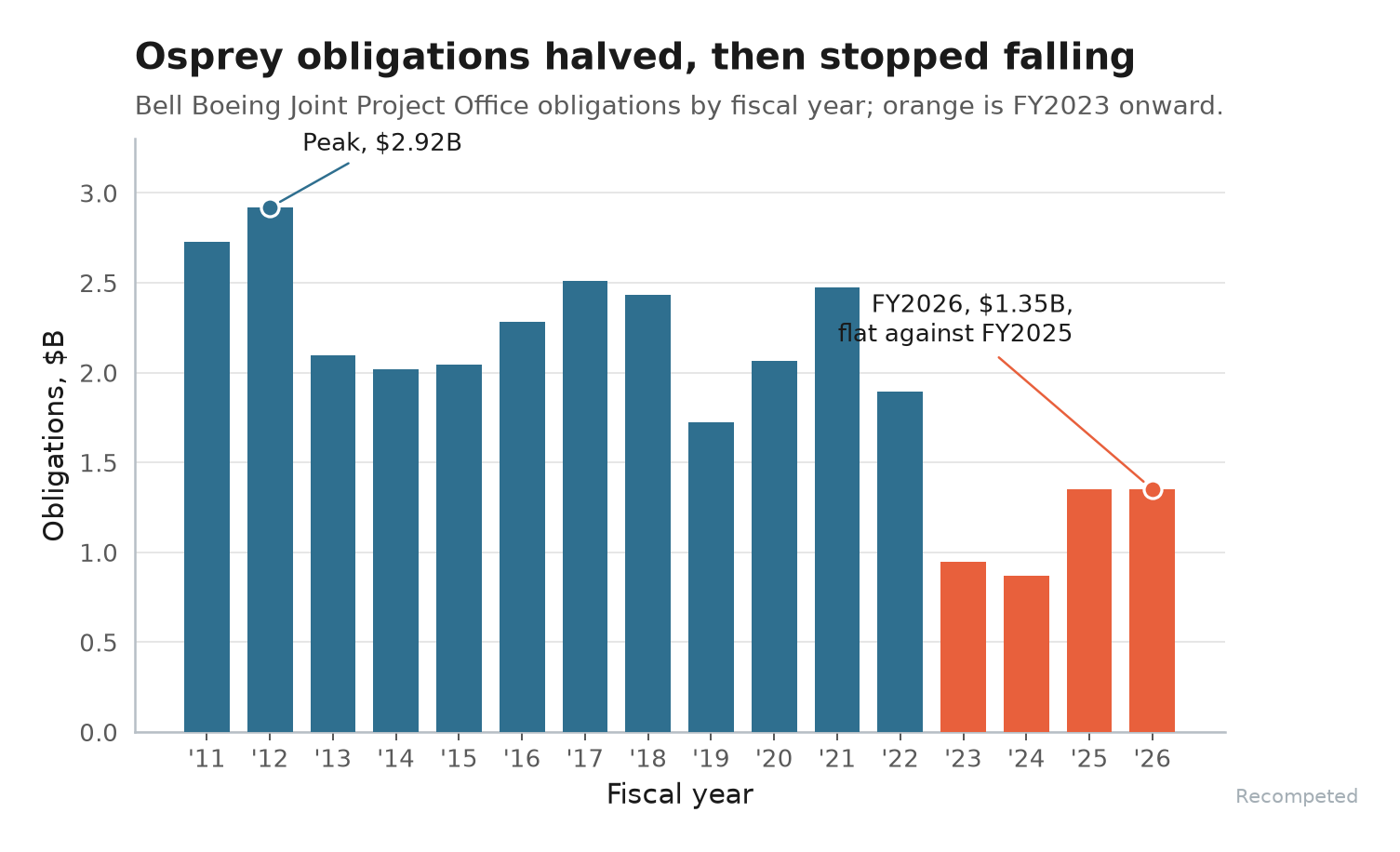
Then it stopped falling. FY2025 closed at $1.35B, and FY2026, with eight days left to run, sits $1.1M above it.
So the program stopped being a production program and kept spending like a mid-size one. That is the shape every platform makes on the way out, and the reason the tail matters more to your pipeline than the line ever did.
Why the data buy is the whole signal
A loads and dynamics model is the engineering basis for deciding whether a repair, a modification, or a service-life extension is airworthy.
Whoever holds it can answer sustainment questions. Whoever does not has to ask the OEM.
Buying it at production cessation, rather than after, is the government putting itself in a position to hold a competition later. The order names the Fleet Support Team and post-production sustainment as the customers for the data, which is what that looks like on paper.
Worth one honest hedge: we could not verify from the public record what data rights license rides on N0001926F2168. Unlimited rights and limited rights buy very different futures, and the announcement does not say which this is.

The rest of this brief is for subscribers.
The specific solicitations, dockets, and dates to act on sit past this line.
$50 a month, or $500 a year.
Already a subscriber? Sign in