 Recompeted
How Much of Your Pipeline Was Ever a Competition?
We pulled the competition record on all 1,197 DoD contracts above $50M coming off period of performance between February 2027 and August 2028. Competition won 53.4% of the rows and 38.4% of the $444.82B. One sole-source exception carries $209.89B of it by itself.
FAR 6.302-1 is the sole-source exception every capture team can recite. It reads differently for the Pentagon than it does for the rest of the government, and the difference is eleven words.
"...available from only one responsible source, or, for DoD, NASA, and the Coast Guard, from only one or a limited number of responsible sources..."
A civilian contracting officer has to find that there is one source. A DoD contracting officer has to find that there are few.
We pulled the competition record on every row in our expiration pipeline this morning: 1,197 DoD prime awards above $50M whose period of performance ends between February 15, 2027 and August 8, 2028, carrying $444.82B in obligations.
Just over half the contracts were competed. Well under half the money was (chart below).
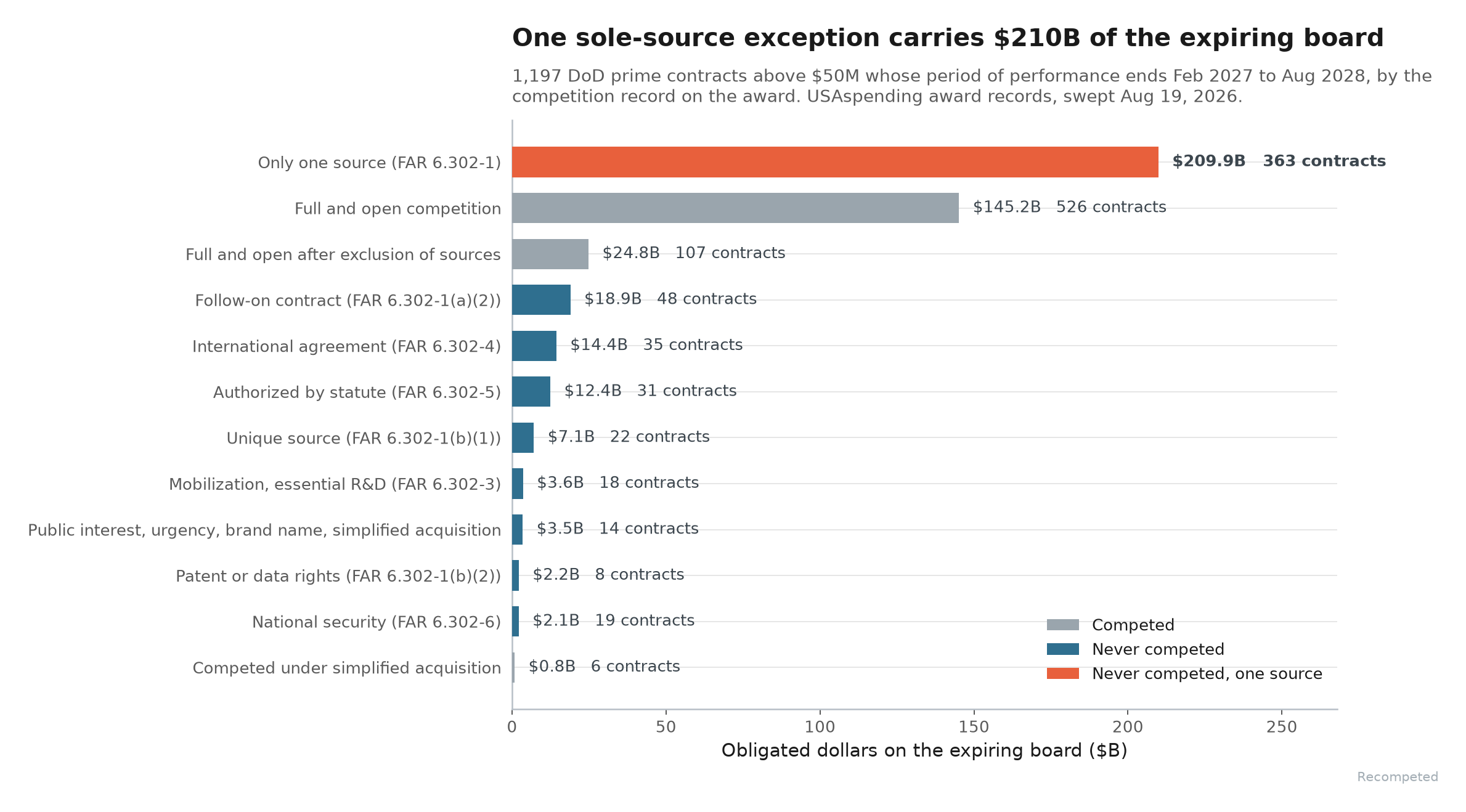
The Exception Outranks the Rule
639 of the 1,197 carry a competed code, which is 53.4% of the rows and $170.81B, or 38.4% of the dollars.
The other 558 were never competed: 46.6% of the rows and $274.01B, which is 61.6% of the money coming off contract in that window.
One authority does nearly all of that work.
363 of those awards cite 6.302-1, only one source, and together they carry $209.89B. That is 76.6% of the never-competed dollars and 47.2% of the entire expiring board, out of a single paragraph of the FAR.
Full and open competition is the second bar on that chart. More contracts (526), less money ($145.16B).
The largest row on the board is N0001920C0009, Lockheed Martin, $30.14B obligated against F-35A LRIP long-lead funding, running to June 1, 2028. One offer, only one source.
Your Lane Reads Differently
Take the products and the R&D out and the shape inverts.
The 403 rows carrying a services PSC hold $75.99B, and 140 of them were never competed. That is 34.7% of the services rows and $26.33B, which is also 34.7% of the services dollars.
On everything else, never-competed work is 67.2% of the money.
So the sole-source concentration is a platform and weapons story first, and the services board is roughly two-thirds competed by value. That two-thirds is the part a capture plan can actually be built on.
The never-competed services rows that remain are worth reading one at a time, because the cited authority tells you what would have to change:
- FA820518F0001, Lockheed Martin, comprehensive F-22 vehicle sustainment services, $3.67B, ends April 30, 2027, taken as a follow-on under 6.302-1(a)(2).
- W58RGZ19C0027, General Atomics, MQ-1C Gray Eagle performance-based logistics, $1.90B, ends April 23, 2027, only one source, one offer.
- FA857724C0001, General Atomics, MQ-9 Reaper support and services, $646.4M, ends December 31, 2027, taken under 6.302-1(b)(2): patents and data rights.
That last authority is the durable one.
A follow-on justification gets harder to sustain as a program matures and the specialized-services argument thins out. A data-rights justification holds until the government buys the data.
What the Field Doesn't Tell You
A screening note, because it changes how you read any pipeline built this way.
All 558 never-competed rows carry a Part 6 exception. Zero of them carry a FAR 16.505(b)(2) fair-opportunity exception, and 308 of the 558 are orders issued under an existing IDV.
The order-level gate simply does not surface in this field. A screen built on extent_competed will read a task order that never went out for fair opportunity exactly the way it reads a standalone sole-source contract, and the two have very different re-entry paths.
Final Thoughts
None of this says a single one of those 558 justifications was wrong. Some requirements really do have one source, and a J&A that survives review is doing the job it exists to do.
What it says is that the headline on a forward pipeline overstates the addressable market by a lot.
$444.82B comes off contract between February 2027 and August 2028. Roughly $171B of it has ever been won by showing up and beating somebody, and the services slice is where the row count and the dollar share finally agree with each other.
Two weeks ago we counted how many bidders actually showed up inside the competed set. This is the rest of the board, and by money it is the bigger half.
Worth knowing which of those two numbers your pipeline review is quoting.
Thanks for reading.