An Agency Can't Make You Bid Alone
GAO sustained a protest against the Army's $50 billion MAPS solicitation over four words buried in a question-and-answer file. The remedy is an amendment and a reopening, and the scorecard arithmetic says exactly who that helps.
The provision that just cost the Army its $50 billion professional services solicitation was never in the solicitation.
It lived in three cells of a question-and-answer spreadsheet.
"Offerors shall not propose subcontractors for this Solicitation." "No teaming is permitted on MAPS."
On August 11 GAO sustained a protest against those answers and recommended the Army amend the Marketplace for the Acquisition of Professional Services solicitation and reopen it for new offers.
Nine days on, the Army has posted nothing. The newest version of W15P7T-26-R-A006 on SAM is still the one from June 19, still showing a response date that closed on June 22.
"Who decides whether a small business bids as a team or as a joint venture, the small business or the agency?"
GAO had never answered that before, and said so in a footnote: an issue of widespread interest to the procurement community that has not been decided previously.
The Whole Case Was One Conjunction
Intelligence Consulting Enterprise Solutions, a small business out of Alexandria, filed on May 5 and supplemented on May 8.
Four grounds. Three of them lost: the Army's solicitation numbering and amendment posting, the bar on classified past-performance references, and a claim that 2,558 answers to industry questions still left the solicitation ambiguous.
The fourth ground was the teaming ban, and the Army's defense of it was grammar.
Two provisions of the Small Business Act carry the language. Section 644(e)(4)(A) says that on a consolidated solicitation, "a small business concern that provides for use of a particular team of subcontractors or a joint venture of small business concerns may submit an offer."
Section 644(q)(1)(A) requires agencies to solicit bids from "responsible small business concerns and teams or joint ventures of small business concerns" on every multiple-award contract above the substantial bundling threshold, which for a DoD component is $8 million.
The Army read the "or" as a menu.
It had allowed small business joint ventures by amendment, so in its telling the statute was satisfied and prime-subcontractor teams could stay banned. Its brief put it plainly: "Congress did not mandate both."
GAO agreed the conjunction is disjunctive and then went past it, twice.
The first answer was structural. MAPS is by its own terms a consolidation, folding RS3 and ITES-3S into one vehicle, and consolidation triggers a framework that runs the other way: decisions made "with a view to providing small business concerns with appropriate opportunities," maximum small business participation to the extent practicable, restrictive terms only as far as the agency's needs require.
Reading it the Army's way, GAO wrote, "has the effect of reducing, rather than maximizing, the opportunity for small business concerns to compete."
The second answer was the sentence itself. The list containing the "or" modifies the subject of section 644(e)(4)(A), and the subject is the small business concern.
So the choice is real, and it belongs to the offeror. "The Army is wrong about with whom the discretion lies."
One footnote is worth the download on its own. RFO 7.107-4 requires agencies to insert provision 52.207-6, the one soliciting offers from small business teaming arrangements or joint ventures, in every multiple-award solicitation above the bundling threshold.
GAO notes, without further comment, that the MAPS solicitation does not include it.
The Reopening Is Not Free
The recommendation is two items and both of them matter:
- Amend the solicitation to permit offers from small business teams, in addition to small business joint ventures.
- Reopen the solicitation and allow a reasonable period for "the submission of new or revised offers."
New offers. Proposals from firms that never bid, including firms that skipped MAPS precisely because they could not put a team on paper.
A GAO recommendation is not an order.
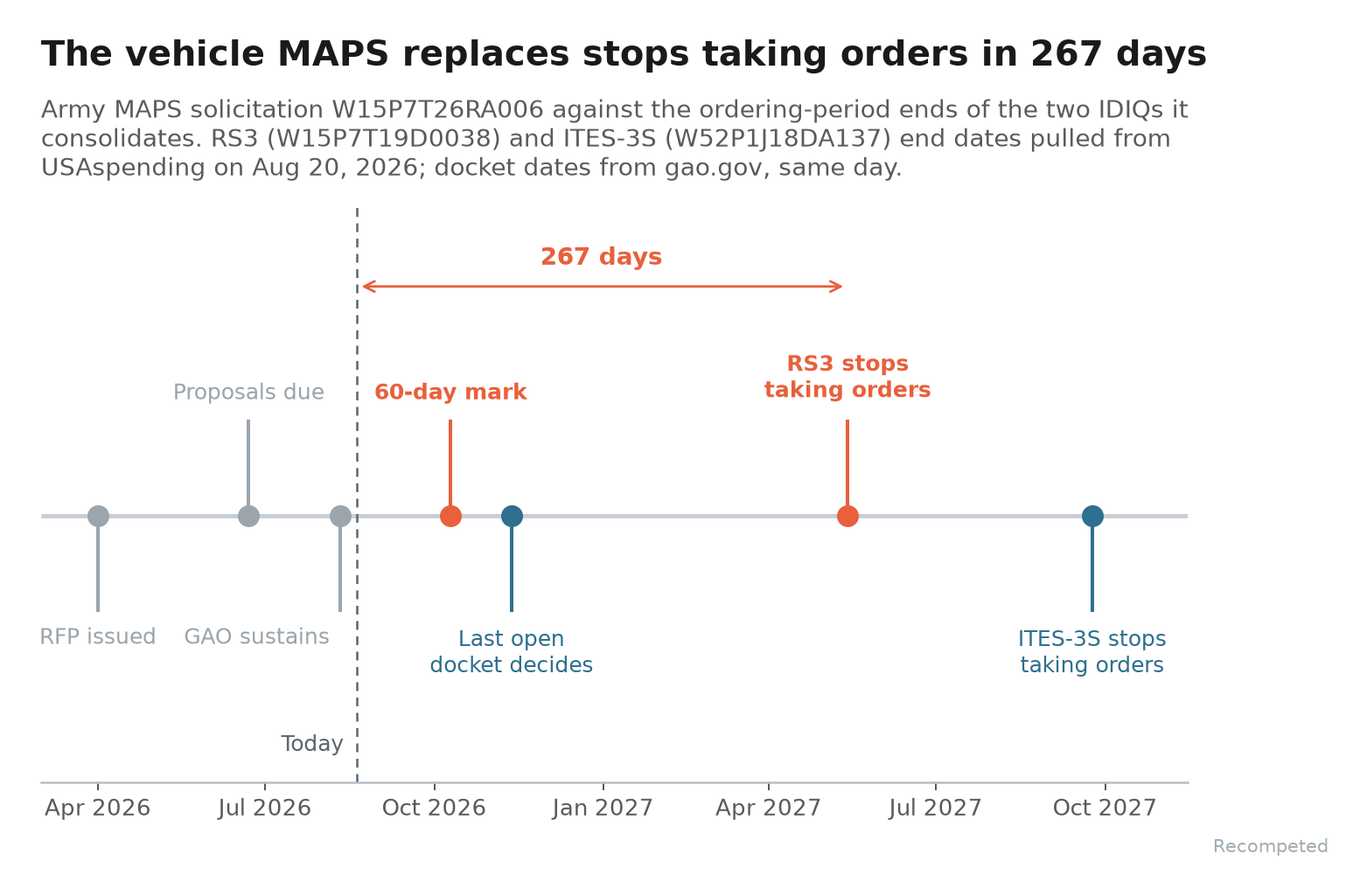
Under 31 U.S.C. § 3554(b)(3) the Army has 60 days from receipt to implement it fully, and if it does not, the head of the procuring activity reports that failure to the Comptroller General within five more days.
GAO then reports it to four congressional committees. Sixty days from August 11 lands on October 10.
The clock that squeezes here sits behind the vehicle rather than in front of it (chart below). RS3 stops taking orders on May 14, 2027, which is 267 days out, and ITES-3S runs to September 24, 2027.
Everything still ahead on MAPS has to fit inside that window: an amendment, a reopening, five domains of scorecard verification, up to 350 awards, and eight more pre-award protest decisions running through November 12.

The rest of this brief is for subscribers.
The specific solicitations, dockets, and dates to act on sit past this line.
$50 a month, or $500 a year.
Already a subscriber? Sign in