How a Price Gets Negotiated When Nobody Else Shows Up
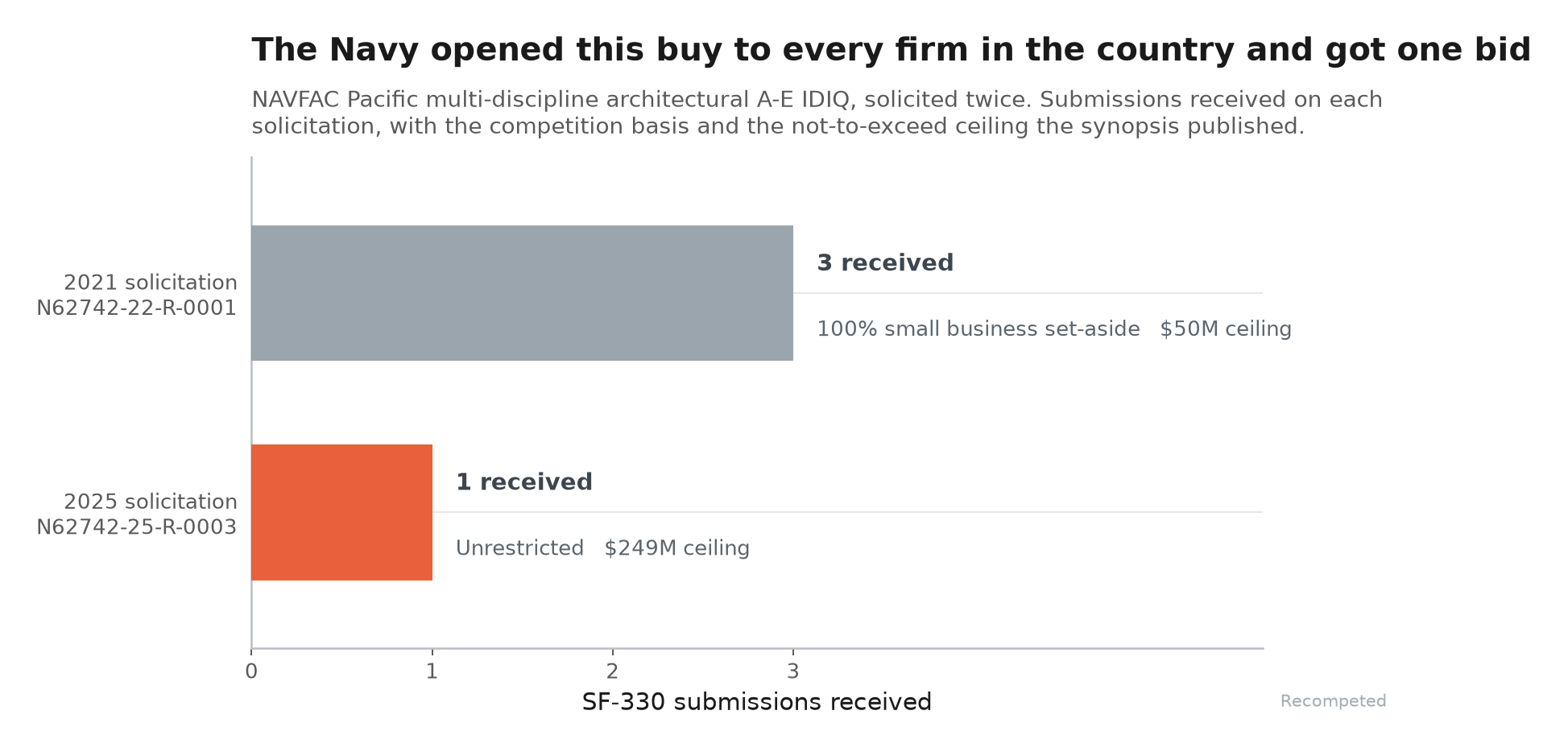
NAVFAC Pacific dropped the small business set-aside on its Pacific architectural A-E vehicle and took the ceiling from $50 million to $249 million. The set-aside version drew three SF-330s. The open version drew one, and FAR 36.6 gives a contracting officer nowhere to walk when the negotiation stalls.
In the autumn of 2021 NAVFAC Pacific went to market for a single architect-engineer IDIQ covering architectural design across Guam, Hawaii and the rest of its area of responsibility. The office set the work aside for small business, published a not-to-exceed ceiling of $50,000,000, and got three SF-330s back.
RMA Architects took it in August 2022.
Tuesday the Navy announced the successor to that vehicle. Same contracting office, same scope language, same NAICS 541310, same PSC C219.
The set-aside is gone, the ceiling is $249,000,000, and the announcement reads "competitively procured via the sam.gov website with one offer received" (chart below).
"Who is sitting across the table when the selection board's list has one name on it?"
What Actually Changed Between the Two Buys
The 2025 solicitation, N62742-25-R-0003, went out unrestricted. Its predecessor, N62742-22-R-0001, was a 100% small business set-aside at a $8,000,000 size standard. Both were procured under 40 USC Chapter 11 as implemented by FAR Subpart 36.6, both structured as one IDIQ with a base year and four one-year options, both paying out through firm-fixed-price task orders with no dollar limit per order and none per year.
So the eligibility door went from small-business-only to everybody, and the ceiling went up 4.98 times.
The field went from three to one. ADRS LLC of Honolulu holds N62742-26-D-1213 for up to $249 million through August 2031, and USAspending returns no prior prime federal contract award to that name.
Two solicitations four years apart are two data points, and we would not call that a trend on its own. What makes this one worth reading is that the record shows exactly which gate the Navy left in place while it opened the other one.
The Gate Nobody Widened
Criterion 1 in both synopses asks for new base development facility projects of approximately $20 million or more in construction value, new construction only, with repair and alteration work explicitly disqualified. Both versions also carry the same sentence: every project in the SF-330 "must have been completed by the actual office/branch/regional office proposed to manage and perform work under this contract." Corporate experience from a sister office does not count.
The 2025 version then tightened around that. Where the 2021 buy let a firm submit seven projects, the new one caps it at five, and it requires that those five collectively demonstrate all three facility types: administration, industrial, and community support.
Criterion 2 went from two design teams to three, at eight named key personnel apiece with active US professional registration.
Run the intersection. You need a Pacific-region office that has itself, in the last ten years, finished designs on $20M-plus new construction across three distinct facility families, plus twenty-four registered professionals to staff three teams.

The rest of this brief is for subscribers.
The specific solicitations, dockets, and dates to act on sit past this line.
$50 a month, or $500 a year.
Already a subscriber? Sign in