 Recompeted
How Long Does a Wrong Announcement Stay Wrong?
Wednesday's board had one line in its entire Air Force section, retracting a $33.1 million L3Harris modification announced the day before. We counted every correction on 308 daily contract boards: a third of them carry one, the median correction lands five days late, and seven took the award back completely.
If you log awards off the Pentagon's daily contract boards, Wednesday's board took one back.
The entire Air Force section of the Oct. 14 announcements was a single line. The $33,141,075 Unified Messaging System modification announced the day before, to L3Harris in Colorado Springs, "was not released."
No explanation, no replacement entry.
So we went and counted how often the board revises something it already printed.
"How long does a wrong announcement stay wrong?"
We pulled every daily contract board war.gov has posted since June 2025, which is 308 of them, and kept every paragraph carrying the word CORRECTION. That comes to 140 corrections across 100 boards.
Roughly one board in three, 32.5%, revises something it already published.
What the board gets wrong
Most of it is a date (chart below).
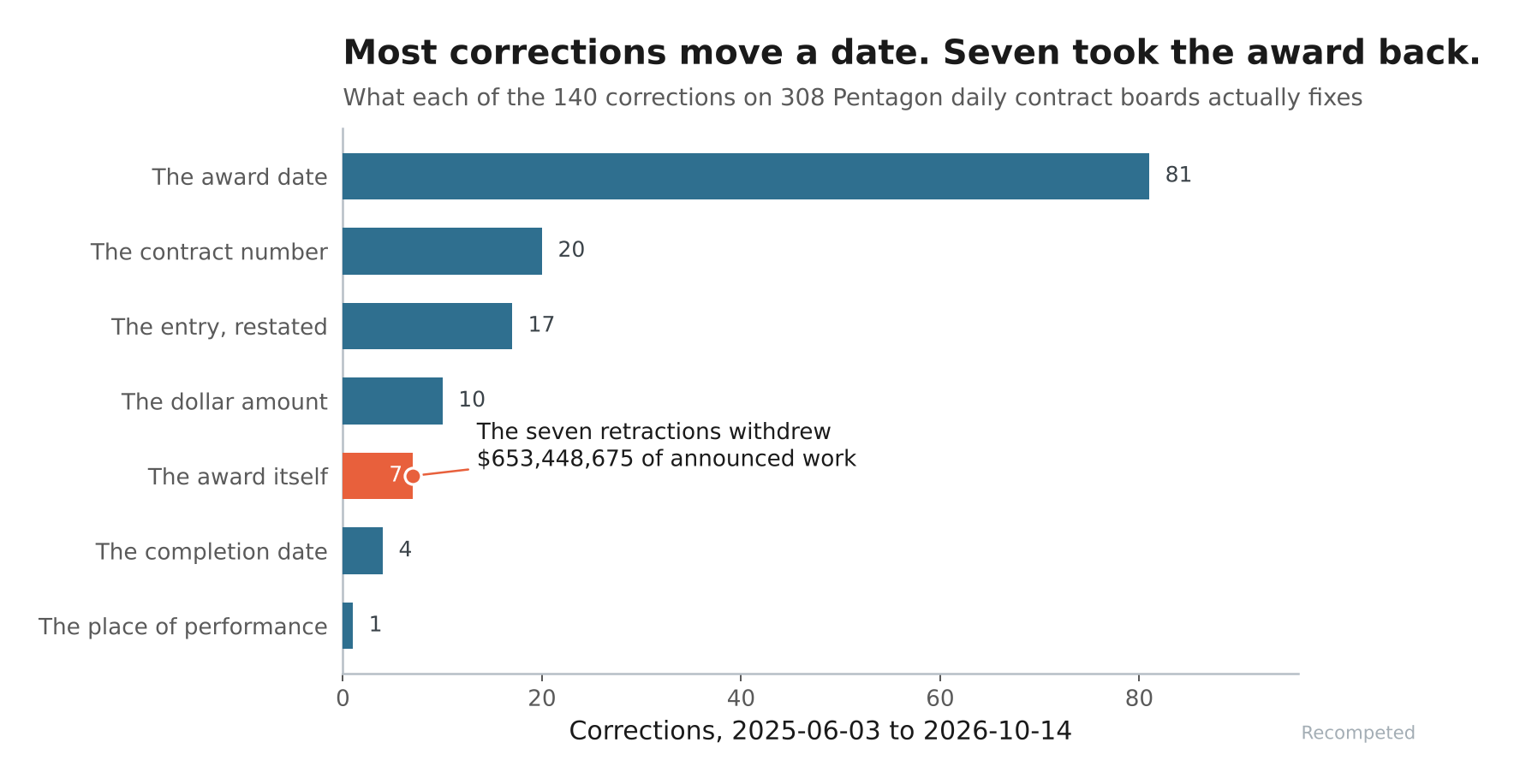
81 of the 140, 57.9%, move the award date by a day or two. Another 20 fix a contract or order number, 17 restate an entry that went out duplicated or against the wrong fiscal year, and 10 fix the dollar amount.
Two of those ten are off by a factor of 1,000:
- Tyto Government Solutions went out on April 1 at $51,384,801,016. Nine days later the correct figure arrived: $51,384,801.
- The Alabama Institute for Deaf and Blind was announced at $15,000,000,000. Correct figure, $15,000,000.
Both of those sat on the public record long enough to be scraped into somebody's database.
The five percent that costs you something
Seven corrections, 5.0% of the census, fix no field at all. They withdraw the award.
Six of the seven state a value, and together they come to $653,448,675 of work that was announced and then was not there.
The largest is not a rounding error. $525,831,923 to ASRC Federal Data Network Technologies for the Cyber Support Services 3 program, announced Sept. 12, 2025, and gone four days later.
The rest of the set: Ecology Mir Group at $11,993,274, A-GAS US at $31,442,629, the University of New Mexico at $27,408,016, an L3Harris entry out of Greenville carrying no value at all, and Tuesday's messaging modification.
The settling time
Median lag from announcement to correction: 5 days. Three quarters of corrections, 75.2%, land inside a week.
The tail is where the damage is. 12.8% take 14 days or longer, and the slowest in the census ran 102 days.
A-GAS is the one to sit with. Announced Sept. 29, 2025, withdrawn 78 days later on Dec. 16.
Anybody who logged that award on the day it posted carried a dead $31.4 million row through the entire first quarter of fiscal 2026.
The one that got un-retracted
Colt Builders and Weil Construction JV is the case worth keeping in mind.
Sept. 30, 2025: announced at $23,631,758, 82nd Contracting Squadron at Sheppard.
Nov. 12: "was not awarded."
Nov. 17: a correction to the correction. The real award date was Nov. 14.
So the original announcement ran 45 days early, the retraction was two days premature, and the contract is live. Anybody who deleted that row from their tracker on Nov. 12 deleted a real award.
Final Thoughts
None of this is a scandal. A board that publishes every business day on a same-day clock will get dates wrong, and the correction mechanism is the system doing its job in public, which is more than most of the procurement record offers.
The useful read is about timing. The board is a first draft with a five-day settling time, one business day in three carries a revision, and on the rare occasion the revision does not adjust a field, it deletes the award.
Treat an announcement as the prompt to go check the award record, and give a fresh entry a week before you quote it to anybody who will plan against it. The Colt Builders row is the reminder that this cuts both ways: an award can come back after the board says it never happened.
Thanks for reading.