How an Option Year Wins the Recompete Nobody Ran
On 181 of the 1,217 DoD contracts expiring on our board, the award record carries a second, later end date, and $79.3 billion of option value across the board has never been exercised. Here is how to tell which of your 2027 pursuits is a competition and which is a contracting officer's written determination.
A DARPA network support contract sits on our expiring board with a clean end date. June 30, 2027.
The same award record carries a second date, and that one says June 30, 2030.
Both are current, both come out of the same FPDS record, and only one of them is on anybody's pipeline sheet.
We pulled the award record behind every row of the board this evening: 1,218 contracts in today's refresh, 1,217 the API returned, $456.93B obligated.
On 181 of them the potential end date sits later than the current one, a median of 525 days later, with a maximum of 3,653 (chart below). 135 of the 181 carry a full year or more.
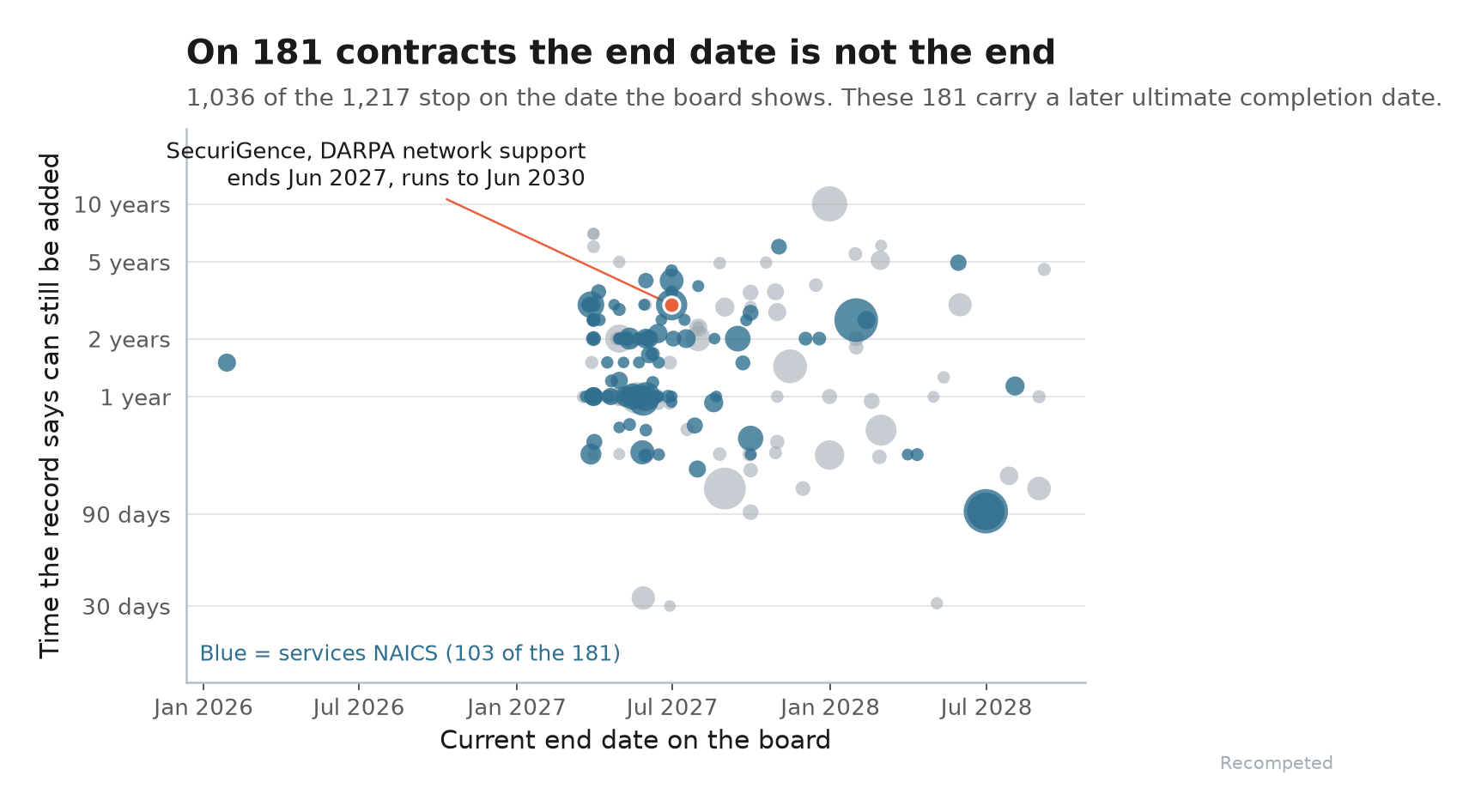
Two dates, two different questions
The date your board shows is the FPDS Current Completion Date. The other one is the Ultimate Completion Date, and it comes from the ceiling FAR 52.217-9(c) makes the contracting officer write into the clause: total duration ... shall not exceed ___.
When those two dates disagree, nothing has to be competed for the gap to close. FAR 17.207(f) is explicit about why:
"To satisfy requirements of part 6 regarding full and open competition, the option must have been evaluated as part of the initial competition and be exercisable at an amount specified in or reasonably determinable from the terms of the basic contract."
The competition already happened. It happened at award, sometimes six years ago, and the option years were priced into the evaluation you either won or lost back then.

The rest of this brief is for subscribers.
The specific solicitations, dockets, and dates to act on sit past this line.
$50 a month, or $500 a year.
Already a subscriber? Sign in