 Recompeted
$34 Billion Is Riding Vehicles That Stopped Taking Orders
Of the 1,218 DoD contracts on our expiring board, 707 are orders issued under a parent IDIQ, BPA or GWAC. On 209 of them the parent stopped accepting orders a median of 440 days ago, which means the follow-on cannot go back where the work came from.
Every row on your pipeline sheet carries a date, and the date belongs to the order. The vehicle underneath it has a clock of its own, and that clock is the one that decides whether you can compete for the work.
Our expiring board refreshed this morning: 1,218 DoD prime contracts over $50 million whose periods of performance end between March 2027 and September 2028. 707 of them are orders sitting under a parent vehicle, $116.7 billion obligated.
We pulled the parent record for every one of those 707 and read its ordering period end date.
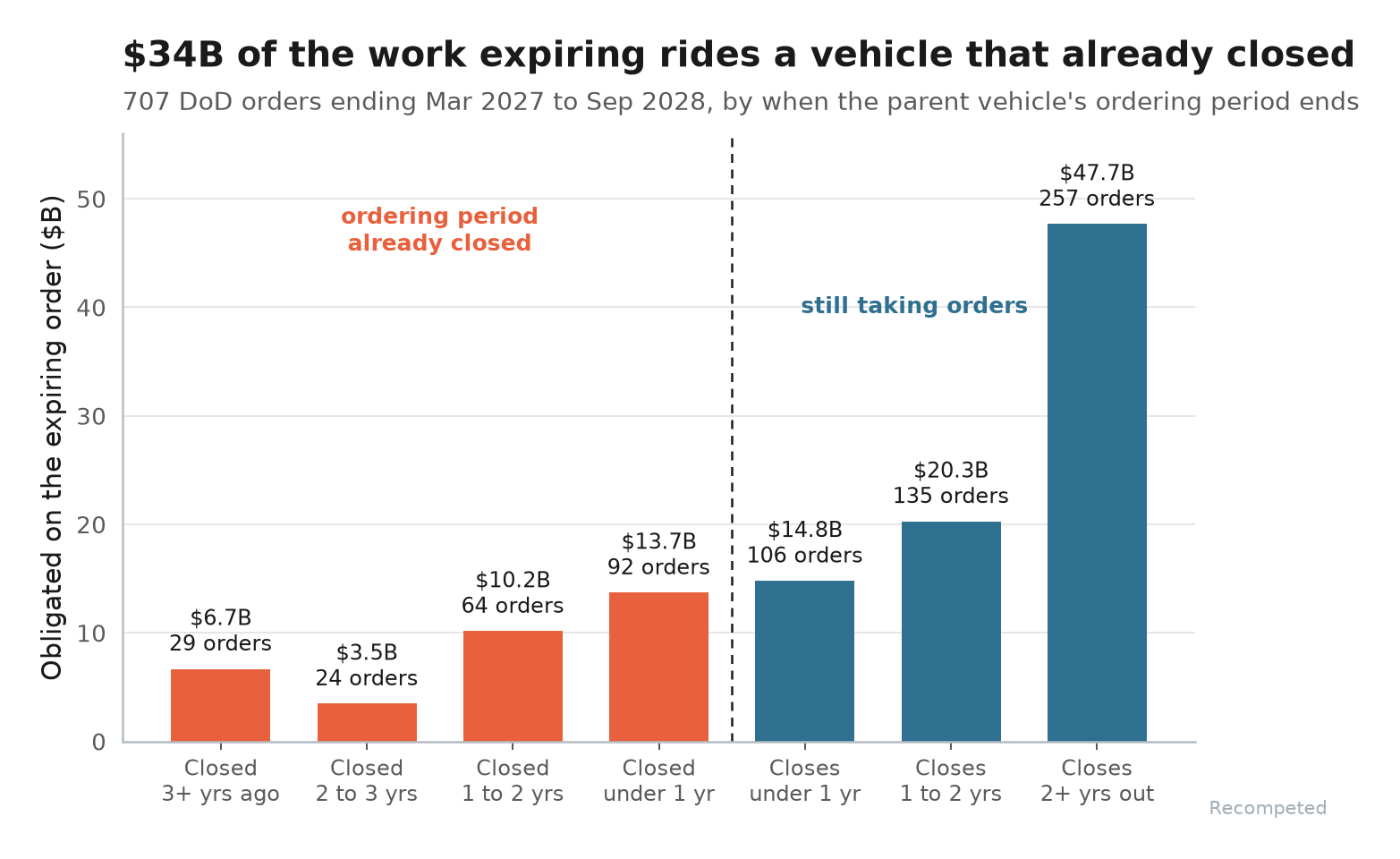
On 209 of them, worth $34.0 billion, the vehicle already closed (chart below). Median time since it closed: 440 days.
A Closed Vehicle Is Not a Dead Order
Nothing improper is happening on those 209 rows. FAR 52.216-22(d) is one sentence long and it settles the whole question: "Any order issued during the effective period of this contract and not completed within that period shall be completed by the Contractor within the time specified in the order."
So the order keeps running. What ends is the government's ability to put anything new on that contract.
That distinction is the whole post, and it points in a direction most capture sheets get backwards:
- Work on an open vehicle recompetes as a fair-opportunity exercise among the holders. Miss the on-ramp and you spend the recompete as a spectator.
- Work on a closed vehicle has nowhere to go but a new solicitation or a different vehicle, and the incumbent's seat advantage went away with the ordering period.
The second case is the better pursuit and it is sitting there unlabeled, because the board's date field tells you when the order dies and says nothing about where the requirement can land next.
What the OASIS Rows Look Like
The cleanest cluster on the board is GSA's. 16 DoD orders worth $4.28 billion ride 14 different OASIS pools.
GSA has published the dates: OASIS Small Business and OASIS 8(a) ordering periods ended December 19, 2024, OASIS Unrestricted ended March 1, 2025. Those are exactly the dates sitting in the award records.
The orders themselves end between March 2027 and August 2028.
Torch Technologies has $624.3 million of Army work on pool S621 ending May 2027. Odyssey Systems has $456.3 million on pool S723 running to July 2028, and CACI has $408.3 million of Air Force work on U309 to August 2028.
Every one of those requirements has to be re-acquired somewhere, and the legacy pool is closed. GSA's answer is OASIS+, which absorbed the OASIS scope along with BMO and HCaTS.
Whether a given agency follows the scope onto OASIS+ or writes its own solicitation is the question worth asking now, roughly eighteen months out, rather than when the RFP posts.
We flagged one of these rows on August 29 as a curiosity: Northrop's InSITE order at AFRL Rome took a $71.9 million engineering change proposal 544 days after its OASIS parent stopped taking orders. That was the first one we happened to open. It is a category.
Where the Record Lags
Here is the catch, and it cuts against the census rather than for it.
Air Force order FA872126FB004, $167.8 million to Odyssey Systems, carries a period of performance that started May 1, 2026, on pool S723, whose recorded ordering period ended December 19, 2024. A new order on a closed vehicle is not a thing that happens, so one of those two records is behind the other.
That is the working rule this census produces. The parent's end date is a field in a record, and records lag.
Before you build a pursuit around "the vehicle is gone", open the parent award and read it yourself. The date on your own sheet is worth even less, because it was never about the vehicle at all.
Final Thoughts
The easy read here is that 209 rows are mislabeled. The more useful read is that the board has two populations in it that behave nothing alike, and almost every pipeline tool in this industry sorts by the field that cannot tell them apart.
$34.0 billion of the expiring work is on vehicles that closed. Another $14.8 billion rides vehicles that close inside the next twelve months, which puts 41.8% of the vehicle-borne board in the same position before the orders themselves come due. Those are the rows where a non-holder gets a real shot, and they are findable today with one extra lookup per row.
Thanks for reading.