 Recompeted
The Army Told You This One Was Coming Sixteen Times
Army Contracting Command Orlando has been publishing its Agile Professional Services requirement since April 1. Yesterday the RFP landed: the whole SETA and professional support layer at CPE ST3 consolidated into one labor-hour contract, set aside 100% for small business, decided by three pass/fail phases and the lowest acceptable price.
On April 1, a contracting office in Orlando posted a presolicitation notice for something called Agile Professional Services.
Then it posted it again. Three more times inside a week at the end of April, twice in May, twice in June, three times across two days at the end of July.
By yesterday afternoon that one presolicitation had gone out in sixteen published versions over 170 days (chart below).
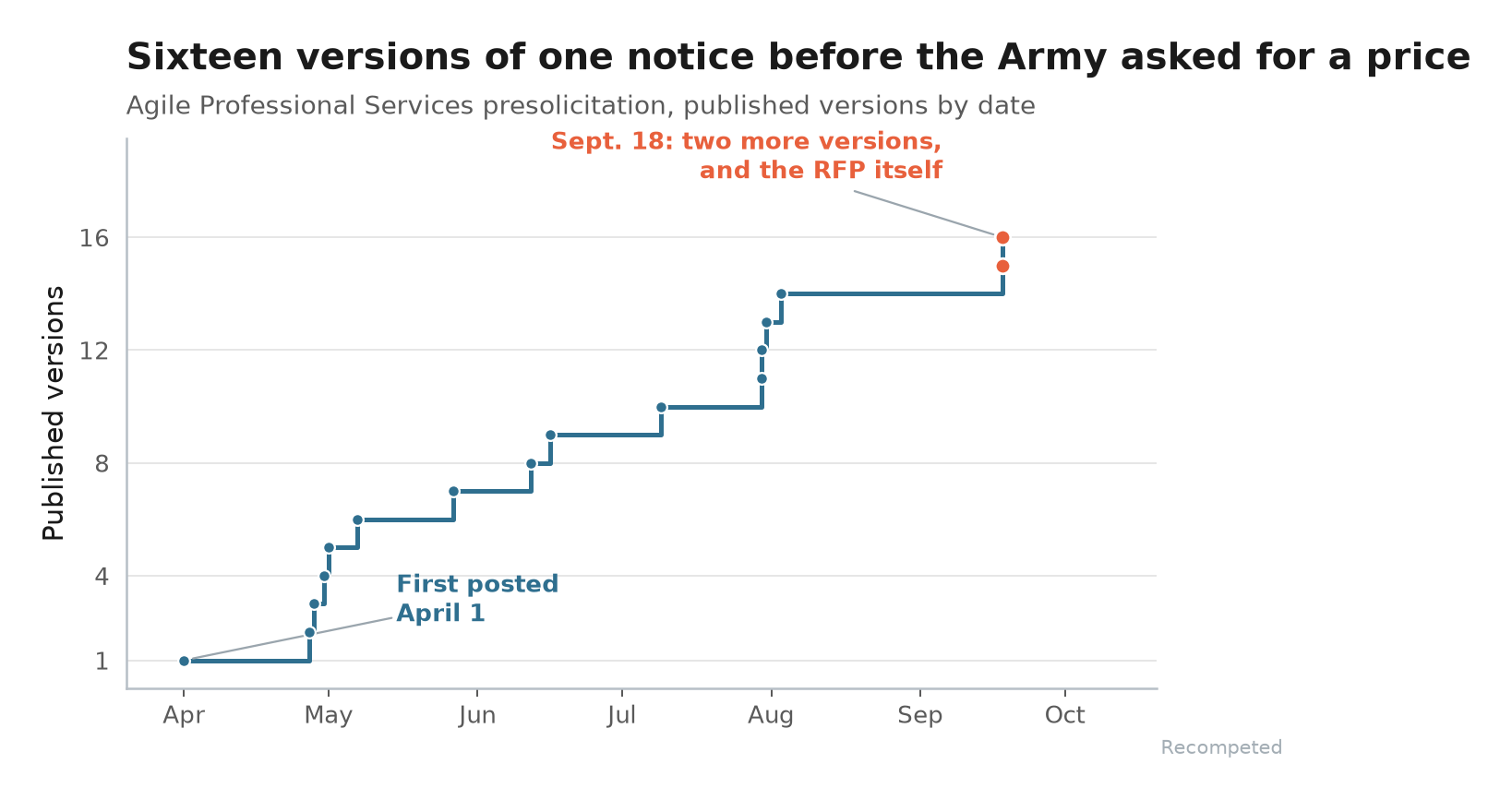
At 17:11 Zulu the combined synopsis/solicitation posted, W900KK-26-R-A023. Five minutes later another version of the presolicitation went up, and six minutes after that, one more.
Nobody working Army simulation and training gets to say this one arrived out of nowhere.
What's Actually on the Table
The buyer is CPE ST3, the Capability Program Executive for Simulation, Training, Test and Threat, which is what PEO STRI was redesignated as on February 6 of this year under Brig. Gen. Christine A. Beeler, sitting under the portfolio acquisition executive for command and control.
The statement of objectives, dated September 8, says what this is in one line: the acquisition "consolidates all previous Systems Engineering and Technical Assistance (SETA) and professional support contracts into a single, comprehensive commercial services vehicle."
That covers a portfolio the SOO puts at more than 370 simulation, training, testing and threat products at more than 400 locations, across PM SIM, PM TRADE, PL TSMO and the TADSS Support Office, foreign military sales included.
The whole advisory layer of a program executive office, in other words, bought on one contract.
And it is a 100% small business set-aside, NAICS 541990, size standard $19.5M, priced on labor hours.
Up to 66 months starting February 15, 2027, though the base period is only the first six of those: the other sixty sit in options, and the base is scoped as transition-in.
Performance runs out of Orlando and Redstone Arsenal, the latter around the clock, plus Campbell, Hood, Drum, Irwin, Polk, Rucker, Bragg, Hohenfels and Camp Humphreys.
Three Phases, Every Gate Pass/Fail
Phase I closes October 13: a 15-page Agile Implementation Plan, a three-page resume for the proposed Agile Program Manager, a one-page cybersecurity statement, and an OCI mitigation plan. All of it rated Acceptable or Unacceptable, nothing scored.
The cybersecurity statement is the sharpest gate in the package.
The offeror needs a self-certified NIST SP 800-171 Rev 2 score of 110 posted in SPRS on the day it submits, and so does every subcontractor, teaming partner and affiliate that will touch the government's data. Short of 110, no data release and no Phase II.
Phase II is in Orlando, in person, five attendees maximum, US citizens, no clearance needed to get in the room. A 20-page deck in the first 30 minutes, then a live demonstration in the offeror's own Jira environment against government baseline data and scenario injects, with up to 30 minutes of clarifications afterward under FAR 15.306(a) that cannot be used to fix anything material.
Phase III is where the winner writes its own contract: the offeror authors the PWS, the CDRLs and the QASP off government templates, and those become the binding performance framework.
Price lands last. Award goes to the lowest Total Evaluated Price among the proposals rated acceptable.
Here's the part capture shops should read twice.
After Phase I, and again after Phase II, the government contacts the firms it considers "unlikely to be a viable competitor" and recommends they withdraw. Then it lets them stay in anyway: "No formal down-select will be conducted."
You get told where you stand before you pay for orals, and the choice to keep spending stays yours.
What the Seat Costs
The OCI factor carries a Baseline Competitive Exclusion, and the solicitation defines it in plain terms rather than leaving it to a post-award argument.
Win this, and the prime, every joint venture member, every proposed subcontractor, and every parent, subsidiary, sister sector and corporate affiliate is barred from bidding, competing for, performing or supporting any competitive program work in the CPE ST3 portfolio: product and hardware development, tactical system integration, software engineering and commercial software licensing, platform test and evaluation, fielding and sustainment hardware.
It runs for the life of the contract and one year past the end of performance. On the full option run, that reaches August 2033.
The rating is Acceptable or Unacceptable, and the government says it will not conditionally approve a plan or negotiate firewall terms after award.
So the trade gets priced before anyone bids, which is the honest way to do it: five and a half years inside the office, against the rest of the portfolio, for your whole corporate family.
Final Thoughts
Questions close September 28. Five per company, one question per form submission, batched questions rejected, anonymous ones unanswered.
That is a tight window on a package with ten attachments and a bidder-written PWS at the end of it. The offices that will be ready for it are the ones that were reading those sixteen versions back in May, when the thing was still a presolicitation nobody had to answer.
A requirement that sits in the open for 170 days is doing something for the bidder pool that a 30-day RFP never does. It gives the small firms, the ones this work is now reserved for, enough runway to decide whether they want a seat that costs them the rest of the portfolio.
Thanks for reading.