 Recompeted
How 95 Bids Ended With One Spectrum Sensor
Research Innovations has booked $166 million of federal prime work since 2012, almost all of it computer systems design and R&D task orders. On Thursday the Army handed it a five-year, $99.5 million contract to build and sustain a three-and-a-half-pound box, out of a field of ninety-five.
In January 2015 a company in Alexandria picked up a $9,181,670 task order for something called GRIDS II research and analysis. That was the largest single award on its books at the time, and the work was what the line item said it was: research, and analysis.
Eleven years later the same company sells a sensor that weighs three and a half pounds.
On Thursday's board the Army gave Research Innovations Incorporated a five-year firm-fixed-price IDIQ to keep building it. $99,529,577, contract W56KGY-26-D-A002, Army Contracting Command at Aberdeen Proving Ground, running through Sept. 2, 2031, for the procurement, delivery and sustainment of Dragonfly systems.
Ninety-five bids came in.
What Fits in Three and a Half Pounds
Dragonfly is RII's own product, and the company publishes its numbers: 10 MHz to 6 GHz, GPU-accelerated, mountable on drones and other platforms, doing automatic signal classification, direction finding and geolocation, and swarm networking across multiple units.
That is a full electromagnetic-support mission in a package a soldier carries. The Army's line for it is deliberately dull, and the dullness is the point: procurement, delivery, sustainment. This is a buy of things, on a five-year ordering clock, with locations and funding set at each order.
Fifteen Years of Selling Hours
Here is what makes the award worth your attention. RII's entire federal prime record runs to 51 awards and $166,169,629.81 since fiscal 2012, and nearly all of it is labor.
Sorted by code:
- $98.2M under 541512, computer systems design services
- $48.5M under 541715, R&D in the physical and engineering sciences
- $9.8M under 541714, which is the DARPA MESSINA program
- $9.66M under 513210, software publishers, and that is a single order for PRIISM licenses placed in June of this year
The customers are the ones you would expect from that mix: Army, Air Force, the Justice Department analytics work, DARPA, Navy. The largest award the company has ever booked is $26,168,001, the 2023 Air Force task order for Command and Control of the Information Environment.
Now put the new ceiling next to that record (chart below). $99,529,577 is more than the company's three best fiscal years put together, which come to $76,836,331.43.
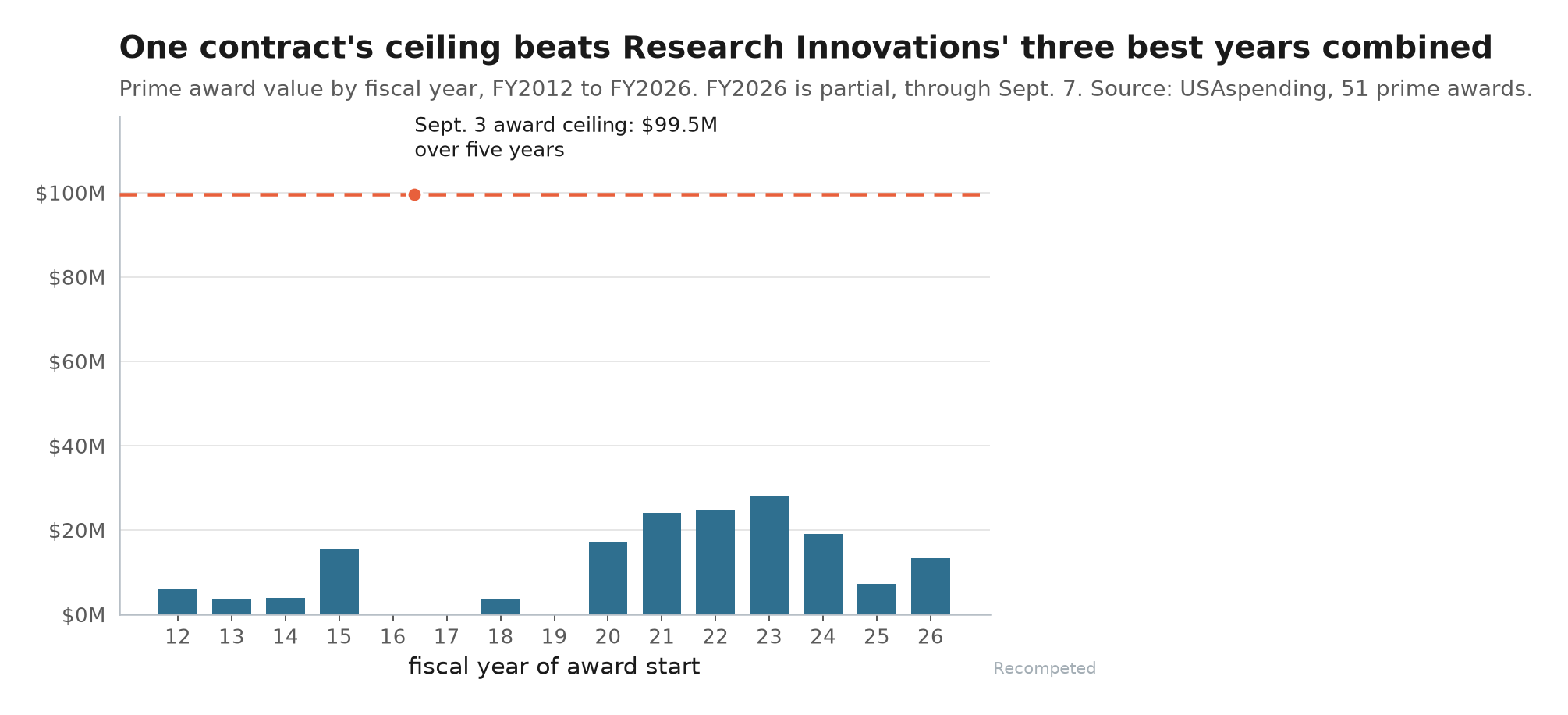
The June software order was the first sign of the turn. This is the second, and it is a much larger one.
The Office Told You What It Wanted
PM EW&C has been unusually plain about where it is going, and it said so in public twice this year.
On Feb. 27 it posted RFI W56KGY-R-26-0224, asking industry to react to a strategy it was still drafting: a FAR Part 12 multiple-award IDIQ, issued through a Commercial Solutions Opening, to buy and sustain commercial electromagnetic warfare and SIGINT equipment across the portfolio. Primary NAICS 334220, responses due Mar. 13, capability pools with the NAICS assigned at the order level, and an explicit line that both large and small businesses were encouraged to answer.
The reasoning in that notice is worth reading if you carry an EW capture. The office wrote that fielding a common basis of issue across heavy, light and airborne formations "has proven to be neither cost-effective nor optimal," and that it wanted commanders closer to the equipment-selection decision. That is an office telling you it intends to buy varied commercial kit fast, rather than one program of record slowly.
Then on Apr. 23 it opened the REWSI Call for Solutions under the Army Open Solicitation CSO, response window running all the way to Apr. 22, 2027.
The award notice for W56KGY-26-D-A002 is not on SAM.gov yet, so the paper trail from that strategy to Thursday's line is not something we can close today. What is on the record is an office that spent 2026 describing the buy, and a five-year hardware IDIQ landing at the end of it.
Ninety-Five
That bid count is the number to keep.
Ninety-five responses for one sensor line tells you the spectrum-sensing bench is deeper than the five or six names that show up in a competitive assessment. Some of that field is resellers and integrators wrapping someone else's radio, sure. Plenty of it is not.
If your account plan for Army EW assumes a short list, Thursday priced that assumption for you.
And the firm that came through it had already spent a decade turning Army and Air Force task orders into a product it owns.
Final Thoughts
By defense standards the money here is small. What earns the attention is the direction of travel: a firm that has spent its whole federal life billing hours against research task orders now holds a five-year line to ship hardware.
Every services company in this market talks about building products. Very few land an ordering vehicle that pays them to.
Whether the sensor actually sells at anything near its ceiling is the open question, and it resolves slowly, one order at a time. Worth checking in a year.
Thanks for reading.