 Recompeted
Who Books $3.3 Billion Without a Bidders List?
Seven organizations run DoD's eleven FFRDCs, and together they booked $3.34 billion of contract obligations this fiscal year. Three of them rank inside DoD's 100 largest vendors. None of that work ever reached a solicitation, and there is exactly one point in the cycle where it is contestable.
Rank every DoD vendor by what they booked this fiscal year and the list tells you who you are up against. Seven names on it are not up against you at all.
Friday's board carried one of them. The Air Force exercised option year 8 on MITRE's National Security Engineering Center contract, a $626,834,540 modification taking FA8702-25-C-B001 from $687,265,904 to $1,314,100,444 of cumulative face value, and running it to September 30, 2027.
We logged that as one radar item on Saturday. The number worth your morning is the one sitting behind it.
Seven Names, $3.34 Billion
Eleven FFRDCs are sponsored by DoD, and seven organizations administer them: MIT, the Aerospace Corporation, MITRE, the Institute for Defense Analyses, Carnegie Mellon, RAND and CNA.
Those seven took $3,338,496,503 in DoD contract obligations so far in fiscal 2026. Three of them sit inside DoD's 100 largest recipients for the year (chart below).
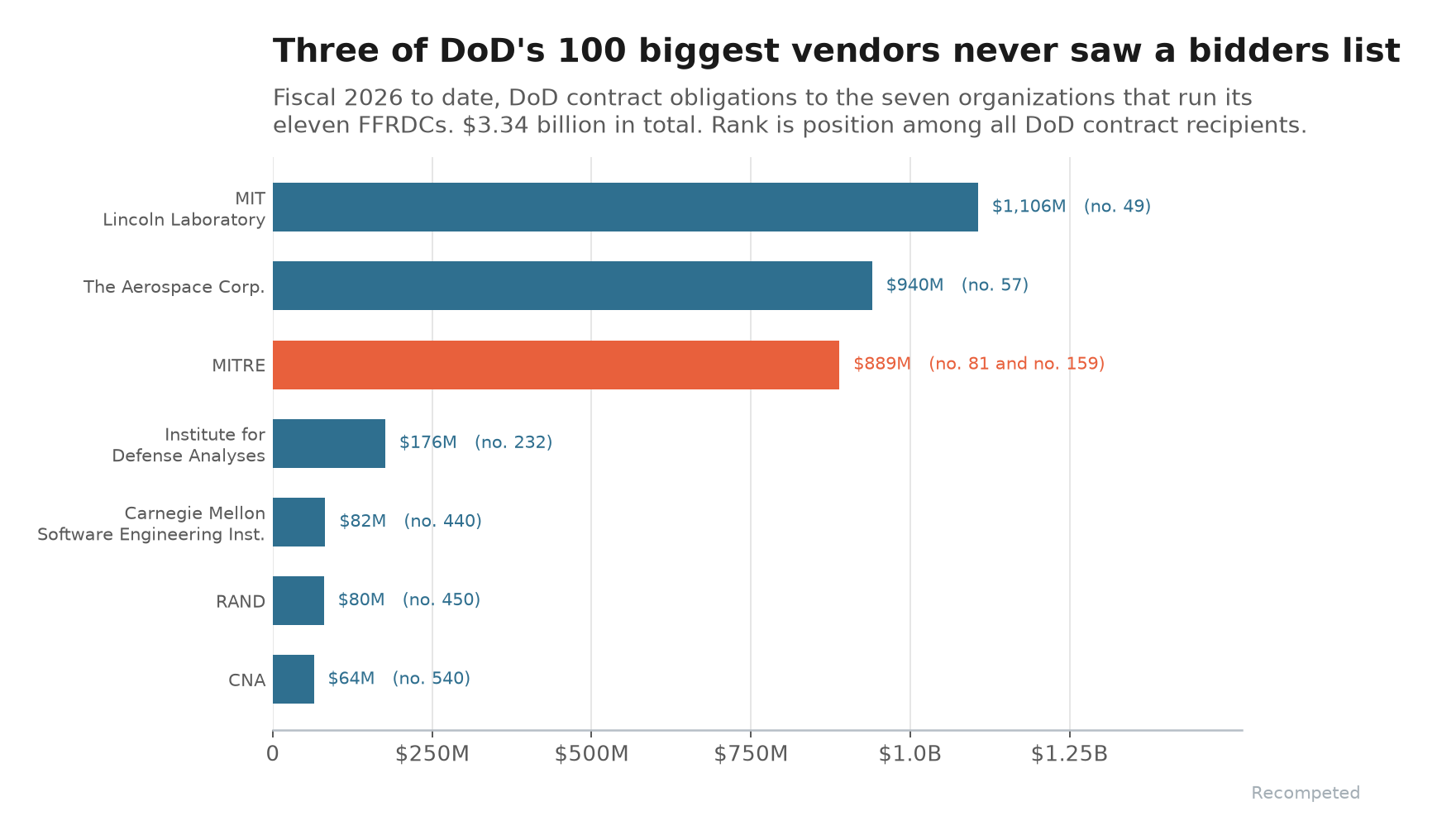
MIT's Lincoln Laboratory work alone is $1.11 billion, which puts it 49th among every recipient of a DoD contract dollar this year, landing between a Northrop Grumman registration at 48 and a Lockheed Martin one at 51. Aerospace is 57th at $940 million. MITRE carries two separate registrations in the vendor file, at $590 million and $299 million, and its combined $889 million would rank it comfortably inside the top hundred on its own.
The counts come off the top 600 DoD recipients for fiscal 2026 to date, a list whose floor is $57.2 million. Every one of the seven clears it.
Why It Never Reaches You
FAR 6.302-3(a)(2)(ii) is the authority. Full and open competition need not be provided for where award to a particular source is necessary to maintain "an essential engineering, research, or development capability to be provided by an educational or other nonprofit institution or a federally funded research and development center."
The instrument underneath is a sponsoring agreement, which is a relationship rather than a procurement.
And the work gets priced in a unit you cannot underbid. RAND's Project Air Force line for this fiscal year is written up as 72 staff-years of technical effort.
There is no scope statement there to propose against.
MITRE's NSEC contract shows the shape clearly on its FPDS record:
- NOT COMPETED, solicitation procedures only one source
- coded under FAR 6.302-1, the single-responsible-source exception, rather than the FFRDC-specific 6.302-3
- NAICS 541990, a professional-services code that would otherwise be squarely in your lane
- a period of performance of exactly one year, October 1 to September 30, with $377,933,683 obligated against it
That last one matters. The contract is re-papered annually under a fresh PIID, so it generates a large dated action every autumn that looks like a competitive event in a pipeline tool and is not one.
The One Door
FAR 35.017-4 is where this becomes contestable. Before a sponsor extends the contract or agreement, it "shall conduct a comprehensive review of the use and need for the FFRDC," and paragraph (c) requires that review to weigh alternative sources available to meet the sponsor's needs, alongside whether the technical need still exists and at what level. Approval to continue or terminate rests with the head of the sponsoring agency.
So the practical moves are narrow and worth knowing:
- Track the sponsoring-agreement review cycle for the centers whose scope overlaps yours, because that review is the only forum where "an alternative source exists" is a question anyone is obliged to ask.
- Treat the annual re-papering action as an accounting event in your tracker, not a recompete, and stop it from inflating your addressable numbers.
- Watch scope drift at the edges. The FFRDC core is untouchable; the adjacent task orders that grow up around it are frequently competed, and those are real.
Final Thoughts
Three and a third billion dollars is not a rounding error in anyone's market sizing, and for a services shop reading NAICS codes off a vendor file, this money looks exactly like the money you chase. It was out of reach last year and it will be out of reach next year.
The useful version of that is subtraction. Knowing which billions are not addressable makes the rest of the pipeline honest, and an account plan that quietly counts Lincoln Laboratory's line as market is a plan with a hole in it you cannot see.
Thanks for reading.