 Recompeted
1,066 RFPs Went Out and Never Changed
We read the publish history on every Department of War services solicitation posted this fiscal year. Three in ten were never touched again after the day they dropped, which means the amendment you built your bid schedule around may not be coming at all.
Somewhere in your pipeline right now sits a services RFP with a hole in it. A workload table that does not reconcile against the historical data, a CLIN structure that fights the PWS, a wage determination sitting one revision behind the one you actually price to.
You wrote the question and you sent it to the contracting officer.
And then you built a schedule that assumes the answer comes back as an amendment, with a new due date attached.
"How often does the agency actually come back?"
So we counted. Every Department of War solicitation and combined synopsis/solicitation in the services codes (NAICS 541, 561, 517 and 518) posted from October 1 of last year through Monday: 3,541 notices.
Then we read the publish history on each one.
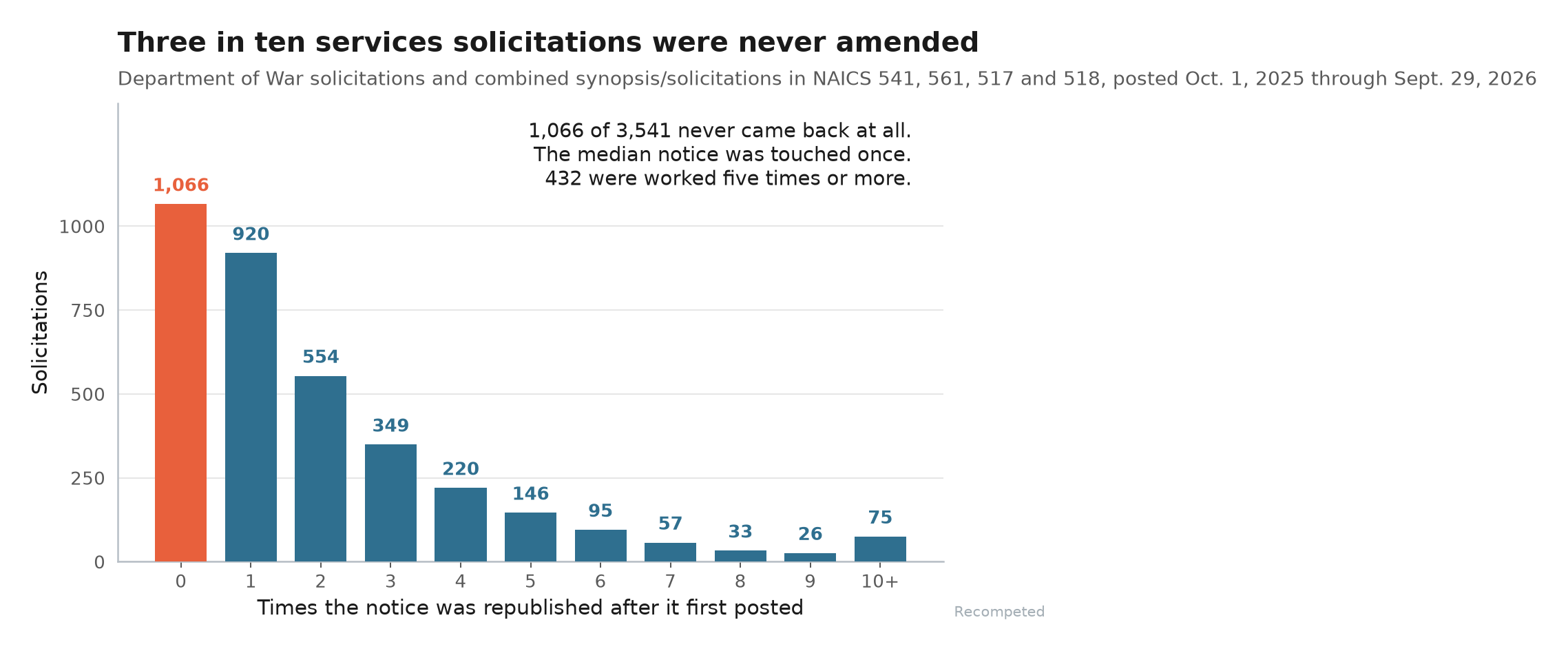
1,066 of them were never posted again (chart below).
What a zero actually means
Everything an agency does to a live solicitation after it drops arrives the same way, as another publish action on the notice: answers to questions, the corrected attachment, the site-visit notice, the extended due date, the cancellation.
One channel, and the public record of it is the history on that notice ID.
So a zero is unambiguous. Nothing came back, in any form, ever.
The median notice in the window was touched exactly once. Stack that on the zeroes and 56.1% of this year's services solicitations got one republish or none at all.
Which reprices the thing you are actually planning against.
If your bid schedule assumes an amendment will move the date, the base rate says three in ten times there is no amendment, and the date on the original notice is the real one. If your pricing assumes the ambiguity gets resolved before proposals are due, same odds.
You bid your interpretation and you carry it.
The right-hand tail is a different animal
432 notices were worked five times or more, and 75 of them ten or more. That looks like the hard end of the distribution, the genuinely contested competitions where everybody had questions.
Here is the catch. A fair slice of the tail is not a competition at all.
Ninety-two of the 3,541 are standing announcements: broad agency announcements, whitepaper calls, commercial solutions openings, open research programs that live on one notice number for years and get republished every time a topic area refreshes. They average 6.15 republishes against 1.95 for everything else. The most-worked notice in the whole window, at 41, is an Air Force research announcement.
Strip those out and the top of the real tail is one line of business, almost entirely:
- W15P7T-26-R-A006, the Army's Marketplace for Acquisition of Professional Services, 34 republishes.
- N4008526R0065, Naval Station Norfolk custodial services, 31.
- N6247324R0036, Camp Pendleton base operations support, 30, and now flagged canceled.
- W5168W-24-R-0009, Ft Carson BASOPS, 24.
Base operations and facilities work, where the property list, the workload data and the wage determination all move under the bidders while the clock runs.
Nobody who has priced a BOS recompete will find that surprising. It is worth knowing that the record shows it this cleanly.
Your buying activity has a house style
The spread between shops is wider than the spread between contract types.
The Air Force never came back on 19.6% of its 684 services notices and averaged 2.96 republishes. DHA is further along the same end, 12.0% zeroes on 50 notices.
Go the other way and DISA leaves 41.9% of 301 notices untouched, the Navy 39.4% of 929, DLA 52.3% of 88.
That is a planning input, and it travels with the office rather than the requirement. The same custodial recompete run out of two commands gives you a materially different chance of ever hearing back in writing.
Final Thoughts
None of this says an agency owes you an amendment. Plenty of buys are clean enough on day one that nobody asks anything worth answering, and a quiet notice is often just a simple one.
What the count does say is that the amendment is the only public channel between the RFP dropping and the award landing, and on a third of this year's services work that channel never opened once. Every assumption you made reading the solicitation cold on day one is the assumption that shows up in your price.
Worth knowing which kind of notice you are looking at before you build the schedule around a document that may not be coming.
Thanks for reading.