 Recompeted
What Fifteen Years of Small Orders Buys at Tinker
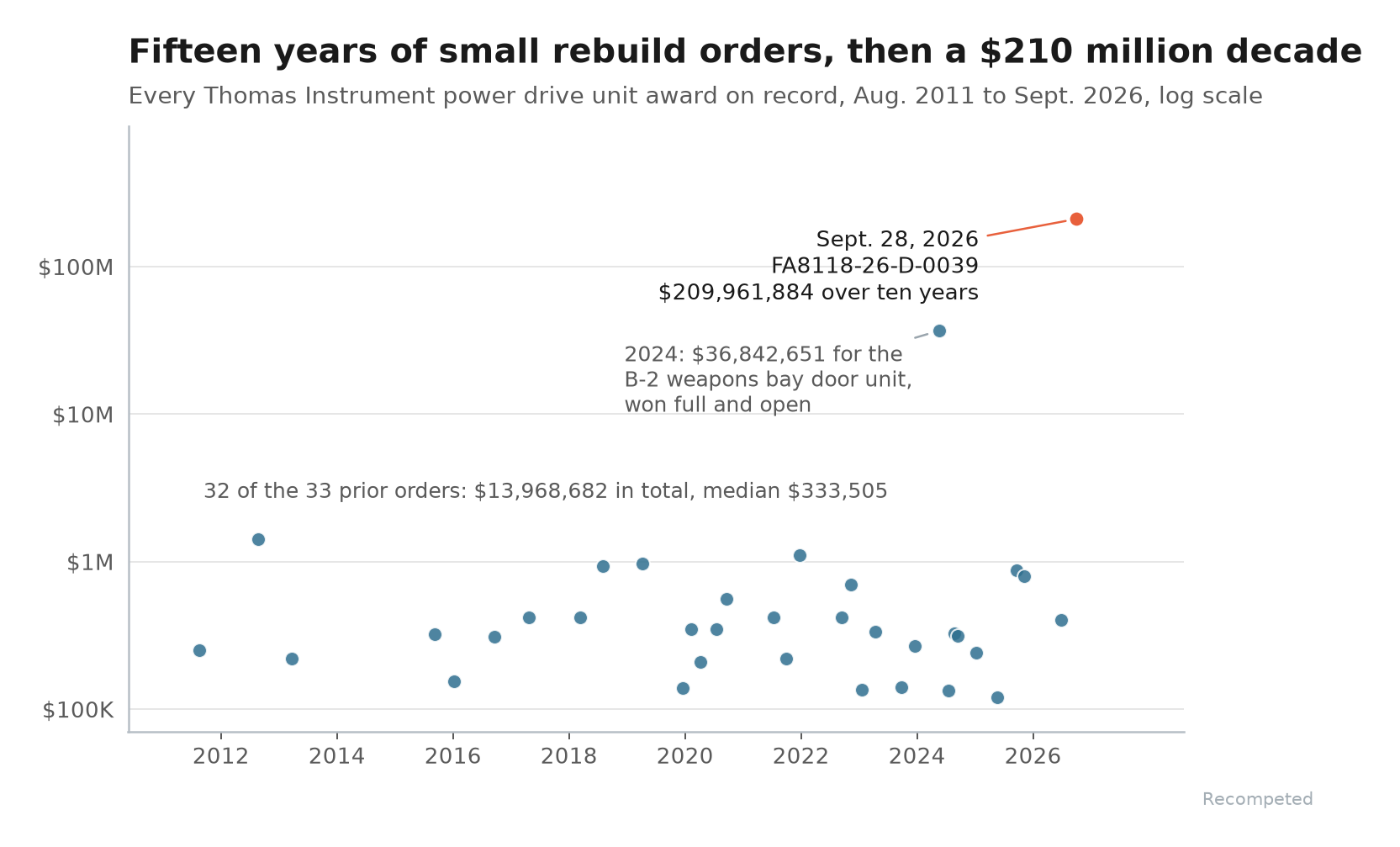
Thomas Instrument has been rebuilding bomber power drive units for the Air Force Sustainment Center since 2011, on 33 orders with a median value of $333,505. Monday's board gave the Brookshire, Texas shop a ten-year requirements contract for the B-2 and B-52 rotary launcher drive, estimated at $209,961,884. The incumbent overhaul contract expires tomorrow.
Thirty-three times since August 2011, the Air Force has paid a shop in Brookshire, Texas to rebuild a power drive unit.
Wing flap units off the B-52. Flap and slat units off the B-1B.
The median order was $333,505.
Monday's board carried the thirty-fourth. It is an estimated $209,961,884, it runs to September 27, 2036, and it is sole source.
Who Thomas Instrument Is
FPDS codes the company a small business on its award records, though Monday's board did not flag this one. Headquarters and main plant at 3440 1st Street in Brookshire, Waller County, west of Houston, with a second plant in Boerne and support offices in Midwest City, Warner Robins, and Layton.
Read that last list again. Midwest City, Warner Robins, and Layton are the towns outside the gates of Tinker, Robins, and Hill, which is all three Air Force air logistics complexes, each with people in it. The company carries ISO 9001, AS9100D, Nadcap approvals in heat treating and nondestructive testing, and an FAA repair station certificate, and it describes its own work as "product development, cost reduction ideas, obsolescence solutions, reverse engineering, and extensive in-house testing."
Obsolescence and reverse engineering are the whole business model, and the award record shows it. 800 prime actions since fiscal 2008, $566,151,272 obligated, and the line items read like a parts bin: C-5 dual power winches, KC-135 and E-3 stabilizer trim, B-1B horizontal stabilizer servocylinders, F-5 and T-38 servovalves, 20mm machine gun housings, B-2 electro-mechanical actuators. 742 of the 800 actions come from DLA or the Air Force.
Nobody builds that book from a capture plan. It accretes, one national stock number at a time, usually because the original manufacturer stopped answering.
The Part
The Common Strategic Rotary Launcher is the carousel in the bomb bay. A crew loads it with AGM-86B cruise missiles and then loads the whole launcher into a B-52H. The power drive unit is what turns it, and the contract title says B-2 as well as B-52, so the scope is not one airframe.
So the work is the drive mechanism for a launcher full of nuclear cruise missiles, on aircraft whose retirement dates keep sliding right. That combination is what produces a ten-year sustainment commitment.
Here is the part worth your attention:
"Who was doing this work yesterday, and what happens to their contract?"
Hamilton Sundstrand Corporation, an RTX subsidiary, has held CSRL overhaul at the same office since September 2018 under FA8118-18-C-0007. FPDS codes that award "not competed," solicitation procedures SSS, one offer received, authority "only one source."
Total obligated across eight years: $16,782,513.03.
Its period of performance ends September 29, 2026. Tomorrow.
Why the Instrument Is the Story
The board called the new award an "indefinite-delivery requirements contract," and that phrase is doing more work than an IDIQ label would (chart below).
A requirements contract under FAR 16.503(a) fills all actual purchase requirements of the designated activities from one contractor for the contract period. Not a ceiling you compete orders under. Not a seat on a vehicle.
If Tinker needs a CSRL power drive unit rebuilt between now and 2036, the order goes to Brookshire, and there is no fair-opportunity process for anyone to lose.
And at this size it took paperwork above the contracting officer. FAR 16.503(b)(2): no requirements contract estimated over $150 million including all options goes to a single source without a determination executed under 16.504(c)(1)(ii)(D), which is a written head-of-agency finding, one of four, most likely here that only one source is qualified and capable at a reasonable price. That determination sits on top of the Subpart 6.3 justification, not instead of it, and 16.504(c)(1)(ii)(D)(3)(i) says so in as many words.
Two documents, then. The J&A becomes public at SAM within 14 days of award under FAR 6.305(a), and it will tell you how the Air Force described a qualification barrier it now expects to hold for a decade.
The board prints no separate award date, which puts the deadline around October 12. Set the reminder.
Final Thoughts
The number that carries this story is the $333,505.
Thirty-two of the thirty-three prior drive unit orders came in under $1.5 million, $13,968,682 of work in total across fifteen years, and the company took them one at a time while building the test cells, the Nadcap approvals, and the data package. The step function arrived in 2024, when Thomas Instrument won the B-2 weapons bay door unit full and open at $36,842,651. The rotary launcher drive followed two fiscal years later, sole source, for a decade.
That is the slowest route into a defense franchise anyone still runs, and on the evidence it works. It also does not scale, cannot be bought, and will not show up in anyone's pipeline tool until the requirement is already gone.
Thanks for reading.