 Recompeted
Why a Corrected Award Date Only Ever Moves One Way
The Pentagon's daily contract board has printed 176 corrections in two years, and 102 of them are fixing the award date. Not one moved the date earlier. The reporting rule says why.
If you time anything off the Pentagon's daily contract board, you are timing it off a forecast.
We pulled every daily board the war.gov contracts feed carries and read all of them: 500 boards, July 15, 2024 through Sept. 1, 2026, 6,709 announcements.
Then we pulled every paragraph that opens with the word CORRECTION.
There are 176 of them, on 134 boards. More than a quarter of the boards the department publishes carry at least one correction of something it already published.
And they are not spread evenly across what can go wrong.
What the Board Actually Fixes
102 of the 176, 58%, correct the award date and nothing else of substance (chart below). The runner-up is the contract or order number at 25. Dollar amounts account for 16. Thirteen say the contract was not awarded at all.
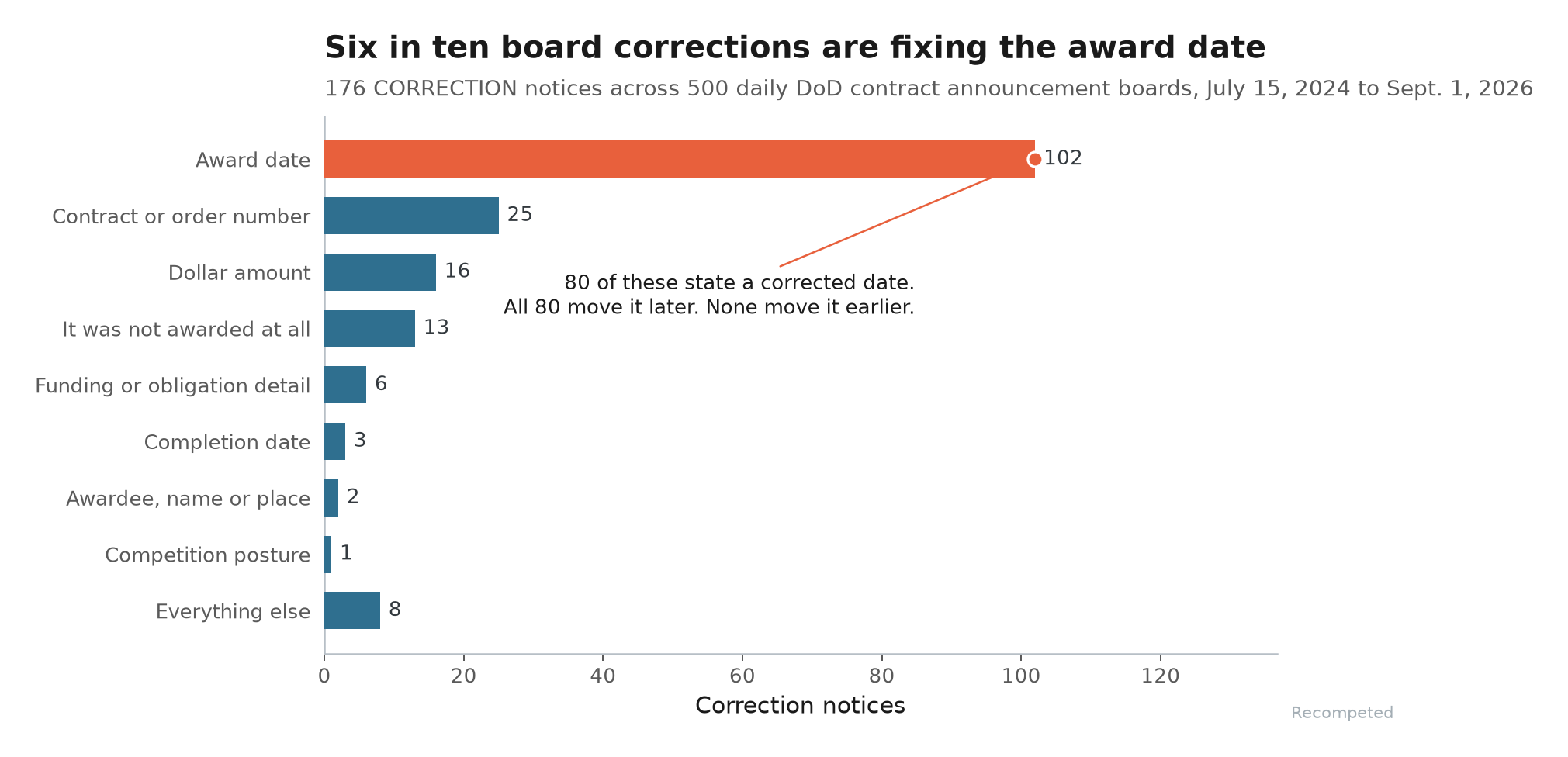
Now the part that makes this a rule rather than a pile of typos.
Of those 102 date corrections, 80 state the corrected date in a form you can read off the page. All 80 move the award date later, and none moves it earlier.
The median move is four days, and 27 of them move it by exactly one.
Random mistakes go both ways. This one has a direction.
A Board Written the Day Before the Award
The submission rule is DFARS 205.303, and it does the explaining. Departments report contract actions over $9 million face value to the Assistant to the Secretary of Defense for Public Affairs "by the close of business the day before the date of the proposed award."
The day before. The proposed award.
So the announcement you read at 5pm is a filing about something a contracting officer intends to sign. When the signature lands on schedule, the board is right.
When the file needs one more day, the board is already out, and the fix runs the next morning as a correction that moves the date forward.
There is no mechanism that produces the opposite error. Nobody submits an announcement for an award that already happened last week, so no correction ever pulls a date backward.
The tail is where it gets expensive. Lockheed Martin's FA860426DB008 was corrected on the Aug. 28, 2026 board to say it "was awarded on Aug. 25, 2026, not Aug. 17, 2026," eight days out. Breeze-Eastern's SPRRA1-25-D-0009 was announced on March 17, 2025 and corrected on June 27, 2025 with a new award date, a new dollar amount, and a new completion date. 102 days between the announcement and the signature.
What This Costs You
Every clock you care about runs from the signature, and the announcement is upstream of it: the debriefing request window, protest timeliness, the FPDS action date you reconcile your tracker against, the option-year arithmetic you build off a start date.
Copy the board date into your pipeline and you are, on the evidence, running early somewhere between one day and three months.
The thirteen that never happened are worse, because there is no correction to catch if you missed it.
They total $1,115,773,933 in announced value, including ASRC Federal Data Network Technologies' $525,831,923 Cyber Support Services 3 award, announced Sept. 12, 2025 and unwound four days later in a single sentence.
The amount corrections are their own genre. Tyto Government Solutions was announced at $51,384,801,016 on April 1, 2026 and corrected to $51,384,801 nine days later, a factor of a thousand.
The Alabama Institute for Deaf and Blind went from $15,000,000,000 to $15,000,000 the same way.
Both are obvious on sight. A four-day date slip slides straight into your model.
Final Thoughts
None of this makes the daily board less useful. It is still the fastest public signal that a requirement changed hands, and this desk reads it every day for exactly that reason.
It does mean the board is a schedule of intent that mostly comes true, and treating a board line as a signed contract is a choice you are making on your own.
We wrote up the reporting mechanics behind that on Aug. 22, when a $36 million Army robotics award was announced and retracted one business day later.
Two years of boards say that day was ordinary.
Read the date as "on or after." The record catches up eventually, and it always catches up in the same direction.
Thanks for reading.