Who's Across the Table on a Services Recompete?
155 of the 1,170 DoD contracts coming off period of performance in the next two years are held by a small business. In professional and management support it is 28.3% of them, and on more than half the set-aside that got them there is not on the contract they hold.
Pull the business size of the incumbent on every $50M-plus DoD contract that runs out in the next two years, and the board splits along a line nobody draws in a pipeline review.
155 of the 1,170 contracts ending between March 2027 and August 2028 are held by a firm the contracting officer coded a small business on its most recent action. That is 13.2% of the count and $18.51B of the $427.06B obligated across the board, spread over 131 distinct firms.
"Who is actually holding the work that comes back to market?"
Where those 155 sit is the part worth an hour of your week.
Twenty-eight percent, then two
Professional and management support, PSC group R and the desk's core family, is 39 of 138 contracts, 28.3% (chart below). IT and telecom services is 11 of 45, 24.4%, and research and development is 22 of 120.
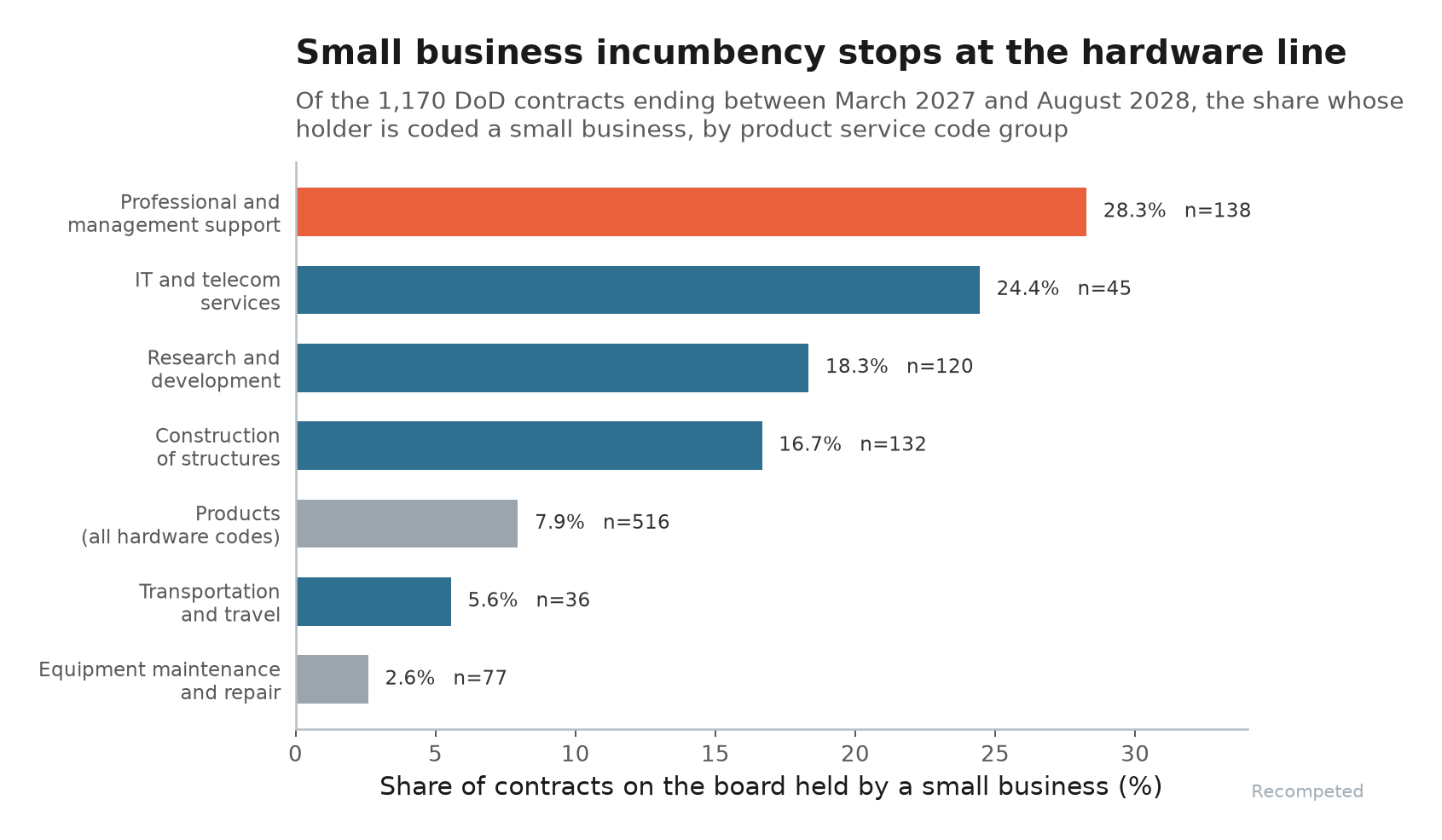
Then the floor drops out. All 516 hardware codes on the board together are 41, 7.9%.
Equipment maintenance and repair, the sustainment work that looks like services on an org chart and prices like a product line, is 2 of 77.
So the answer depends on which half of your portfolio you are looking at.
On a support services recompete, better than one in four incumbents is a small business. On a depot sustainment recompete, it is one in forty.
Nothing mysterious is driving that. Sustainment sits behind data rights and OEM qualification, and both of those are structural barriers a size standard has no effect on. Labor-based services have neither.
The count is not the money
Small firms hold 28.3% of the R contracts and 19.8% of the R dollars, $4.67B of $23.57B. Board-wide the gap is wider: 13.2% of the rows, 4.33% of the obligations.
That ratio is the useful part. A small-business incumbency on this board is a real contract that runs reliably smaller than the large-business contract sitting next to it in the same NAICS.
When the requirement comes back, that difference in size is what the rule-of-two analysis gets run against.

The rest of this brief is for subscribers.
The specific solicitations, dockets, and dates to act on sit past this line.
$50 a month, or $500 a year.
Already a subscriber? Sign in