 Recompeted
Who Stops Competing in September?
A USACE task order runs out on Sept. 29 and needed a sole source extension, because the option to extend it was in the RFP but never priced. We pulled three fiscal years of DoD obligations by competition code to find out how much of the year-end surge actually moves that way. On the services side the competed share went up in September, all three years. The whole drop sits somewhere else.
If you hold a services task order that runs out in the next two weeks, the Army just published a short lesson in what happens next.
USACE Huntsville posted an Exception to Fair Opportunity on Aug. 12 to hand RMC another six months of the Army Energy and Water Reporting System, sole source, on task order W912DY23F0523 against the TPSS MATOC.
The order's period of performance ends Sept. 29, one day before the fiscal year does.
The reason sits in the notice, and it has nothing to do with money. FAR 52.217-8 was in the original RFP, and the notice says it "was not priced, not evaluated, and was not included in the actual task order award."
So the government cannot exercise it. The only route left to continuity is an exception, which is what got written.
That notice is the September everybody describes: the month the competitive machinery gets stepped around because the calendar ran out. We wanted to know how much of the money actually moves that way.
"When DoD obligates two and a half times its normal monthly volume in September, how much of it is riding a competed code?"
The Answer Splits Down the Middle
We pulled every DoD contract obligation by fiscal month for fiscal 2023, 2024 and 2025 off USAspending and sorted each dollar by its FPDS extent competed code.
Competed here means full and open, full and open after exclusion of sources, or competed under simplified acquisition. Everything else is not.
September is as big as advertised. Fiscal 2025 closed with $92.34B obligated in that one month against a $36.31B average for the other eleven, or 2.54x.
And the competed share of it dropped to 46.1%, from 54.3% across October through August.
Sort the same dollars by product service code and that drop turns out to live entirely on one side of the house (chart below).
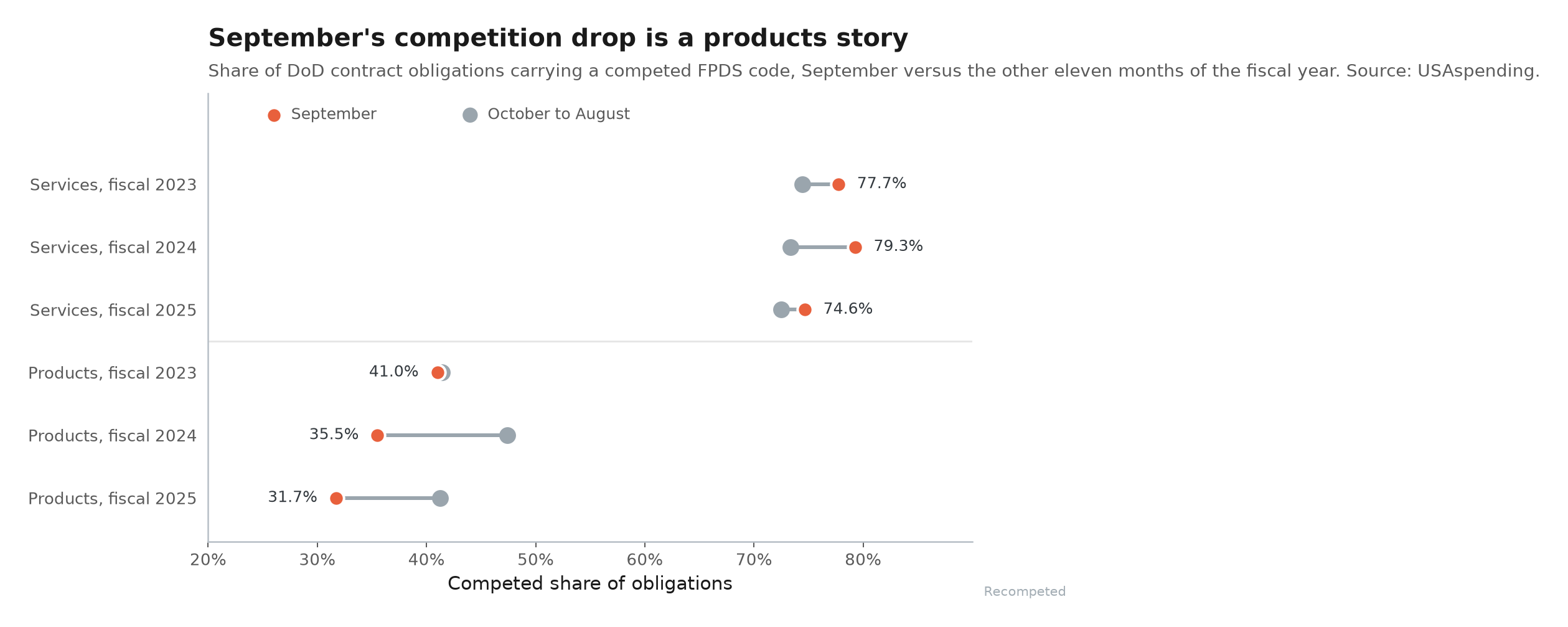
- Services: 74.6% of September's $30.84B carried a competed code, against 72.5% the rest of the year. September ran higher.
- Everything else, meaning products, R&D and construction: 31.7% of September's $61.50B, against 41.3% the rest of the year. Down 9.5 points.
The services number is not a fiscal 2025 accident. September came in above the rest of the year in all three years we pulled: 77.7% against 74.4% in fiscal 2023, 79.3% against 73.4% in fiscal 2024, 74.6% against 72.5% in fiscal 2025.
Three for three, in the month the whole industry assumes competition goes out the window.
What Actually Surges
The services year-end surge is real, and it is boring. That is the useful part.
Services obligations ran 2.08x, 2.16x and 2.04x a normal month in those three Septembers. Steady volume, steady competitive mix.
The products side is where the acceleration lives, and it has been getting steeper: 1.66x, 2.48x, 2.90x across the same three years. Its competed share went 41.0%, 35.5%, 31.7% over those same three Septembers, so the money is arriving faster and arriving less competed at the same time.
Two weeks ago we counted notices and found what looks like the opposite. September is DoD's annual low for sources sought and its annual high for sole source justifications, four years running, with justifications climbing 94% against a 48% rise in award notices.
Both readings hold.
A justification is a document, and the count of them says the paperwork of skipping competition piles up in September. The obligation record says what those documents release is a modest slice of a very large month.
One caveat worth saying plainly: these are transaction dollars, so what the split measures is the competitive posture recorded on the money, not a tally of competitions that closed inside the month.
Final Thoughts
Versions of the AEWRS extension are being signed across the department right now, and more will be before the 30th. What the three-year record says is that they stay a small share of what September actually moves on the services side.
Roughly three of every four services dollars DoD obligated last September carried a competed code, the same as every other month of the year.
Which points the year-end watch list somewhere more useful than the surge itself. The thing that cost RMC's contracting officer a justification was a clause: an option to extend that made it into the solicitation and never made it into the award.
Priced and evaluated, 52.217-8 gives an incumbent six more months by right. Left out, it turns the same six months into a document somebody has to defend.
One of those is a recompete date you can plan against. The other is a decision you will hear about afterward.
Thanks for reading.