How a Product Line Runs Out of Bidders
Three companies bid on the Army's Live Training Transformation product line in 2009. Five bid in 2014. When the Army ran the same competition again in 2019, after an RFI, a sources-sought and a published draft solicitation spread across 807 days, exactly one company bid. Last Wednesday the notice for the next cycle went up, and it asks whether the work can be set aside for small business.
In November 2009 the Army's Orlando contracting shop signed a single-award IDIQ with General Dynamics Mission Systems to run the Live Training Transformation product line.
Ceiling $200,000,000. Full and open competition, three offers received.
That contract, W900KK10D0001, ran its ordering window to September 2014.
The follow-on, CPM Next, went to General Dynamics in February 2015 on five offers. The follow-on to that, CPM Plus, went to General Dynamics in January 2020.
On one offer.
Last Wednesday ACC-Orlando posted the sources-sought notice for the cycle after that, and the notice does something sources-sought notices almost never do. It names the incumbent in its own text.
Three, Five, One
The notice is W906ZL26RCST3, Consolidated Product-Line Management, Sustainment, and Modernization. Responses close September 24 at 5pm Eastern, which is ten days from today.
The notice reads: "The incumbent contractor for the existing CPM Plus effort under contract number W900KK-20-D-0007 is General Dynamics Mission Systems, Inc., 12001 Research Parkway Ste 500, Orlando, FL 32826-3249." Street address included.
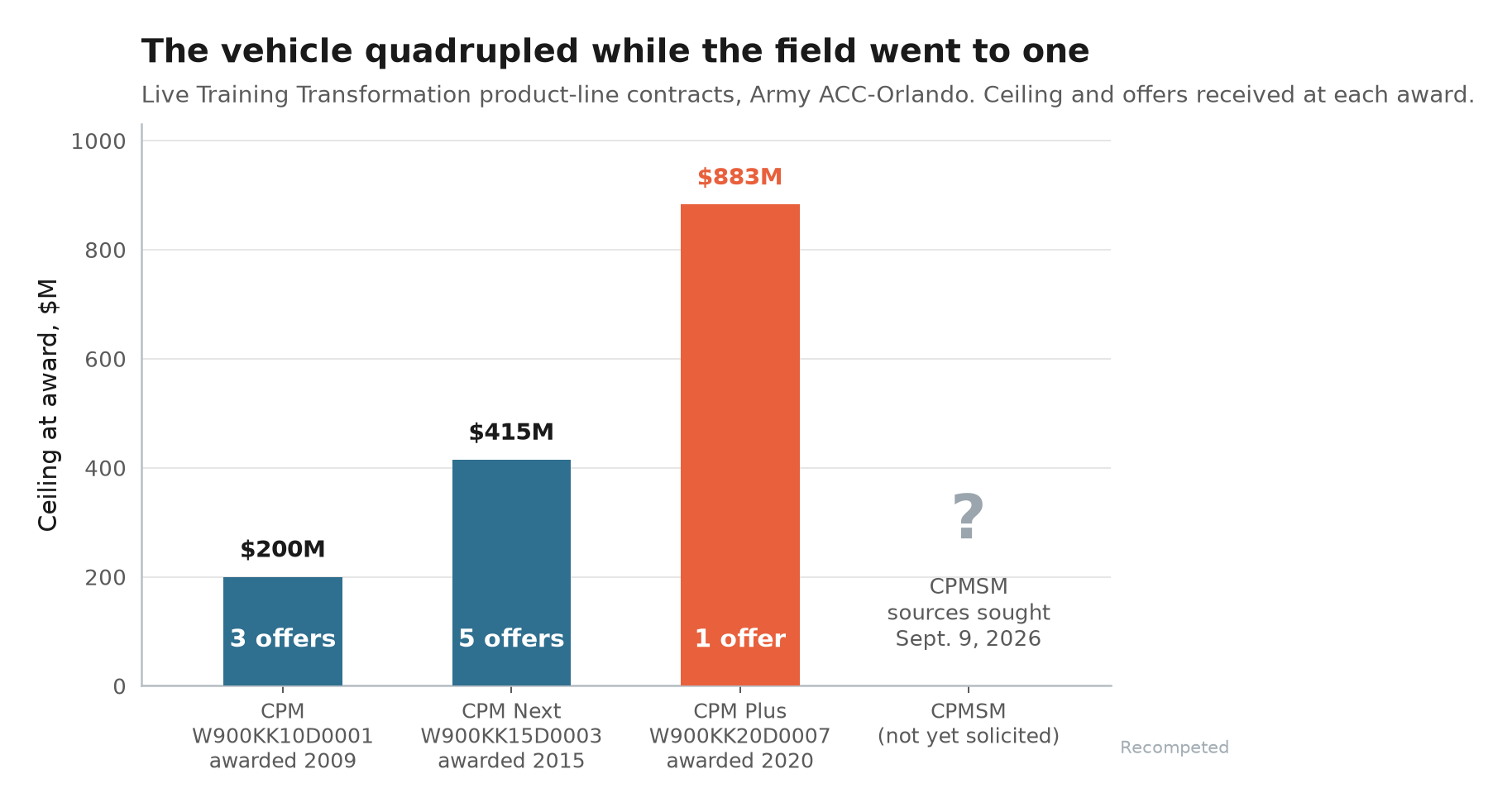
The three vehicles behind that sentence move in opposite directions (chart below). The ceiling went $200M to $415M to $883M, roughly doubling each cycle, 4.4x across the span.
Offers received went 3, then 5, then 1.
Underneath those ceilings, the work is real and it compounds:
- CPM, 2009 to 2014: 17 task orders, $244,132,843.55 obligated
- CPM Next, 2015 to 2020: 25 task orders, $379,228,104.76 obligated
- CPM Plus, 2020 to now: 34 task orders, $429,132,991.68 obligated
That is 76 orders and $1,052,493,939.99 to one company across three full-and-open competitions, on an unbroken ordering chain that starts in November 2009 and runs to January 2028. Same UEI on all three, YZNQG917LBE4.
The Army Did the Outreach
Where it gets interesting is that the obvious explanation for one offer is wrong here.
You would expect the one-offer competition to be the rushed one, the buy that appeared on a Friday with a two-week response window and no warning.
That is the usual shape of a competition nobody shows up to.
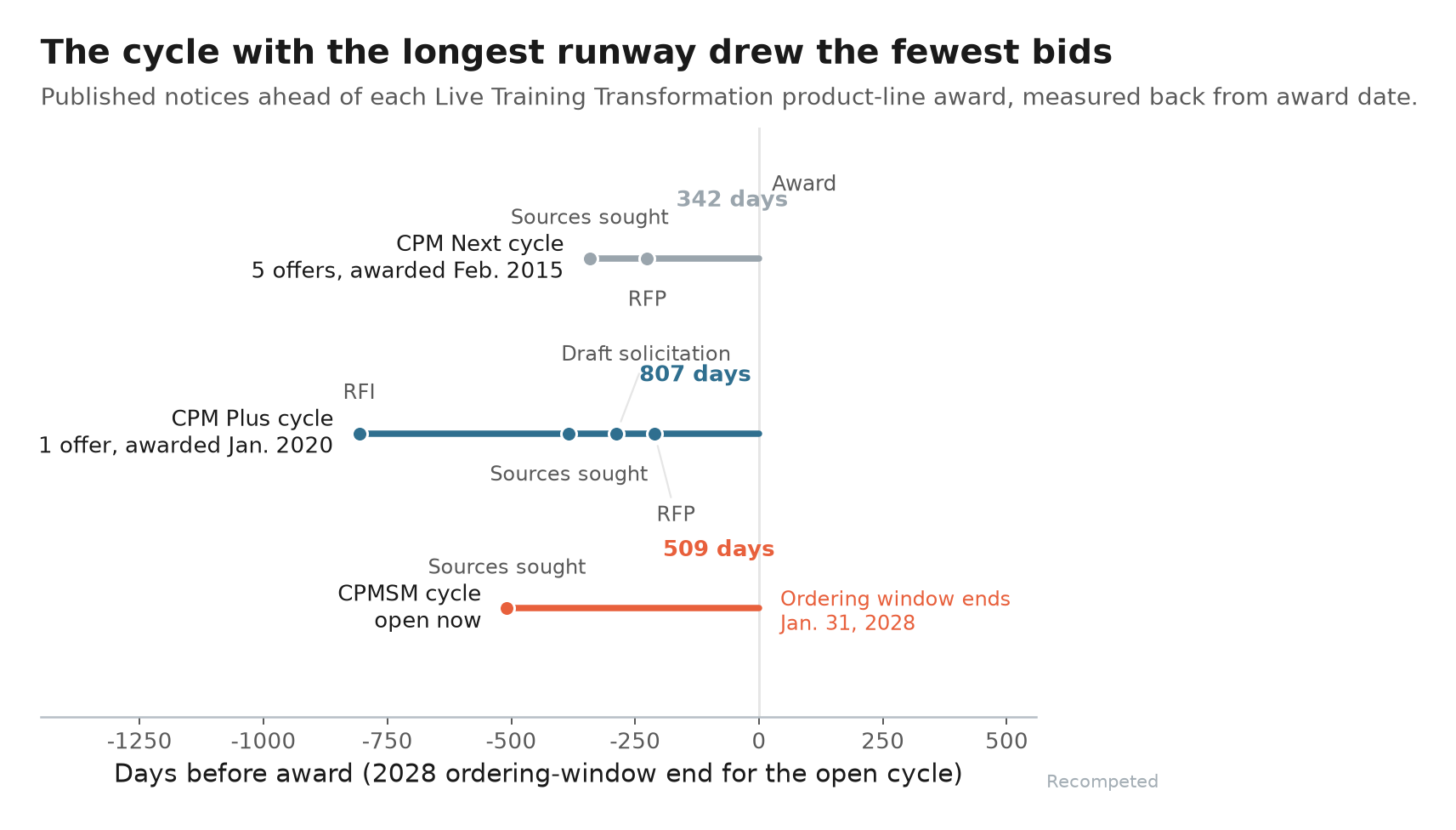
The CPM Plus cycle was the opposite. It was the most telegraphed of the three (chart below):
- RFI posted November 14, 2017, responses due December 15
- Sources sought posted January 11, 2019, responses due January 31
- Draft solicitation posted April 17, 2019
- RFP W900KK19R0021 posted July 3, 2019, proposals due July 17
- Award signed January 30, 2020
From the first RFI to signature is 807 days. Industry got a request for information, a sources-sought, and a published draft solicitation to comment on, spread across more than two years, on a full-and-open competition with no set-aside and a nine-figure ceiling.
One company bid.
The 2014 cycle, by comparison, ran 342 days from its sources-sought notice to award and drew five offers. More outreach, fewer bidders.
Whatever the 807 days bought the Army, it was not a field.

The rest of this brief is for subscribers.
The specific solicitations, dockets, and dates to act on sit past this line.
$50 a month, or $500 a year.
Already a subscriber? Sign in