 Recompeted
What Happens When the 8(a) Clock Runs Out?
Peerless Technologies signed its first 8(a) contract in February 2009 and its last in April 2018. On Thursday, eight years after the set-aside coding stopped, it took an $85 million ten-year ceiling out of AFRL against eight offers. The whole transition is sitting in FPDS if you know which field to read.
Two of the oldest contract records carrying Peerless Technologies' name are titled, in the government's own words, "EITDR HELP DESK BRIDGE 8(A) PEERLESS" and "STES BRIDGE 8(A) PEERLESS."
Both signed in the summer of 2009. Both coded 8(a) sole source, extent competed "not available for competition," one offer solicited and one received. $5,153,501 between them.
On Thursday the same Fairborn, Ohio company took an $85,000,000 ceiling out of the Air Force Research Laboratory. Ten years long. Eight offers.
That is a complete set-aside arc, front to back, and every step of it is in the public award record.
What the Clock Actually Does
13 CFR 124.2 gives a participant nine years from the date of SBA's approval letter, shortened only by termination, early graduation or voluntary withdrawal. No extension exists.
So the useful question about any 8(a) firm on your teaming list is what its award record looks like on either side of that line.
Peerless's line is easy to find. The first 8(a)-coded award in its FPDS record was signed Feb. 26, 2009, and the last was signed April 20, 2018.
Nine years and two months, which is what a full term looks like from outside the SBA's files.
That last one was FA852718F0001: $29,565,850 obligated, three offers, system security engineering for the Air Force Distributed Common Ground System, out of AFLCMC's C3I and networks shop.
Four months later, in August 2018, the company won FA942218F6019 at the Air Force Nuclear Weapons Center. No set-aside code. Seven offers. $38,465,793 in obligations, running to 2027.
Where the Set-Aside Dollars Went
Pull every Peerless prime obligation by fiscal year and split it on the set-aside code, and the shape is unusually clean (chart below).
In FY2010, 97.3% of the company's $10.5M in prime obligations sat under an 8(a) code. By FY2019 that share was 28.3%. In FY2025 it was zero, on $51,671,803 of obligations.
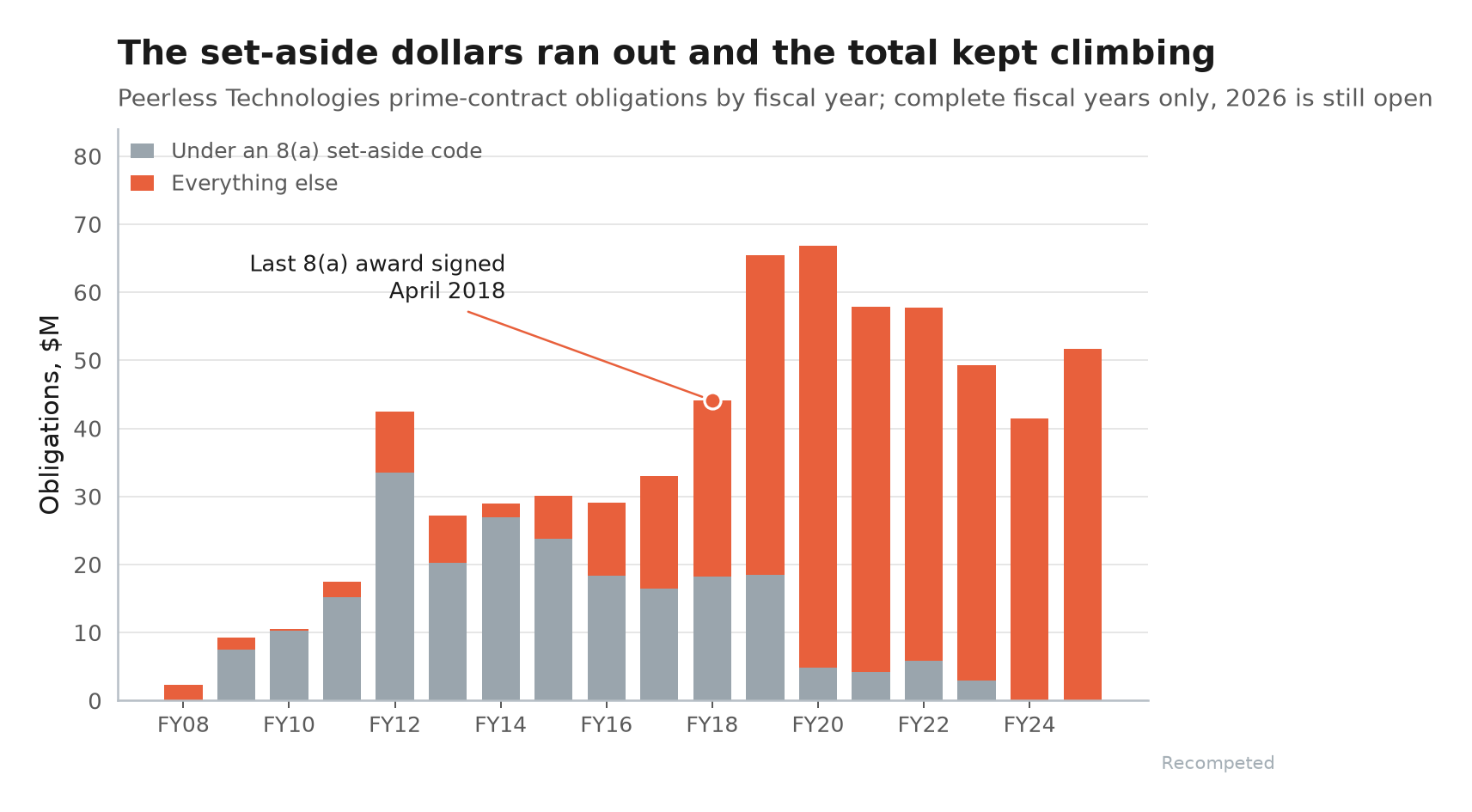
The grey layer is what the program is for, and it drains out on schedule. The orange layer is the part that has to get built while the grey is still there, and the tallest orange bars in the record all come after the last 8(a) signature.
Across FY2008 through FY2025, Peerless booked $664,770,270 in prime obligations, 34.1% of it under an 8(a) code. The single biggest year is FY2020 at $66,828,262, two fiscal years past the last set-aside award.
The Same Scope, Three Times
The EPASS thread at AFLCMC shows the transition at task-order resolution, because the requirement barely changes and only the set-aside posture does:
- January 2015. FA862215F8103, SCAT I engineering, professional and administrative support services. Coded 8(a) competed, two offers, $60,276,527.
- September 2019. FA862219F8138, same scope, same office, same OASIS vehicle. No set-aside code, $97,903,887, performance through July 2025.
- July 2025. FA862225FB004, same scope a third time, $25,463,137.
Eleven years on one requirement, won first behind a set-aside screen and held twice without one. For anyone reading an incumbent's record, step two is the one that matters, because that is where the past performance stops being program-assisted.
What Thursday Actually Bought
The AFRL award is called VOLARE, for digital system-level mission-driven integrated design methods for aerospace systems, and the Air Force seated it as two ceilings rather than one:
- Peerless, FA2391-26-D-B016, $85,000,000, completion Sept. 10, 2036, eight offers received.
- DCS Corp. of Alexandria, Virginia, FA2391-26-D-B014, $85,000,000, completion Sept. 14, 2036, eight offers received.
Neither entry carries the board's small-business asterisk. The first task orders are funded at $75,000 and $110,000, so both ceilings are an option on the next decade of research work with almost nothing obligated behind them yet.
The set-aside channel is still open to Peerless, and it runs through a joint venture. SierTek-Peerless JV LLC holds 13 prime awards worth $86,933,657, four of them coded as total small business set-asides. One is FA852724F0002, signed November 2023: a five-offer small-business set-aside for systems security engineering on the Air Force DCGS, out of the same AFLCMC office that wrote Peerless's last 8(a) award five years earlier.
Same scope, same shop, recompeted under a different screen, won by the JV Peerless is half of.
Final Thoughts
None of this is visible in a capability statement, and all of it is free. The set-aside code on a firm's award history is a timestamp, and reading the sequence tells you something a size certification never will: whether the unrestricted wins started before the clock ran out or only after it did.
For Peerless the answer is before, by about four months, and the fiscal years that followed are the biggest in its record. A company founded in 2000 with something north of 400 people now competes head-to-head for ten-year research ceilings at Wright-Patterson and reaches small-business work through a partner.
The nine years are fixed. What a firm does with the transitional stretch is the part the record actually grades, and it grades in public.
Thanks for reading.