 Recompeted
Who Gets to Design a Drydock?
NAVFAC Hawaii just signed a $249M architect-engineer IDIQ with a Honolulu joint venture on qualifications alone, five days after the contract it replaces ran out of ordering authority. One sentence in the synopsis decided who could compete, and a bidder asked the Navy in writing to take it out.
If you chase Navy architect-engineer work, NAVFAC Hawaii's waterfront seat has a new holder as of Thursday.
NAVFAC Hawaii signed a $249,000,000 A-E IDIQ on October 29. Nobody bid a price on it.
That is the Brooks Act working as designed. Firms send an SF-330, the Government ranks them on demonstrated competence, and the fee gets negotiated afterward with whoever ranks first.
The winner is MNBMcD Waterfront JV of Honolulu, on contract N62478-27-D-5050, for waterfront design across the NAVFAC Hawaii area of responsibility out of Joint Base Pearl Harbor-Hickam.
"What does a firm have to own in-house to get the drydock work at Pearl Harbor?"
One Sentence Decided the Field
The synopsis for N62478-25-R-5050 carries a line that reads like boilerplate and is anything but:
"For this acquisition, the Government is seeking a Prime A-E firm or Prime JV whose primary discipline shall be in waterfront/structural engineering within the Prime."
Somebody in industry read that and pushed back, on the record. Question 16 in the Q&A told the Navy the requirement "severely limits the competition to a small number of firms while excluding many highly qualified firms," and asked it to open the procurement to firms carrying waterfront depth alongside other practice areas.
The Navy declined, in one sentence: the intent is to have those disciplines "within their firm and not their sub-consultants."
So the test was whether you already were a waterfront team.
Two offers came in.
Nine Criteria and No Price
Under 40 USC Chapter 11 and FAR Subpart 36.6 there is no RFP package to download, and the synopsis says so in capital letters. Everything an offeror needed was in the notice.
Nine selection criteria, in descending order of importance, with volume of work as the tiebreaker:
- Specialized Experience
- Professional Qualifications
- Past Performance
- Quality Control Program
- Program Management and Capacity
- Firm Location
- Sustainable Design
- Commitment to Small Business
- Volume of Work
Criterion 1 is where the field thinned. Five relevant project types, and a firm had to show at least three of five: piers and wharves, drydocks and drydock caissons, waterfront facilities, mobile crane load studies on piers, and seismic analysis of drydocks or caissons.
With a floor under each one. Roughly $20 million of construction cost for new work, roughly $10 million for repair and renovation.
And the line that makes the in-prime rule bite twice: "Experience from a firm's sub-consultant(s) will not be considered."
One more number worth sitting with. The guaranteed minimum on a $249,000,000 ceiling is $3,000.
The Seat It Inherits
The predecessor is N62478-20-D-5035, signed September 25, 2020 with Moffatt & Nichol - Burns & McDonnell Hawaii, a single-award firm-fixed-price IDIQ under the same NAICS 541330 and the same PSC C211, usable by NAVFAC Hawaii alone.
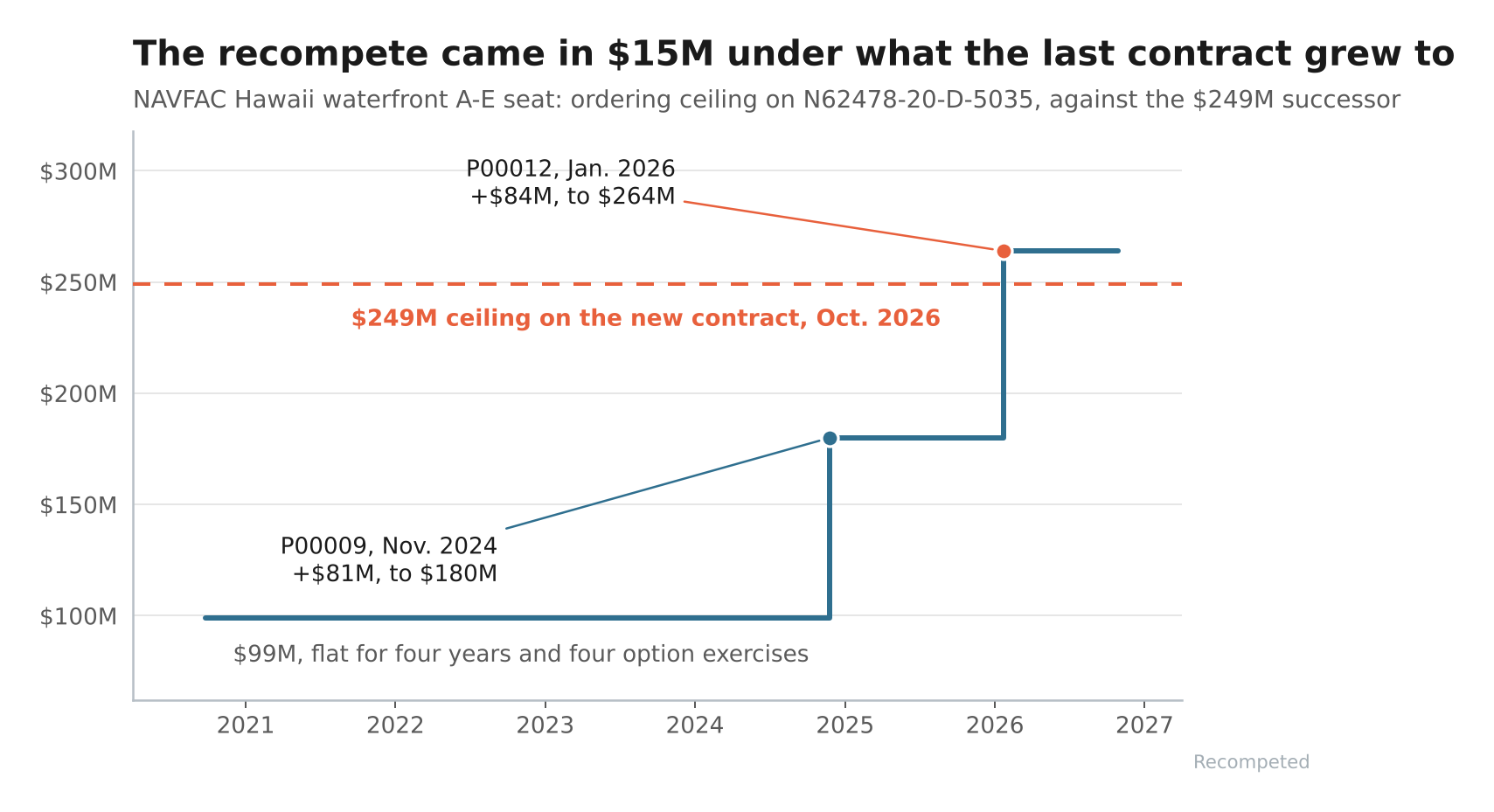
It launched with a $99,000,000 ceiling and sat there through four option exercises (chart below).
Then it moved twice in fourteen months. P00009 in November 2024 added $81 million to take it to $180 million; P00012 in January 2026 added $84 million more, landing at $264,000,000, or 2.67x what the vehicle was sized for.
Where it gets interesting is the ordering clock. The original last date to order was 2025-09-24.
A FAR 52.217-8 extension went on in September 2025, and an administrative mod in January 2026 moved the date to 2026-03-24. Then P00013 in March 2026, labeled in FPDS exactly as what it is: "BRIDGE CONTRACT TO EXTEND SERVICES."
That bridge expired October 24, 2026. The successor was signed October 29.
Five days. On a competition whose synopsis went up 582 days earlier and whose SF-330s were due in May 2025, with an estimated start date of September 2025 printed in the notice.
The new ceiling is $249,000,000, which is $15,000,000 below where the old seat finished.
What the Public Record Actually Says About the Winner
Here is the honest limit. MNBMcD Waterfront JV, UEI WPELNJ59LEE8, CAGE 9XNE5, is a Honolulu entity with no record in FPDS or USAspending under that UEI as of this morning, and no company release anywhere announcing the win.
The naming convention is the firms' own, though. Moffatt & Nichol's January release on a separate NAVFAC Atlantic award names that entity "M&N-BMcD LANT SIOP Joint Venture," a Moffatt & Nichol and Burns & McDonnell pairing that has been side by side at Norfolk Naval Shipyard since 2017.
Who signed the MNBMcD joint venture agreement is not in the public record yet, and we are not going to guess at it.
What the record does say is the part that matters for your pipeline: somebody walked into a qualifications-only competition carrying piers, caissons and seismic drydock analysis on their own balance sheet, cleared a bar explicitly written to exclude borrowed capability, and took a nine-figure seat at Pearl Harbor for the next five years.
Final Thoughts
Qualifications-based selection gets described as the soft version of competition, the one where nobody sharpens a pencil. The Hawaii waterfront seat says otherwise.
You can win a price shootout by being hungry. A criterion that says the discipline has to live inside your own firm, you win by having spent a decade building it, and no teaming agreement signed in April closes that gap.
So read the next NAVFAC A-E synopsis for its scope paragraph before its ceiling. One sentence in there quietly describes a bench you either have or you do not.
Thanks for reading.