 Recompeted
Who Answers When the Army Asks for a Spectrum Analyzer?
Thursday's Pentagon board carried 150 stated offers across fifteen competed lines. Ninety-nine of them landed on one requirement, and the company that won it was founded in 2024 and has no prior prime award record in FPDS.
Fifteen of the announcements on Thursday's Department of War board state how many bids they drew. Add them up and the whole day comes to 150 offers.
Ninety-nine of them came in on one line.
That line is W56KGY-26-D-A003, a $99,000,000 firm-fixed-price IDIQ to Heaviside Industries Inc. of Marina del Rey, California, covering "the procurement, fielding, upgrades, and sustainment of the Heaviside MOTH spectrum analyzer" out to Aug. 27, 2031. Army Contracting Command, Aberdeen Proving Ground. The competition sentence is one line long: "Bids were solicited via the internet with 99 received."
Ninety-Nine of a Hundred and Fifty
Set that against everything else that posted the same day (chart below).
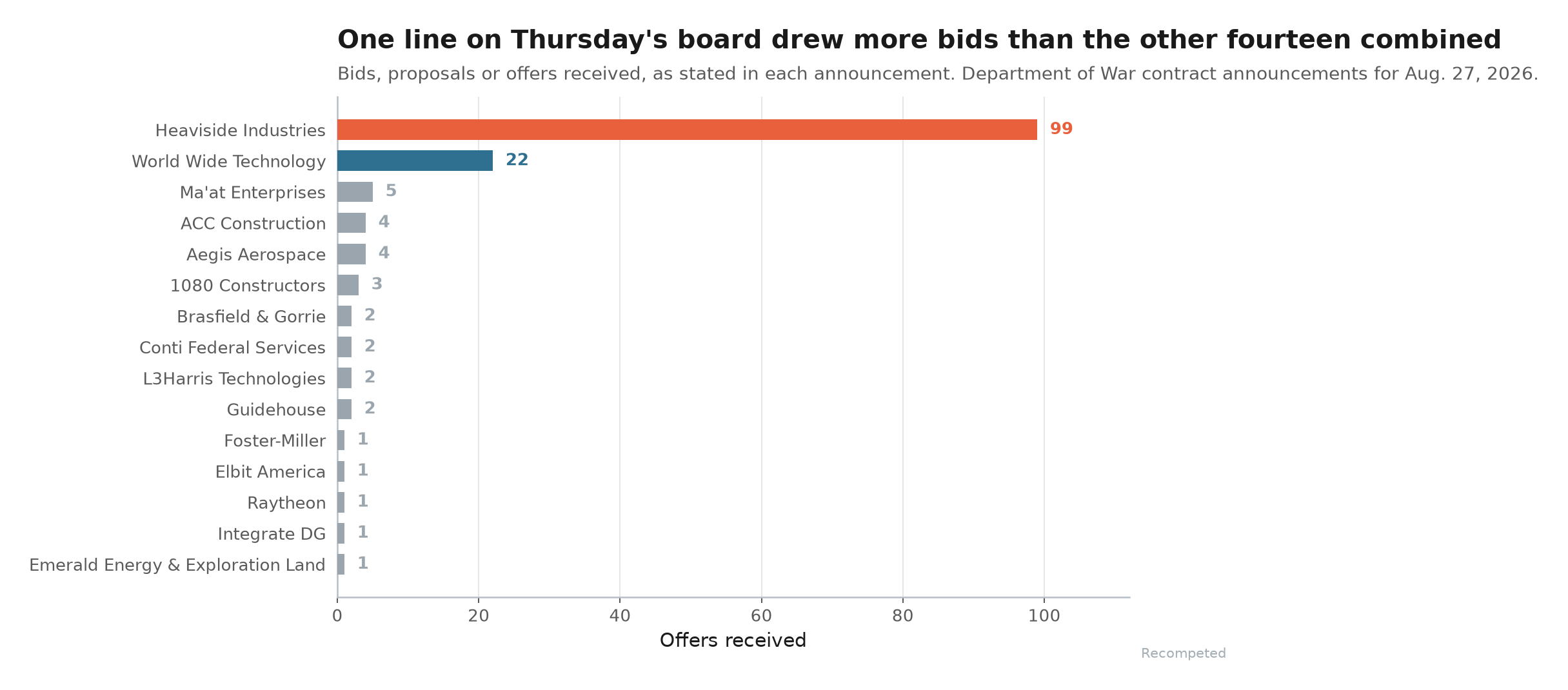
The second deepest field on the board was 22, on Air Combat Command's 688 Cyberspace Wing cybersecurity services ceiling to World Wide Technology.
After that it drops off. Ma'at Enterprises drew five on Marine Corps Recruiting Command Salesforce training, ACC Construction and Aegis Aerospace took four apiece, and the median across the other fourteen competed lines is 2.
A $654 million power and water resiliency job at Portsmouth Naval Shipyard drew three offers. A handheld spectrum analyzer drew ninety-nine.
None of that is mysterious once you look at what each requirement asks a bidder to already own. NAVFAC Atlantic wants bonding capacity, a shipyard-cleared workforce and a P-number in hand.
This one wants a box you can put in a soldier's hand, and the population of firms that can build that box is now very large.
Field size is the cheapest read there is on a requirement's barrier to entry, and this is the deepest field this desk has logged on a single announced line.
The Winner Is Two Years Old
Heaviside was founded in 2024 and spent most of its existence quiet. It came out of stealth on May 11 of this year with a $28 million Series A led by Interlagos, with Menlo Ventures, Flume Ventures, Cantos and Anorak Ventures in the round. Frank Finelli, formerly of Carlyle, Partners Capital co-founder Paul Dimitruk, and former Dedrone chief executive Aaditya Devarakonda came in individually.
Fifty-plus engineers and operators. Offices in Los Angeles and Oslo. Phillip Walker as chief executive. The company describes its work as multi-domain autonomous precision munitions for US and allied special operations and conventional forces, and MOTH is the land spectrum-awareness piece of that line.
One hundred and eight days separate the funding announcement from the award.
Here is the part worth sitting with. We queried FPDS four ways and USAspending twice this morning, and neither system carries a prior prime award to this company under any spelling we could construct. FPDS runs a reporting lag, so the new IDIQ itself has not landed there yet either, and that is expected. The absence of everything before it is the notable thing: a firm with no visible prime history took a five-year fielding and sustainment vehicle on its first appearance in the record.
What the Ceiling Actually Buys
Three things about the instrument are worth separating from the headline number.
- It is a ceiling. An IDIQ authorizes ordering. The Army has obligated nothing against it that the announcement discloses, and firm-fixed-price delivery orders will arrive on whatever schedule the funding does.
- The scope carries a tail. "Procurement, fielding, upgrades, and sustainment" is the durable half of this award. Fielding and sustainment are where a device becomes an installed base, and an installed base is what makes the next competition hard for everyone who came second on Thursday.
- The buying office is a specialist. W56KGY buys electronic warfare. Its recent SAM postings run to PM Electronic Warfare and Cyber requirements, an electromagnetic warfare payload for small UAS, and Joint Tactical Terminal next-generation market research. This came through the Army's EW shop, and it will be sustained there.
One honest gap. We searched the SAM opportunity index on the product name, the company name, the contract number and the generic capability, and found no solicitation for this requirement. The board sentence is the only public account of the field size we could locate, which means the 99 is reportable and the reasons behind it are not.
Final Thoughts
Ninety-nine bidders on a single Army requirement is the kind of number that gets read as a story about one company. The more useful version is the one about the shape of the requirement.
When a capability arrives as a device rather than a services scope, the qualification barrier collapses and the field goes from two to a hundred. Past performance and cleared headcount stop doing the sorting, because the field fills with firms that have neither and showed up anyway.
For a capture shop, the actionable piece is the sustainment tail. Whoever chases MOTH's replacement in 2031 will be bidding against an installed base and five years of upgrade history, and the time to think about that is now, while the ordering period is still empty.
Thanks for reading.