 Recompeted
Two-Thirds of the Services Pipeline Never Hits SAM
We refreshed the expiration pipeline this morning: 1,222 DoD contracts above $50M come off period of performance between February 2027 and July 2028. Narrow to services and 217 of the 326 are task orders under a vehicle somebody else already won, which means the recompete you are planning against was never going to be posted.
Yesterday the Marine Corps put $14,897,521 into Operational Command Post hardware with World Wide Technology. Two offers, competed through NASA's SEWP vehicle, done.
Now go look for it on SAM.gov. The opportunity index returns zero records for M67854-26-F-0135.
That is working exactly as designed, and it is the single most under-modeled fact in a services capture pipeline.
The Number
We refreshed the expiration pipeline this morning. It carries 1,222 DoD prime awards above $50M obligated whose current period of performance ends between February 3, 2027 and July 27, 2028, worth $440.71B in obligations.
Every row on it is either a standalone contract or an order placed under a vehicle that was competed years ago. USAspending marks the difference cleanly: an award page URL either names a parent IDV or says -NONE-. We checked that shortcut against USAspending's own award-type field on a random sample of fifty rows and it matched fifty out of fifty, twenty-five delivery orders and twenty-five definitive contracts.
713 of the 1,222 are orders. That is 58.3% of the board.
Narrow to the services NAICS where capture headcount actually lives, the 541 professional and engineering families, 518210 and the 517s, 561210 facilities support, and it gets sharper: 217 of 326, or 66.6%. The pattern holds quarter after quarter across the whole window, not just in the busy near end (chart below).
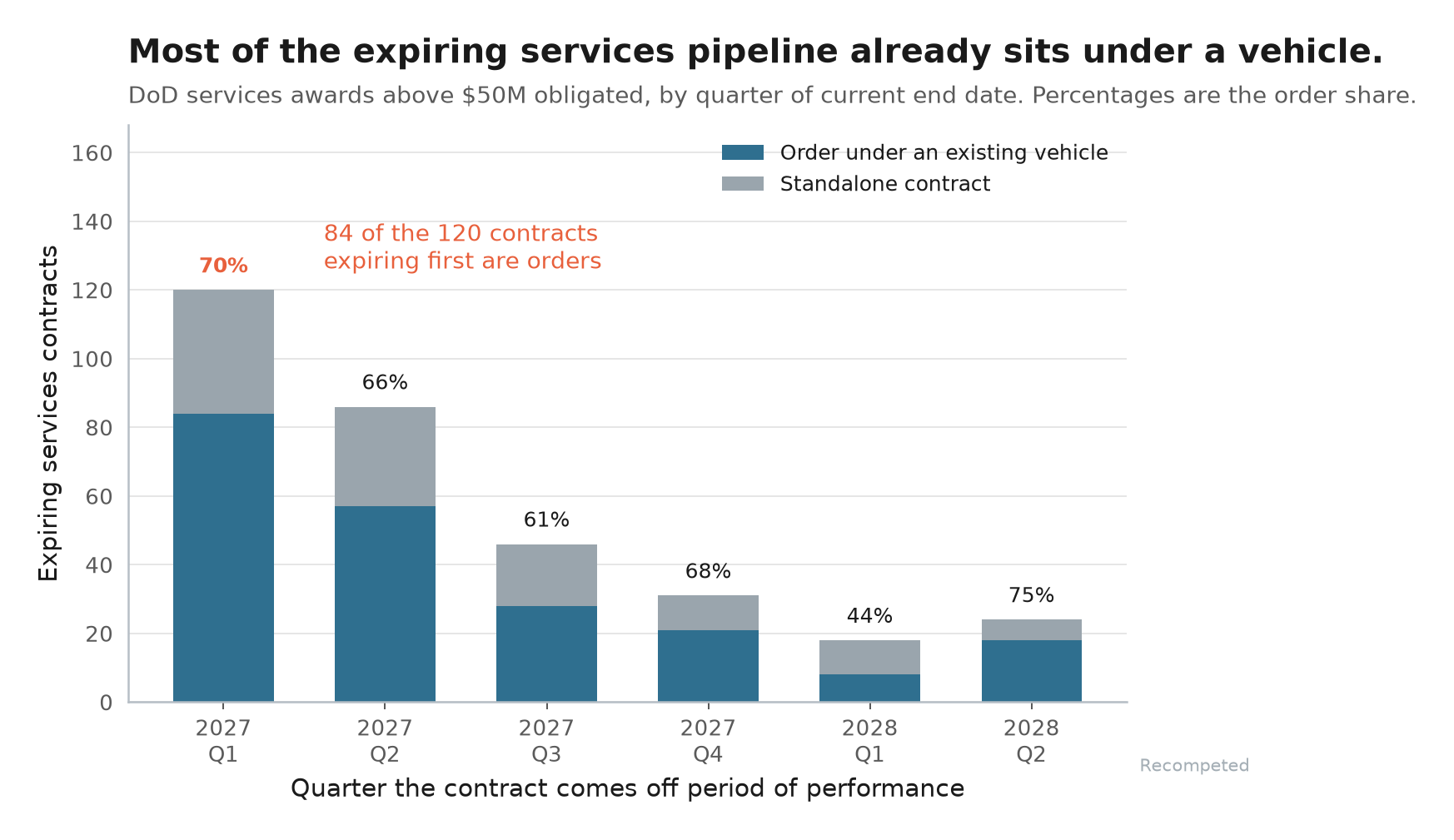
The one quarter that breaks it is 2028 Q1, where standalone contracts lead 10 to 8. That is eighteen rows total at the thin far end of the window, so we wouldn't read anything into it yet.
Why You Can't Find Them
FAR 16.505(a)(1) is one sentence and it does all the work:
"In general, the contracting officer does not synopsize orders under indefinite-delivery contracts."
There are exceptions at 16.505(a)(4) and (11) and at (b)(2)(ii)(D), and they are narrow. The default is silence.
What replaces the synopsis is 16.505(b)(1)(i), fair opportunity: the CO owes each awardee on the vehicle a fair shot at each order above the micro-purchase threshold. Awardee, singular and specific.
If you do not hold a seat, the fair-opportunity obligation has nothing to do with you.
So the visibility test is mechanical. We ran it on three of the biggest orders on the board:
- W52P1J19F0394, KBR, the LOGCAP V EUCOM performance task order, $2.31B obligated, off contract March 29, 2027. SAM: zero records.
- FA807522F0030, CACI, $477.8M of digital engineering for the Navy Digital Integration Support Cell and NSWC Crane, off contract May 4, 2027. SAM: zero records.
- M67854-26-F-0135, the SEWP order above. Zero records.
For contrast, the NAVFAC Washington 8(a) janitorial recompete we wrote about this week, N40080-25-R-2233, is a standalone definitive contract. SAM returns it immediately, combined synopsis/solicitation, terms attached.
That is the shape of the third of the pipeline you can actually watch.
The Seat Is the Product
Here is where it gets uncomfortable for anyone running a vehicle strategy off a list of the big five.
Those 217 expiring services orders sit under 171 distinct parent vehicles. And 137 of the 171 carry exactly one expiring order apiece.
There is no small set of doors. Holding OASIS+, SEWP, ITES and Seaport-NxG gets you a real share of the market and still leaves most of these individual recompetes on vehicles you have never onboarded to.
The CACI order is the tell. Its parent is FA807518D0006, the DoD Information Analysis Center MAC, run out of the Air Force's 774 ESS at FA8075, which is how a Navy digital-engineering requirement at Crane ends up competing on an Air Force vehicle. That IDIQ was solicited in the open in 2017 as FA8075-17-R-0001, a $28B nine-year IDIQ with a draft RFP, a synopsis, and a response date. Fully visible, once, nine years ago.
It ends March 31, 2028, about ten months after the CACI order does.
Final Thoughts
Put the two moments a vehicle is actually open on the capture calendar: the original competition, and the on-ramp.
The IAC MAC on-ramp is instructive because it happened in public and almost nobody outside the winners noticed, ten Pool 1 award notices posting to SAM between October 2024 and January 2025.
That is the asymmetry. An order worth $2.31B generates no public notice at all, and the on-ramp that decides who may bid on the next one generates a routine award notice nobody sets an alert for.
If your pipeline is built on solicitation feeds, it is structurally blind to two-thirds of the services work coming off contract in the next two years. The dates themselves are knowable, and we publish them.
Getting standing to bid on those dates is a decision you make one and two years earlier, on a vehicle whose name is nowhere in this quarter's headlines.
Thanks for reading.