 Recompeted
The Small Business That Didn't Need the Set-Aside
SCMI1 spent six years at Mayport turning one-person support orders into past performance. When the Navy took the small business set-aside off the combat systems recompete, the company won the work anyway, at $20.8 million.
Two entries in SCMI1's federal record are described, in the government's own words, as a requirement for "one individual" and a requirement for "two individuals."
The first is facilities support at Naval Station Mayport, awarded March 2020, worth $257,189. The second is two people inside Code 300 waterfront operations, helping with advanced planning and scheduling.
That is where this company's relationship with the Southeast Regional Maintenance Center begins.
On Aug. 7 the same command awarded Supply Chain Management Inc.1.com, a Hauppauge, New York firm that carries small, minority-owned and self-certified small disadvantaged codes on its federal registration, $20,766,943 for technical and logistical services on Navy surface combat weapons systems. Options run the period of performance to August 2032.
"What do six years of small orders inside one customer actually convert into?"
The ladder had four rungs before this one
Every SCMI1 award at Mayport is on the public record, and they climb in a straight line (chart below).
March 2020, one person on facilities support, $257,189. September 2020, two people on waterfront planning, $1,008,586. March 2022, assessment program support, $2,269,899. August 2024, professional support for hull, mechanical and electrical engineering, $3,728,417.
Then August 2026, at $20,766,943.
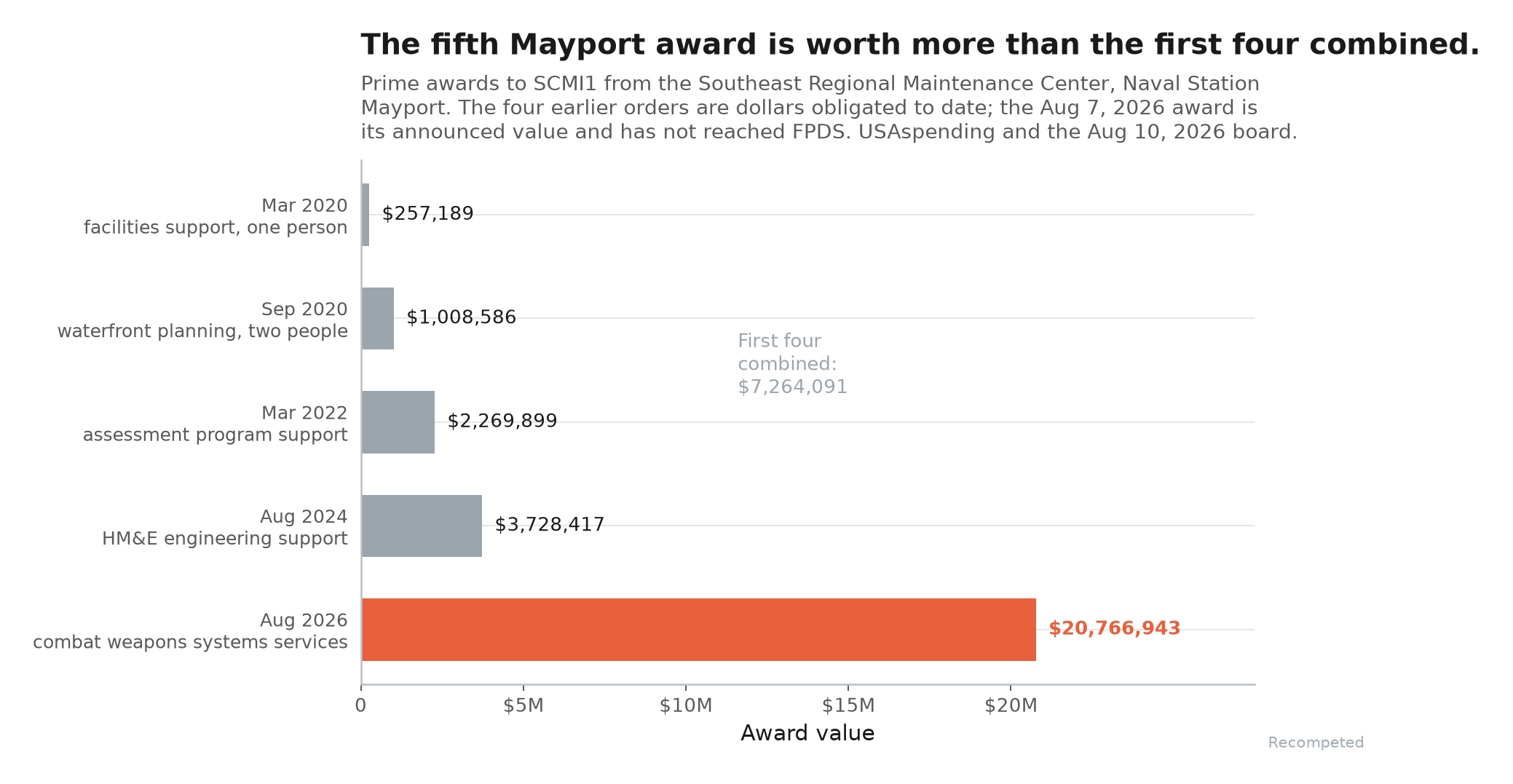
The fifth award is worth 2.86x the first four combined and 5.57x the largest single award the company had ever held. Across seventeen prime awards on its whole federal record, SCMI1 had been awarded $13.5M before this one.
A single Thursday in August beat that by half again.
The rungs matter more than the arithmetic. Each of those four Mayport orders was competed, and none of them was a set-aside: four offers, then seven, then three, then four, all coded full and open.
The company was buying relevant past performance at a customer, one CLIN-sized requirement at a time, in a market where nobody was protecting it.
The scope came to them
Here is where it gets interesting. Read what the Navy said it was buying.
Solicitation N4002725R3000 describes support for two areas of SERMC's Engineering Department:
- combat systems technical support services for USN ships
- clerical and administrative support services to that department's workforce
Two lanes, one requirement. And SCMI1 had been running both of them at that pier for six years, the administrative lane since the 2020 facilities order and the technical lane since the 2022 assessment work and the 2024 HM&E engineering support.
The combat systems half is the one piece they could not show at Mayport, so they showed it from Norfolk. In March 2025 the Mid-Atlantic Regional Maintenance Center gave them $3,040,219 for technical support to MARMC's C290 surface combat systems shop, competitively, seventeen months before the Mayport award. When the bundled requirement hit the street, every element of it had a matching line in their past performance.
Bundling usually reads as a barrier to a company this size. Here the bundle described the incumbent-adjacent bidder exactly.
The reserve came off and they won it anyway
The predecessor contract is N40027-20-F-3002, held since August 2020 by The McHenry Management Group of Chesapeake, Virginia, a small veteran-owned business, with $18,521,738 obligated against it. Its period of performance ends Aug. 15, 2026, eight days after the successor was signed, with no option runway left behind that date.
Same office, same NAICS 541330, same PSC R425. One thing changed.
The 2020 solicitation was a total small business set-aside and drew three offers. The 2026 solicitation carries no set-aside at all and drew four.
The protected competition became an open one, the field got deeper rather than thinner, and a self-certified small disadvantaged business took it.
That is the part worth carrying into your own pipeline review. The set-aside question and the win-probability question get treated as the same question, and this award is a clean case where they came apart.
Final Thoughts
Nothing here is exotic. A small firm took a $257,000 order for one person, delivered, took the next one, crossed to a second maintenance center to pick up the one qualification its home customer could not give it, and was standing in the right place when the requirement consolidated.
To be fair, the award has not reached FPDS yet, so its competition and set-aside coding are not public and we have written none of that from the award record itself. The solicitation is unambiguous about carrying no set-aside, and the Aug. 10 announcement is unambiguous about four offers.
The version of capture that gets written up is the big pursuit with the color team and the price-to-win. The version that produced this one was six years of showing up for work nobody else wanted to bid, at a command that kept writing down what it thought of the result.
Thanks for reading.