 Recompeted
The Contractor Dyess Ran Out of Room For
The 7th Contracting Squadron just added $10 million to a base engineering vehicle it awarded three years ago. The company on the other end has held that work since 2017, through two set-aside competitions, and the ceiling is the part that keeps moving.
If you price base engineering work for the Air Force, you have bid a SABER, and you know what you are really buying when you win one: a four or five year ordering period, task orders in the quarter-million to million-dollar band, and a ceiling that decides how much of your year the vehicle can actually feed.
Dyess Air Force Base spent last week telling the market its ceiling was wrong.
On Wednesday's board, the 7th Contracting Squadron put a $10,000,000 increase on FA4661-23-D-0001, lifting the contract from $20,000,000 to $30,000,000 with the ordering period closing March 15, 2027.
No funds obligated, no new scope, no competition. Just more room.
The company on the other end of it is MW Services Inc., of Temecula, California, and the reason the room ran out is worth about twenty minutes of your pipeline review.
Eleven Bidders, Then Five
MW Services has held Dyess base engineering work for nine years, and it got there the hard way, twice.
The first vehicle, FA4661-17-D-0003, was signed 2017-09-29 off solicitation FA4661-17-R-0002. Women-owned small business set-aside, 11 offers received, ceiling $34,047,250, orders through 2022-09-30.
The recompete, FA4661-23-D-0001, was signed 2023-03-16 off solicitation FA4661-22-R-0009. Same set-aside, same NAICS 236220, same company, 5 offers received.
So the field for Dyess base engineering more than halved between 2017 and 2023, and the incumbent won anyway.
On the award record MW Services carries the women-owned small business designation, 8(a) program participation, and minority-owned status. That stack gets a company invited to a lot of set-asides.
Winning the same one twice is a separate problem.
Nine years of task orders is what won the second one.
The Ceiling Came Back Smaller
Here is the part that should go in your notes, because it is not a Dyess quirk.
The 2017 vehicle carried $34,047,250 across a 5.00-year ordering period, which is $6,806,655 of ceiling per year. The 2023 recompete carried $20,000,000 across 4.00 years, or $5,003,425 a year.
The successor was written at 73.5% of the rate of the contract it replaced (chart below).
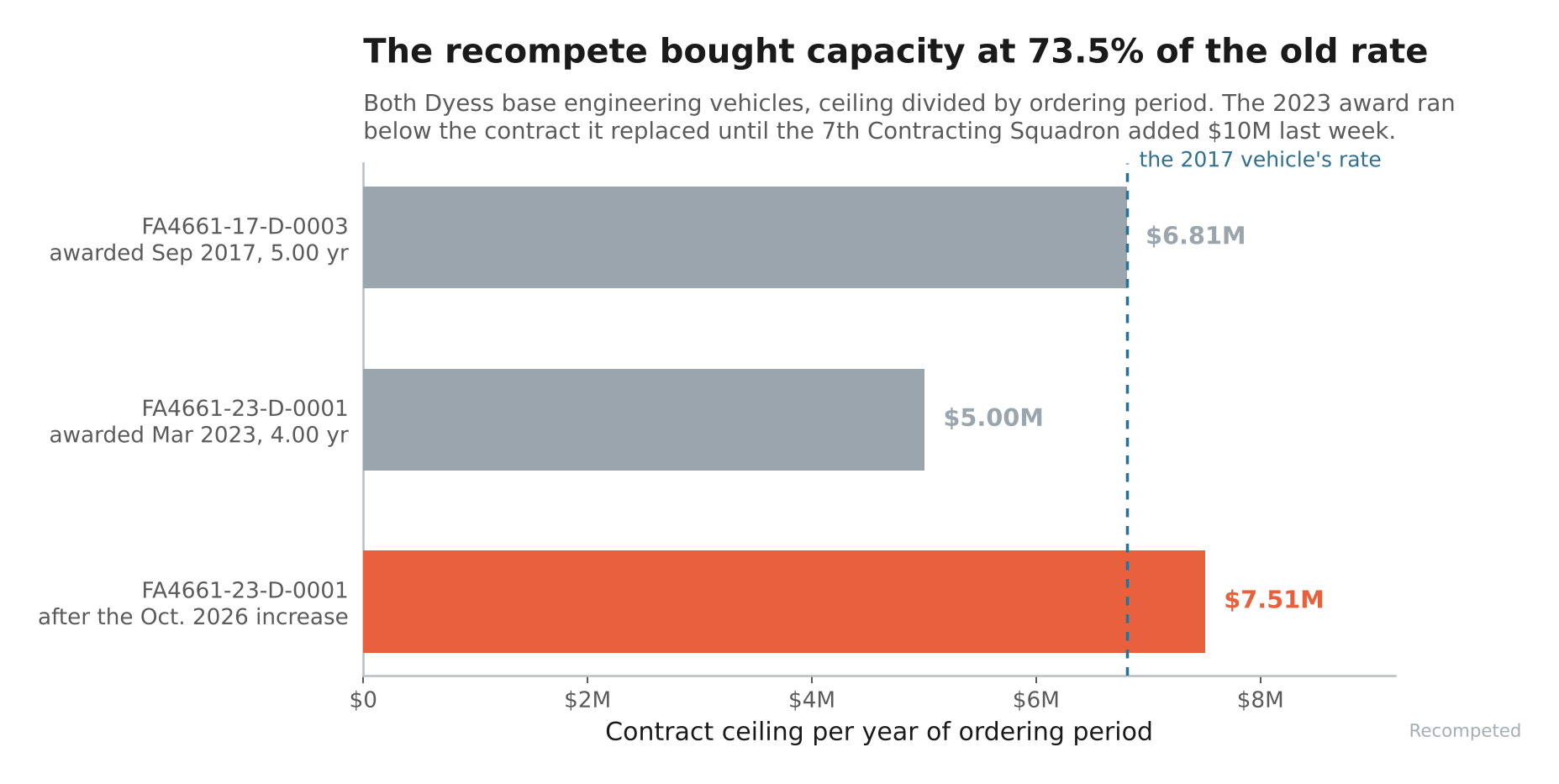
Last week's increase takes it to $7,505,137 a year, which is 110.3% of the old rate. In total dollars the vehicle is still $4,047,250 short of what its predecessor was authorized to spend.
"Was the recompete smaller, or was it just written smaller?"
Written smaller. The demand never left, the base is buying at a pace $20,000,000 could not carry for four years, and the correction took three and a half of them to arrive.
Three things follow for anyone building a number off a vehicle like this:
- Size the opportunity off the predecessor's ceiling and ordering period, not the one in the new solicitation. The new one is a budget estimate and it gets corrected by modification.
- A ceiling increase with no added scope and no new money is a demand signal about the base, and a performance signal about the holder. Offices do not buy more room from a contractor they are trying to get away from.
- FPDS has not caught up. Every action record on FA4661-23-D-0001, the most recent included, still reads $20,000,000 as the contract total. If you are screening by ceiling this week, the $30M only exists on the board.
What $500 Buys at Dyess
The texture of this vehicle is in the small records, and it explains why nine years of it adds up.
Dyess orders proposals, and not as a line on a task order. As its own task order: FA4661-23-F-0017 through F-0024 were each issued on 2023-04-18 for $500, every one of them described as a proposal fee off the SABER.
More followed in 2024, 2025 and December 2025. One of them, F-0020, was cancelled a few months later by modification for minus $500.
Then the real orders land on top. FA4661-24-F-0059, signed 2024-08-09 to renovate Building 7312, runs $1,916,729.53 after its one modification.
That single order is 9.6% of the original ceiling of the entire four-year vehicle.
Count a couple of those a year against $5,000,000 of annual room and the arithmetic finishes itself.
Final Thoughts
We counted 65 of these SABER vehicles across 34 Air Force contracting activities two weeks ago, and the thing that makes them worth tracking is exactly what Dyess just demonstrated.
The competition is visible once every four or five years. The capacity decision gets made continuously, by modification, in records nobody reads.
MW Services won a shrinking field in 2023 and has spent the three years since proving the award was priced low. That is a quiet way to run a business and an unusually legible one, which is why a company most of this industry has never bid against is the reason a contracting squadron rewrote a number last Wednesday.
Thanks for reading.