 Recompeted
The Co-op That Audited Its Way Into a Twenty-Year Contract
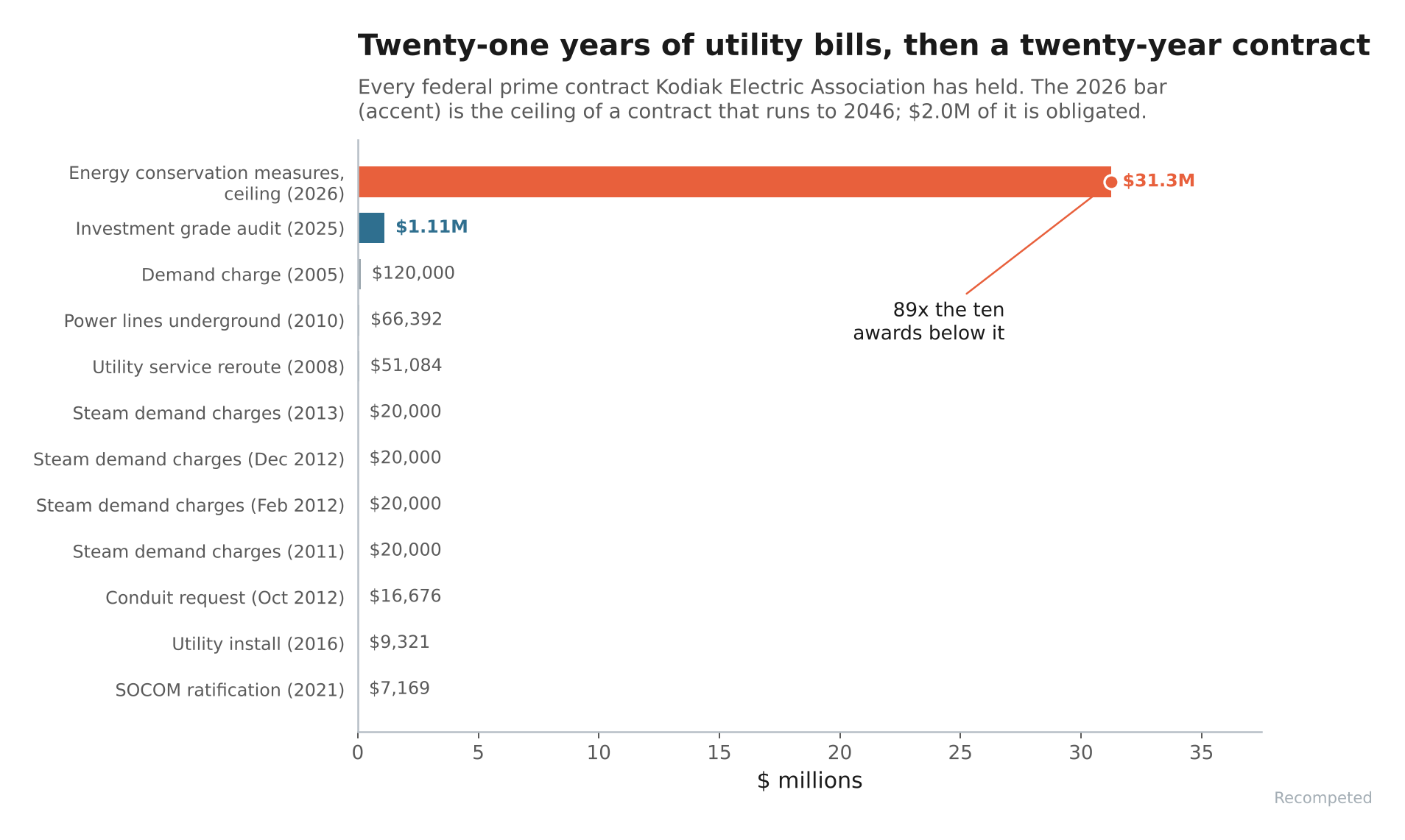
Kodiak Electric Association's entire federal prime record ran to $350,642 across twenty-one years. On September 30 it took a contract with a $31.3 million ceiling that runs to 2046, and the step between the two was a single audit.
In March 2005 the Coast Guard bought a demand charge from Kodiak Electric Association. The contract was worth $120,000.
Nine more followed over the next sixteen years. Steam demand charges four separate times, at $20,000 each.
Rerouting the primary electrical service in 2008, moving power lines underground on Windrider Drive in 2010, a conduit request in 2012. The smallest is a $7,169 ratification of an unauthorized commitment that Special Operations Command tidied up in 2021.
Ten contracts, $350,642 between them.
Then on September 30 the member-owned cooperative that runs the grid on Kodiak Island took SP060426C8000: firm fixed price, ceiling $31,269,241, period of performance running to September 29, 2046 (chart below). That is 89x everything the cooperative had ever held from the federal government, on a clock as long as the entire record that preceded it.
So far nobody has posted a word about it. SAM.gov carries no notice on the contract number, and DLA Energy's whole opportunity book there has said nothing about Kodiak since September 2025.
The cooperative's own annual report, published this April, went only as far as expecting the project to "move forward sometime during 2026."
A Million Dollars to Find Out What Was Wrong
The hinge is a contract from last year, and it is the part worth stealing.
DLA Energy put KEA on SP060425C8001, $1,106,916, firm fixed price, description INVESTMENT GRADE AUDIT FOR UESC. Effective March 28, 2025, signed that September, closing out October 10.
The job was to walk Base Kodiak's energy consumption and, in the agency's own words on SAM, "identify potential cost savings and efficiency improvements."
A utility energy service contract is the instrument that lets a federal site buy conservation work from the utility already serving it and repay out of the savings. The audit is what turns a wish into a priced scope.
Here is the sequencing, and it is tighter than it looks. DLA Energy posted the audit award notice on September 24, 2025 at 11:22 Zulu. Eight hours later the same office posted SP060425-NOI-KODIAK, its notice of intent to sole-source the UESC itself. Both notices gave industry until noon Eastern on October 10 to come forward. The audit contract's own period of performance ended October 10.
The window for anyone to raise a hand closed the day the audit was due.
Why There Was Never a Competition
Read the authority on the award and it says UT, which decodes to FAR 6.302-1(b)(3). The provision has two halves, and the second one is doing the work here:
"...or when the contemplated contract is for construction of a part of a utility system and the utility company itself is the only source available to work on the system."
One electric cooperative serves Kodiak Island, and the conservation measures land on its distribution system.
Under that clause there is no competitive field to assemble, and the record agrees: extent competed B, solicitation procedures ONLY ONE SOURCE, one offer received, no synopsis.
Worth noting for anyone who tracks this authority across agencies: the same FAR section names "DoD, NASA, and the Coast Guard" together in its looser "one or a limited number of responsible sources" test. The Coast Guard rides with the defense agencies in that sentence.
Where Twenty Years Comes From
This is the piece that surprised us.
GSA's utility-services authority under 40 U.S.C. 501 runs to ten years, and FAR 41.103(b) delegates exactly ten years of it to DoD. The Coast Guard's other big UESC this fiscal year shows what that looks like in practice: a $86,681,878 order to Baltimore Gas & Electric at the Coast Guard Yard in March, placed against GSA areawide contract 47PA0724D0003, whose ordering period runs December 2023 to December 2033. Ten years to the day.
Kodiak had no areawide to order from, so DLA Energy wrote a standalone definitive contract and reached for the other authority.
DFARS 241.103(2): "The contracting officer may enter into an energy savings contract under 10 U.S.C. 2913 for a period not to exceed 25 years."
The Coast Guard sent the money over on the Economy Act, and a DoD contracting activity signed twenty of those twenty-five.
That is the whole trick, and it is on the table at any DoD installation with a serving utility worth partnering with.
What the Island Brings to It
The cooperative is a serious operator, and the franchise is the least interesting thing about it. KEA generated 99.77 percent of its 2025 electricity from renewable resources, by its own published count.
Its vision statement is to hold 98 percent of energy sales on cost-effective renewable power. It returned $1,103,058.23 to its members in capital credits last year and paid down over eight million dollars of debt.
It also told its members plainly what is coming: large projects that "would increase our loads," and a repowering of the three oldest wind turbines to protect the renewable share while that happens. A Coast Guard liaison sits on its board.
And it has been patient. The annual report attributes the UESC's slipped schedule to "multiple government shutdowns," which is the single most relatable sentence in the whole federal record this week.
Final Thoughts
The prime seat on this one was settled by geography long before any contracting officer looked at it. The pursue decision was the audit.
$1.1 million of scoping work, bought sole source, converted a utility bill into a twenty-year capital program on an island with one grid and a load its own utility expects to grow. If you sell design, controls, heat pumps, boilers or metering, go look at which investment grade audits are being funded right now at the installations you already cover. By the time the installation contract shows up in the record, the scope has been written for a year.
Thanks for reading.