 Recompeted
The Busiest Second Name in Defense A-E
IMEG has no prime contract with the Department of War under its own name, and it already sits on six Pentagon architect-engineer ceilings. Thursday at Arnold made seven. The vehicle every time is a joint venture, and the partner in front of the name keeps changing.
If you assemble A-E teams for federal pursuits, you have probably had IMEG's name in a proposal and never once competed against it.
Look for the firm in the Pentagon's award record and you will not find it. No prime contract, no task order, no basic ordering agreement.
Search every spelling of the corporate name against a Department of War awarding-agency filter and the record returns zero.
Search the same filter for the string IMEG and the record returns 32 awards worth $8,451,940.11, every one of them to a joint venture.
Thursday added an eleventh ceiling.
Pond-IMEG JV of Peachtree Corners, Georgia took FA9101-27-D-B001, a $50,000,000 firm-fixed-price A-E IDIQ at Arnold Air Force Base running to October 8, 2034, off ten qualification packages at the Air Force Test Center. Seven partner names now, eleven ceilings, one engineering firm on all of them (chart below).
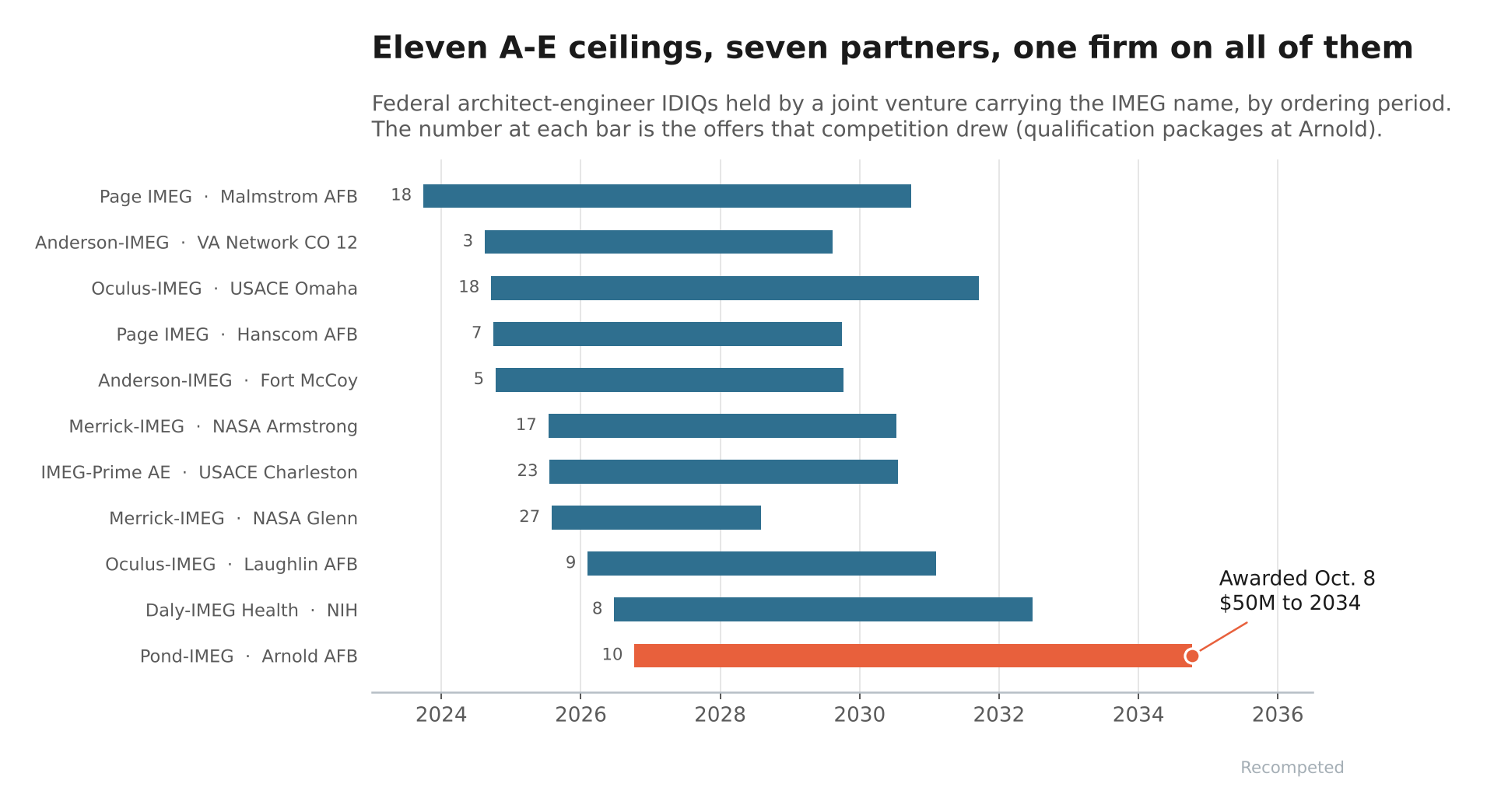
Three Years, Eleven Doors
The first one opened on September 29, 2023, when Page IMEG Joint Venture took the 341st Contracting Squadron's A-E vehicle at Malmstrom out of 18 offers.
Then a year of three in quick succession: the VA's Network Contract Office 12 in August 2024, USACE Omaha in September, Hanscom in September, Fort McCoy in October.
July 2025 is the part that stands out. Three ceilings inside eighteen days, with three different lead partners: Merrick-IMEG at NASA Armstrong on the 14th, IMEG-Prime AE at USACE Charleston on the 21st, Merrick-IMEG again at NASA Glenn on the 31st.
The Charleston one drew 23 offers. Glenn drew 27.
Those are not thin fields. The A-E selections in this set are qualification-based, so the winning package is a record of relevant projects and named key personnel, and on a 27-offer board the firms that lose are usually the ones who could not staff the breadth the synopsis asked for.
Which is the whole reason the second name on the door keeps being the same one.
What the Partner Actually Carries
IMEG describes itself as employee-owned, with 3,000 team members across 100+ locations. The discipline list is the giveaway: civil, structural, mechanical, electrical, plumbing and piping, fire protection, technology, security, acoustics, architectural lighting, medical equipment planning, commissioning, water and wastewater.
That is the entire engineering half of a building, which is exactly the half that a design firm, an architecture studio or a regional civil shop has to subcontract or go find.
So the firm sells it as a partner instead. Each JV pairs a different lead with the same deep bench:
- Page IMEG at two Air Force installations, Malmstrom and Hanscom.
- Oculus-IMEG out of St. Louis, at USACE Omaha and at Laughlin.
- Anderson-IMEG out of Minneapolis, at the VA and at Fort McCoy.
- Merrick-IMEG out of Greenwood Village, Colorado, at two NASA centers.
- Daly-IMEG Health, seated at NIH's A-E construction shop in August off 8 offers.
And IMEG-Prime AE JV LLC, which carries a Rock Island, Illinois address of record, the same town as IMEG's own registrant entity.
Its one obligation so far is $1,000.00, the IDIQ minimum guarantee: a seat on an unrestricted USACE Charleston ceiling that beat 22 other packages, with the money not started yet.
That is normal, and it is the correct way to read a fresh A-E MATOC seat.
Who Gets To Be Small
Here is the piece worth taking into your own teaming discussions.
FPDS codes the joint venture, not the partners behind it. Four of the seven come back as Not Designated a Small Business: Page IMEG, Merrick-IMEG, IMEG-Prime AE, and the mixed record on Daly-IMEG Health.
Two do not. Anderson-IMEG is coded Service Disabled Veteran Owned Business and small, and Oculus-IMEG is coded Joint Venture Women Owned Small Business.
Look at the competition fields on those two and the restriction shows up where you would expect.
The VA, Omaha, Fort McCoy and Laughlin awards all record extent competed D, full and open competition after exclusion of sources. The unrestricted ones record A.
So the same engineering bench shows up inside a 3-offer restricted field at the VA and inside a 27-offer open field at NASA Glenn, and the structure in front of it is what changed.
Final Thoughts
A capture plan usually treats teaming as the step after the pursue decision. The record here runs the other way around.
Seven lead firms, four agencies, eleven ceilings in three years and nine days, and the constant is the partner nobody is competing against because it never shows up as the prime. For a mid-tier design or civil firm staring at an A-E synopsis it cannot staff alone, that is a live option and it is sitting in public data: pull the JV recipient names on the last five A-E MATOCs your district awarded and see whose name is on the back half of three of them.
For everyone else, the check is faster. The next time you lose an A-E selection to a joint venture, look up which of the two firms has been there before.
Thanks for reading.