The Air Force Admitted the Violation and Kept the Award
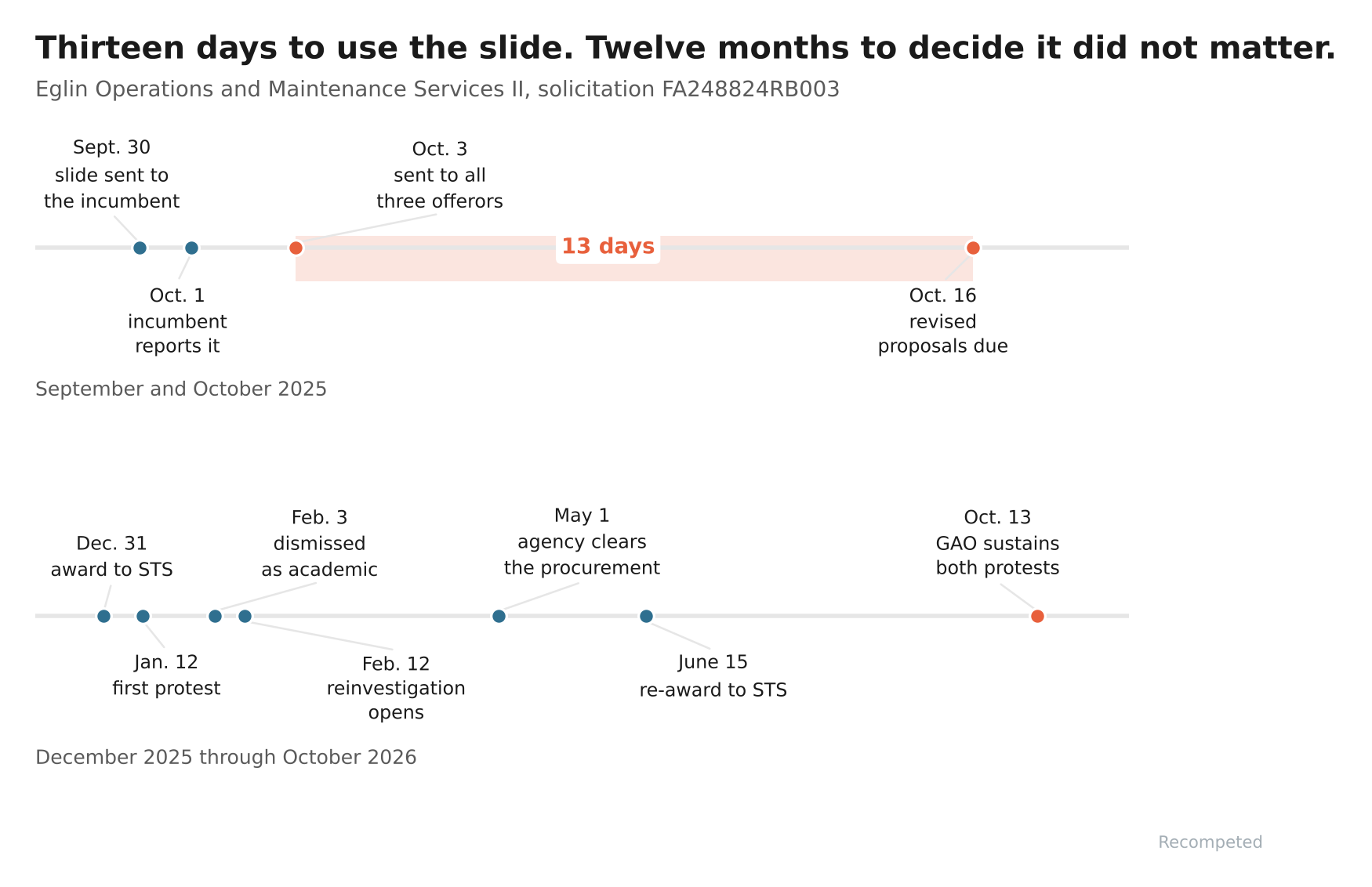
A briefing package sent to the incumbent on EOMS II had an extra slide in it: every offeror's evaluated labor cost, set costs, and the ranking of all three total evaluated prices. Final proposal revisions were due thirteen days later. The head of the contracting activity found a Procurement Integrity Act violation and cleared the procurement anyway, and the Air Force re-awarded to the same company. GAO sustained both protests in part on Oct. 13.
On Sept. 30 of last year the Air Force closed discussions on the Eglin operations and maintenance recompete and asked its three offerors for final proposal revisions. The briefing package that went to one of them had an extra slide in it.
The slide carried, for all three, evaluated labor cost, set costs, and unevaluated fees, overtime and overhead. It also carried the ranking of the three total evaluated prices.
Reliance Test & Technology, the incumbent, is the one who got it. Reliance told the Air Force the next day.
Two days after that the Air Force sent the same slide to everybody, with a line explaining that "the Government is providing the same information to all offerors."
Revised proposals were due thirteen days after that (chart below).
"What is a competition worth once every offeror knows where its price sits?"
The Air Force spent the next eight months answering that question in its own favor.
On Oct. 13 GAO answered it the other way, in two decisions that landed on its public docket this week. Both sustained.
What the slide actually gave away
The ranking is the part that matters. Reliance was low. Strategic Test Solutions, the Huntsville company that would go on to win, was high.
So one offeror learned something the other two could never have told it, which is that it was the most expensive proposal in the room. With the labor and set-cost columns sitting right there, it could also work out roughly by how much.
The Air Force's position was that none of this was competitively useful. GAO noted in both decisions that the agency's own statisticians could reverse engineer cost elements from the slide.

The rest of this brief is for subscribers.
The specific solicitations, dockets, and dates to act on sit past this line.
$50 a month, or $500 a year.
Already a subscriber? Sign in