The 339 Agreements That Never Come Up for Recompete
Friday's board put $241,340,000 of F/A-18 repair work through a Boeing instrument whose ordering period closed thirteen months ago and whose recorded value is zero. One Navy supply command runs 339 of them, carrying 21,576 orders and $10.77 billion. Sixty-five orders on our own expiration pipeline sit under one.
Friday's Navy board carried a $241,340,000 order to Boeing for the repair of nine configurations of flight control surface on the F/A-18E/F and the EA-18G. Work runs to September 2032. One source was solicited, one offer came back.
The instrument it was placed under, N00383-22-G-YY01, stopped accepting orders in August 2025 according to the only public record of it.
"What is there to recompete when the thing carrying the work was never a contract?"
The Agreement Has No Value, No Ceiling and No Competition Record
Pull N00383-22-G-YY01 out of USAspending and the fields a pipeline reads come back empty.
Total obligation $0.00. Base and all options, null. Extent competed, null. Number of offers received, null. Solicitation number, null.
It has been modified 31 times since August 2022, and every one of those modifications carries a federal action obligation of zero dollars. They read like inventory tickets, because that is what they are: "ADD NIIN 016779780 AND NIIN 016417627 TO BOA N0038322GYY01."
The money is entirely in the children. 363 orders, $1,392,039,619.58 obligated, a median order of $22,408.20.
Two hundred sixty-four of them are under $100,000 and account for $5.2 million between them. Five are $100 million or larger and account for $691,966,844, half the total.
The same agreement bought a $503.93 connector body and a $177,092,796 mechanical actuator.
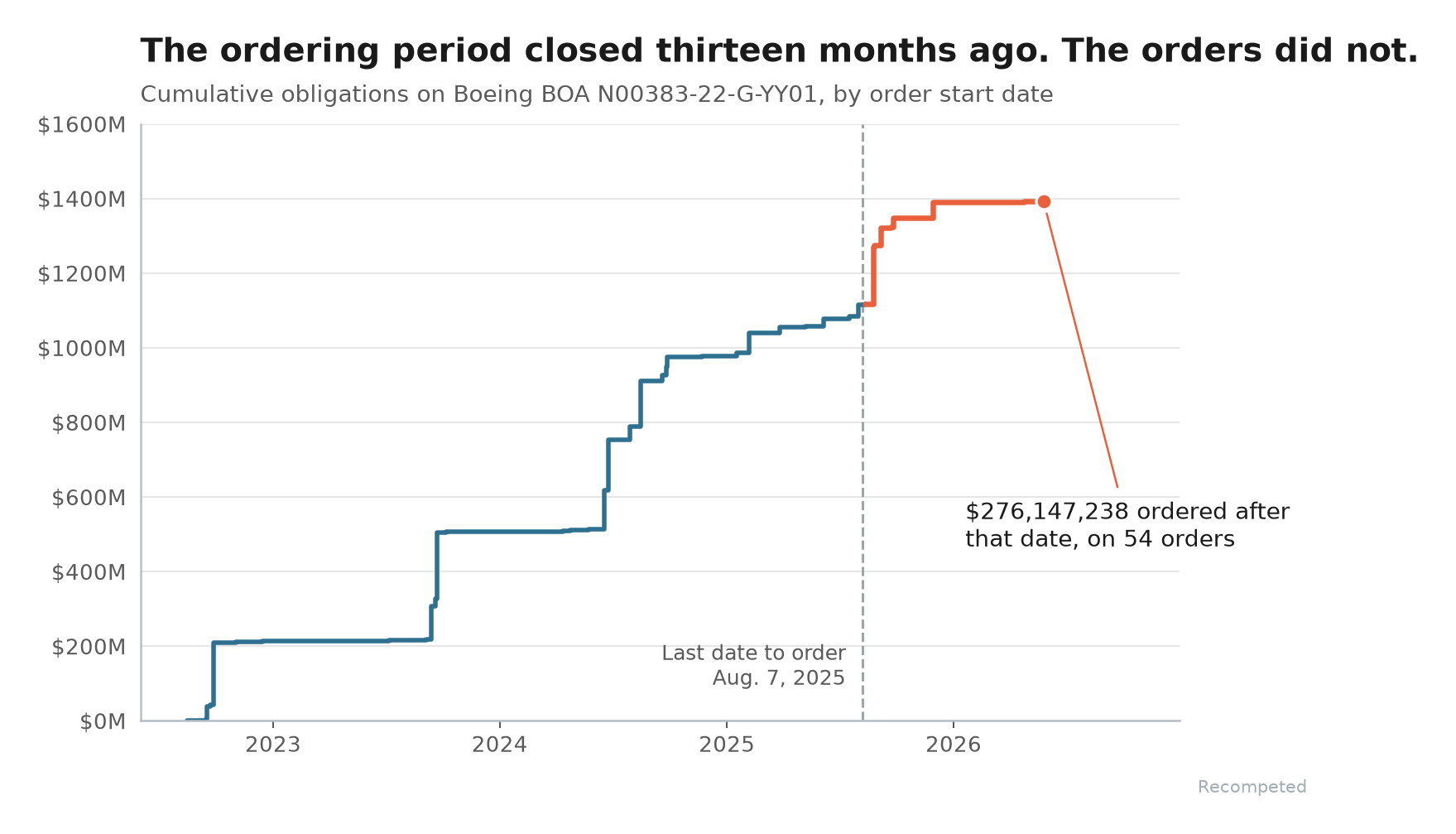
And its stated ordering period ended on August 7, 2025. Since that date, 54 more orders worth $276,147,238 have been placed against it (chart below), which is before you count Friday's $241,340,000, an order that would be 36% larger than any in the agreement's history.
To be fair, a record can lag a modification that extended the ordering period. That is exactly the point for anyone screening on dates: the field is there, it is populated, and it is not a date that stops anything.
Not a Contract, and That Is the Design
FAR 16.703(a) is unambiguous about what this thing is. A basic ordering agreement contains terms and clauses that will apply to future orders, a description of the supplies or services, and methods for pricing and issuing them. Then the sentence that does all the work: "A basic ordering agreement is not a contract."
So the competition question never attaches to the agreement. It attaches to each order, five steps at a time:
- The contracting officer obtains competition in accordance with part 6 before issuing the order (16.703(d)(1)(i)).
- Any justification or approval gets signed "as if the order were a contract awarded independently of a basic ordering agreement" (16.703(d)(1)(iii)).
- The order cites its 6.302 exception (16.703(d)(2)(iii)).
- The order becomes a binding contract at whatever point the agreement says it does (16.703(c)(1)(iv)).
- If price has not been settled, the order may still authorize work, provided it establishes a ceiling price limiting the government's obligation and the agreement has procedures for pricing early in performance (16.703(d)(3)).
Step five is the line Friday's award was written to. Boeing has a $241,340,000 ceiling, $60,335,000 (25%) obligated at award and $181,005,000 committed behind it, and no agreed price.
Under 16.703(c)(1)(v), failing to agree on that price later is a dispute under the Disputes clause. Nobody walks away.

The rest of this brief is for subscribers.
The specific solicitations, dockets, and dates to act on sit past this line.
$50 a month, or $500 a year.
Already a subscriber? Sign in