The Commercial Preference Stops Before Your Recompete
FAR 12.101 tells agencies to buy commercial whenever commercial will do the job. Of the 1,170 DoD contracts coming off period of performance in the next two years, 131 were. We mapped where those 131 sit, and which named services programs are already coded for a part 15 recompete.
FAR 12.101 is three lines long and it reads like an order.
Conduct market research. Acquire commercial products and commercial services when they are available to meet the need, and make your primes and their subs do the same, to the maximum extent practicable.
So we ran it against the board.
Of the 1,170 DoD contracts coming off period of performance between March 2027 and August 2028, 131 were awarded under part 12 procedures. That is 11.2% of the count and 4.3% of the $426.8B obligated across them.
The other 1,039 carry the FPDS code that reads, in full, "commercial products/services procedures not used."
"Where does the commercial preference actually reach?"
Two corners of the board, and then nothing
It reaches launch and it reaches bandwidth (chart below).
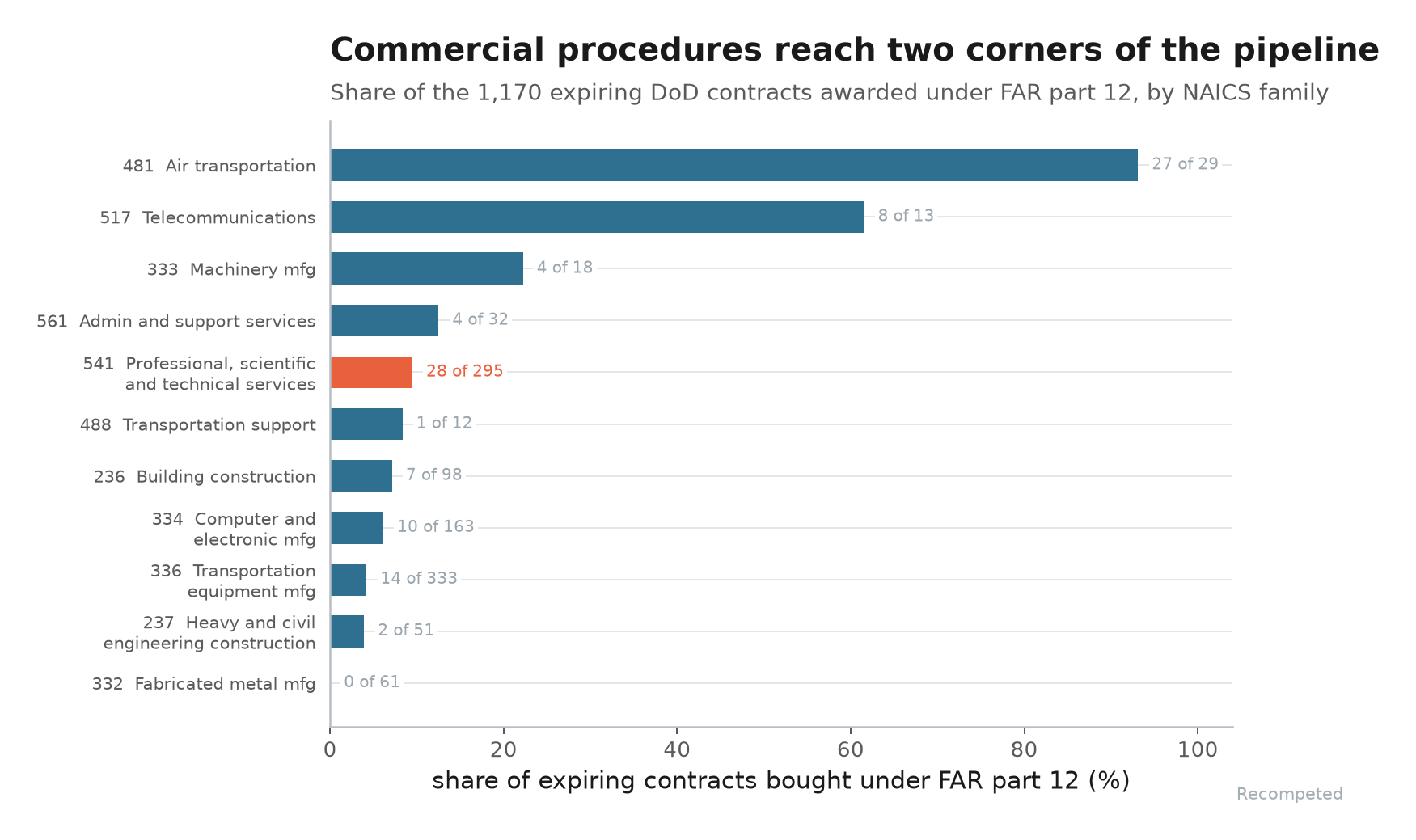
Air transportation, NAICS 481, is 27 of 29 contracts, essentially the National Security Space Launch Phase 3 Lane 1 order book at SpaceX, United Launch Services and Blue Origin. Telecommunications, the 517 family, is 8 of 13, split between SpaceX Starshield service orders and the DISA cellular awards at AT&T, Verizon and T-Mobile.
Machinery manufacturing is 4 of 18 and admin and support services is 4 of 32.
Fabricated metal manufacturing is 0 of 61.
Inside 541 the average is doing a lot of work
Professional, scientific and technical services is the desk's core family and the aggregate number there is 28 of 295, or 9.5%. The aggregate hides the actual finding.
Split it at the four-digit level and the same reader sees four different markets:
- 541512 and the rest of 5415, computer systems design: 15 of 37 commercial, 40.5%.
- 5416, management and technical consulting: 3 of 13.
- 5417, research and development services: 6 of 115, 5.2%.
- 5413, engineering and architectural services: 2 of 114, 1.8%.
If you sell systems integration, two of every five contracts around you are bought as a commercial service. If you sell engineering support, two of 114 are.
Worth saying plainly: 541330 also collects a fair amount of production and development work that never looked like a service, which pulls that 1.8% down a little.
What the code actually buys
The determination is not a label. It sets the terms of the buy that follows:
- Contract type is capped. FAR 12.207(a) puts commercial buys on firm-fixed-price or FFP with economic price adjustment. Time-and-materials or labor-hour is available under 12.207(b), and only with competitive procedures, a written D&F that no other type is suitable, and a ceiling the contractor exceeds at its own risk.
- No certified cost or pricing data. FAR 15.403-1(b)(3) bars the contracting officer from requiring it when a commercial product or service is being acquired. The government can still ask for data other than certified.
- CAS falls away on the fixed-price side, per 12.214.
That third item is where the money is. Across the 310 expiring services contracts that were not bought commercially, 99 of them, 31.9%, already show certified cost or pricing data obtained on the current award.
That is the cost volume, the disclosure statement, and the defective-pricing exposure your recompete inherits by default.

The rest of this brief is for subscribers.
The specific solicitations, dockets, and dates to act on sit past this line.
$50 a month, or $500 a year.
Already a subscriber? Sign in