 Recompeted
One in Four Sole-Source Justifications Beats the Award
We pulled every justification DoD posted to SAM.gov in FY2026 and measured the gap between the award date each one cites and the day it went public. The median is four days, 637 were public before the contract was signed, and the long tail is not what it looks like.
"How old is the decision by the time the justification shows up?"
Every capture shop runs some version of this check. A justification lands on SAM, you read who got the work and under which authority, and you decide whether there is anything left to do about it.
The honest answer has always been a shrug. So we measured it.
We pulled every justification notice DoD published in fiscal 2026, 2,780 of them, and went one call deeper on each to get the structured award block: the PIID being justified, the authority, and the date of the award. After dropping the brand-name notices (FAR 6.305(c) puts those on the solicitation, not on a post-award clock) and the FAR 13 simplified-acquisition justifications, the population is 2,416 DoD FAR 6.302 justifications.
Most of Them Are Not Archaeology
The median gap between the award date a justification cites and the day it posts is four days (chart below).
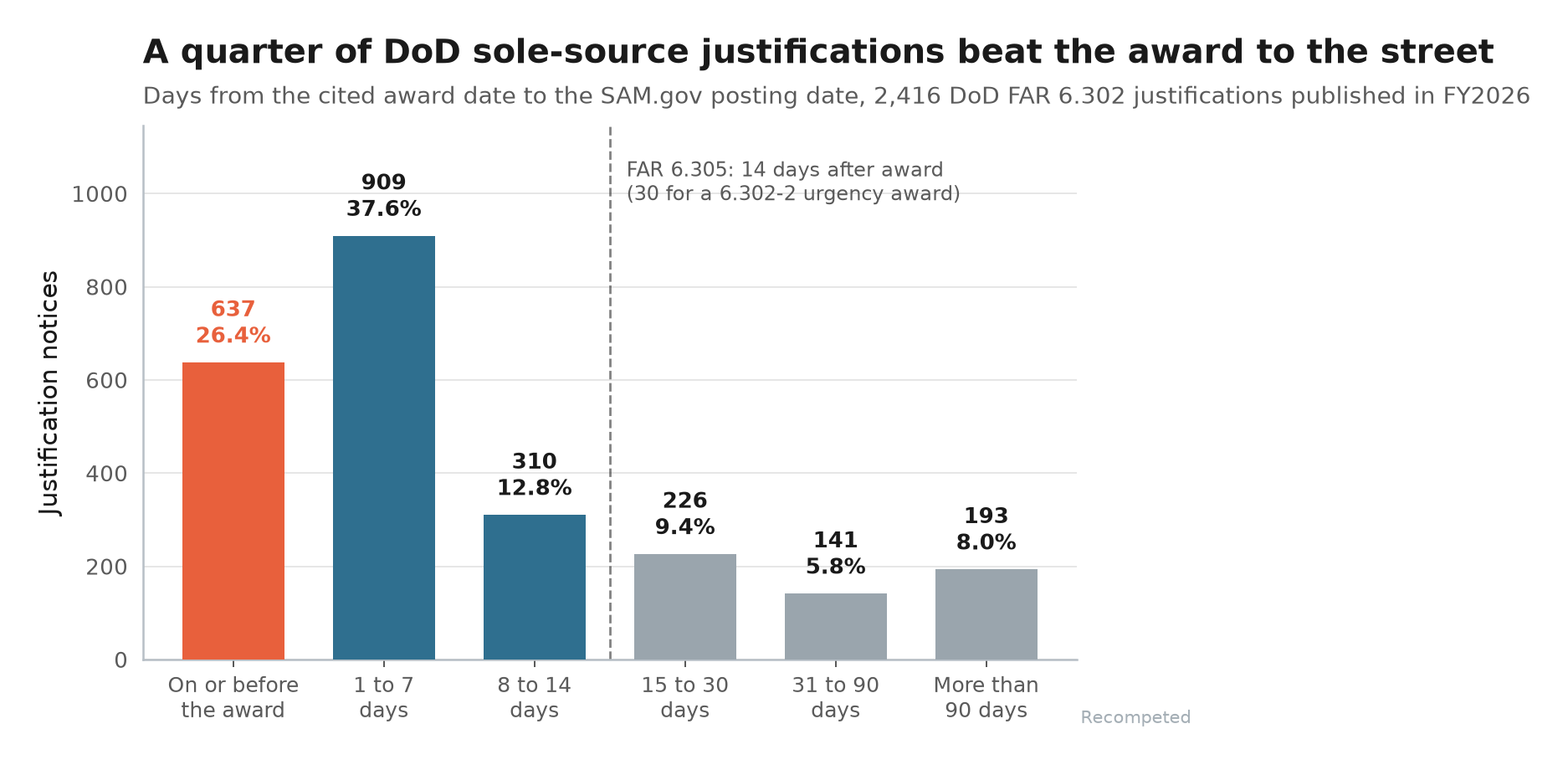
637 notices, 26.4%, were public on or before the day the contract was signed. Another 909 landed inside a week. All in, 1,856 of 2,416 cleared the FAR 6.305 fourteen-day window.
That first bar is the one worth staring at. A justification you can read before award is a justification you can still answer, which is the whole premise behind the notice-of-intent pattern the services use when they want industry to talk them out of something. It showed up live on Friday, when Army Contracting Command posted a sole-source intent on the OMDAC support contract twenty-nine days before the incumbent's period ends.
The component split says who runs that way and who does not:
- Defense Logistics Agency, 1,136 notices and 37.2% of them public on or before award. DLA dominates the denominator and sets the DoD-wide median almost by itself.
- Air Force 22.6%, Navy 18.0%, Army 14.2%.
Where the Field Stops Being a Clock
Here's the catch, and it is the reason nobody has published this number before.
The award.date on a justification notice is the date of the award carrying the PIID in award.number.
When the justification covers a modification or an extension, that PIID is the base contract. The date then predates the thing being justified by the entire life of the contract.
Five NAVFAC Mid-Atlantic justifications posted on the same February morning this year, all citing an award date of February 12, 2020. Read the body of any one of them and it says plainly that the purpose is to extend the period of performance on a waterfront facilities inspection A-E contract.
The decision was weeks old. The field says six years.
Of the 193 notices sitting past ninety days, 83 carry a populated modification number outright and 94 carry either that or extension language in their own title. So we are not calling that bar lateness, and neither should your tracker.
The 281 That Actually Ran Late
Inside ninety days the field behaves, because a contract awarded eleven weeks ago is a recent award however the agency codes it. In that band, 281 notices, 11.6% of the population, posted past their own FAR 6.305 limit.
Army runs the highest rate at 19.9%, then Navy at 17.1%, Air Force at 14.7%, DLA at 5.9%. Two Army examples with nothing ambiguous about them: the AI Platform justification on W15QKN25F0477, an urgency award with a thirty-day allowance, posted 71 days out; and custodial services at Springfield under W911SA26PA027, 62 days.
Services buys are the slower half of the file. Across the 409 justifications in NAICS 541, 561, 518 and 517, the median gap is eight days against four for the population, and 65 landed in the late band.
Final Thoughts
None of this makes the justification feed a bad habit. Three quarters of it arrives inside two weeks and a quarter of it arrives early enough to argue with, which is better than the industry folklore says.
What it does change is what you do with the date printed on the notice. Treat anything inside ninety days as real and anything beyond it as a pointer to a base contract you now have to go look up, because the agency has told you which PIID is being extended without telling you when. For the roughly one notice in nine that genuinely ran late, the award was signed, the money moved, and the median first look came 31 days after the award.
Thanks for reading.