 Recompeted
One Bid Is Still a Competition
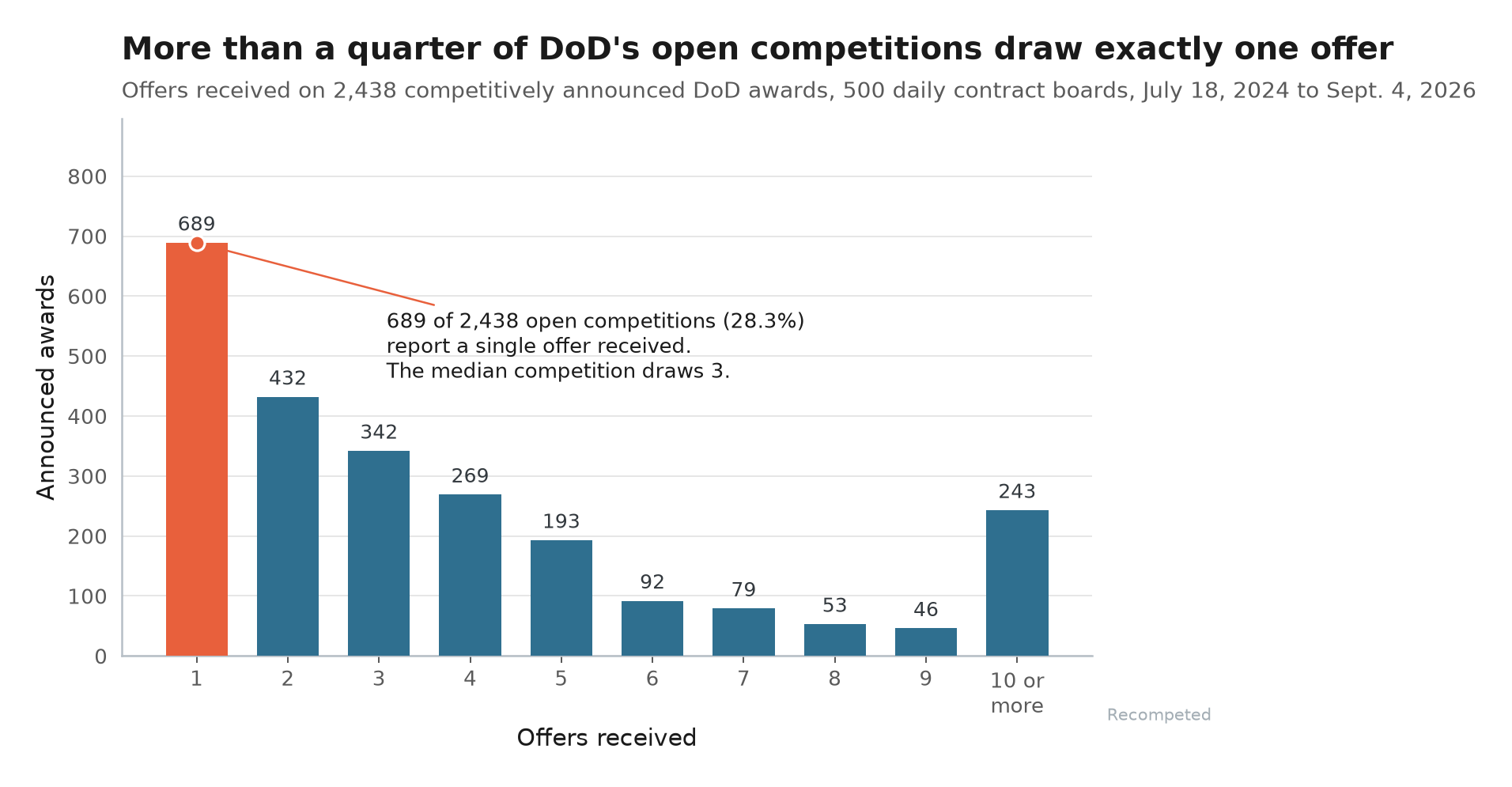
We read the offer count out of every award paragraph on 500 Pentagon contract boards. Of the 2,438 announcements that say the requirement was solicited, 689 came back with a single offer. The sole-source awards are counted separately, and they are not what is driving the number.
"Bids were solicited via the internet with one received."
That sentence, word for word, appears 425 times on the Pentagon's daily contract board. No other statement about how a requirement was competed appears as often. The same sentence ending in "two received" runs 172.
We pulled all 500 daily announcements the war.gov feed carries, July 18, 2024 through Sept. 4, 2026, and read the offer count out of every award paragraph that states one. 2,697 of them do.
Take out the paragraphs that say sole source and 2,438 are left in which DoD says the requirement actually went out the door. 689 of those, 28.3%, report a single offer received (chart below).
The median open competition on the board draws three.
The Control
The obvious objection is that we are just re-counting sole-source awards, where one offer is the design rather than the outcome. So we classified them separately.
The board flags them clearly enough to sort: "one company was solicited for this sole-source requirement", "non-competitive", FAR 6.302-1, 10 U.S. Code 2304(c)(1).
That bucket holds 188 announcements, and 98.4% of it reports exactly one offer. Median 1, mean 1.06.
Which is what a control is supposed to do. It confirms the sort works, and it confirms the 689 are a different animal: requirements that went out, got advertised, and drew one response anyway.
Where the Thin Ones Actually Are
Not where you would guess. Sorted by the announcing service, the spread is wide:
- Army: 36.5% one-offer across 1,220 open competitions, median 2. Comfortably the thinnest.
- Defense Logistics Agency: 20.4% across 269, median 3.
- Air Force: 19.5% across 384, median 4, and 20.6% of its competitions draw ten or more.
- Navy: 19.2% across 515, median 3.
The dollar cut runs against intuition too. Competitions above $1B are the least likely to come back with one bid, at 19.0%, with a median of seven offers and 47.6% drawing double digits. The thinnest band is the one just underneath: $250M to $1B, where 31.0% of competitions draw a single offer.
Big enough to fund a bid-and-proposal budget, small enough that nobody bothers.
What a Single Offer Is Hiding
The exception at the top of the range is worth naming, because it is where the board's language stops distinguishing things that are not alike.
Four of the largest one-offer competitions in the corpus are all Army Contracting Command, all carrying the identical sentence:
- Palantir USG, W519TC-25-D-0039, $10,000,000,000, described on its own board line as "transitioning existing contracts in which Palantir is currently a prime or subcontractor to this enterprise agreement."
- Computable Insights, W519TC-26-D-A009, $5,644,302,996, a decentralized enterprise agreement for Salesforce products.
- Lockheed Martin, W31P4Q-26-D-0016, $2,998,742,163, Sentinel A4 radar production.
- Boeing, W58RGZ-26-D-0013, $2,728,234,918, Apache post-production support.
Two of those are consolidations of work that already exists. Two are production follow-ons on platforms with one manufacturer. All four are reported to you in the same nine words as a genuinely open services recompete that happened to draw one bidder.
That is the practical problem with the field. The board's competition sentence tells you a solicitation was issued, and nothing about whether anyone was ever going to answer it.
Final Thoughts
The useful number here is not the 28.3% on its own. It is what that figure does to your priors in both directions.
Hold an incumbency on an open recompete and draw no challenger, and you have not gotten lucky. You have landed on the most common single outcome on the board.
Work the other side of it and the arithmetic is friendlier than the reputation of the band suggests. In the $250M to $1B range, 31.0% of competitions close with one offer and 46.0% close with two or fewer, which means a serious bid walks into a field of one other name or none about half the time.
Somebody is winning those. On this record, more often than the industry talks about, it is whoever bothered to answer.
Thanks for reading.