 Recompeted
Eleven Years of Seats, Then a Contract of Their Own
Aerospace Training Systems Partners has held a seat on the Air Force's training-systems vehicle since 2015, next to Boeing, Lockheed and CAE. On Tuesday the Navy handed the Oklahoma joint venture $10,096,092 to upgrade the P-8A flight trainer's projection system, on a small-business set-aside that drew four offers.
On June 27, 2023, the Air Force issued thirty-seven task orders in one day, every one of them obligated at exactly $1,000, every one of them described as a post-award conference.
That is what a seat on Training Systems Acquisition IV pays on the day it opens.
Boeing got one. So did Lockheed Martin, Northrop Grumman, CAE USA, CACI and Booz Allen. So did a joint venture registered in Oklahoma called Aerospace Training Systems Partners.
Tuesday's Pentagon board is where that last name turns up again, and the figure beside it has four more digits.
What the Navy Bought
"Aerospace Training Systems Partners JV LLP,* Norman, Oklahoma, is awarded a $10,096,092 firm-fixed-price contract (N6134026C1017) for the design, fabrication, installation, integration, testing, and delivery of P-8A Operational Flight Trainer projection system upgrades for the Navy and Royal Australian Air Force."
Three performance sites, split on the board: Jacksonville, Florida at 50%, Oak Harbor, Washington at 40%, and RAAF Base Edinburgh, Australia at 10%. Completion is November 2028. Naval Air Warfare Center Training Systems Division in Orlando is the contracting activity, and the asterisk is the board's own small-business marker.
The funding line rewards a second read. Fiscal 2026 aircraft procurement (Navy) money covers $8,202,118, Royal Australian Air Force cooperative funds cover $1,893,974, and those two add to $10,096,092 exactly. The whole contract is obligated at award, and 18.8% of it is Australian.
The award was a small-business set-aside with four offers received.
Eleven Years, Two Vehicles
Aerospace Training Systems Partners has been a qualified Air Force training-systems prime since 2015.
That September it took a seat on Training Systems Acquisition III (FA8621-15-D-6253), the multiple-award IDIQ run out of AFLCMC's simulators shop: full and open, no set-aside, 41 offers, a $20.9 billion potential ceiling, ordering through August 2025.
In June 2023 the JV did it again on TSA IV (FA8621-23-D-B004), off solicitation FA8621-21-R-0030. That competition drew 37 offers and produced 37 seats, numbered DB003 through DB039, with a $32.5 billion ceiling and an ordering period running to May 31, 2033. The holder list reads like the industry's whole training bench, Boeing and Lockheed and Northrop and CAE and SAIC and GDIT and HII and FlightSafety and Rockwell Collins among them.
Clearing two full-and-open source selections ten years apart, against fields of 41 and 37, is a genuine credential.
Here is what that credential had booked in prime dollars before this week. $2,000. The 2015 seat opened with a $1,000 task order that ran to January 2017, the 2023 seat opened with the $1,000 post-award conference order, and nothing else in the federal record carries this joint venture's UEI (chart below).
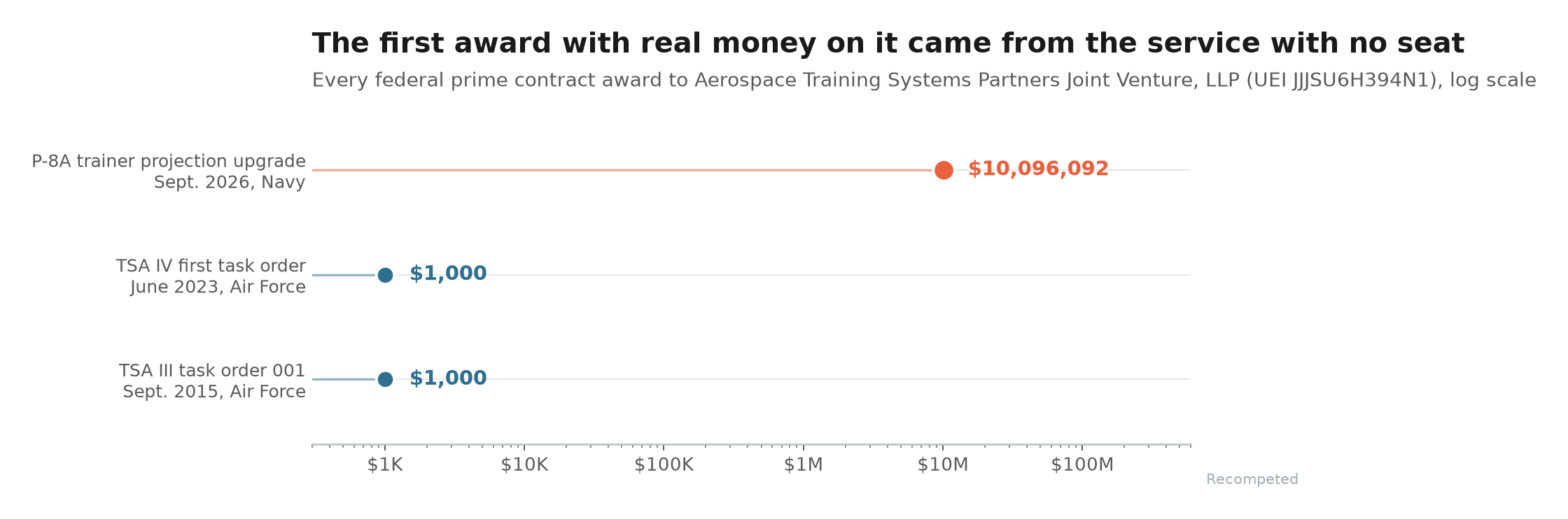
The first eight-figure award of the JV's life came from a service that never seated it on anything.
The Competition They Actually Won
NAWCTSD ran this one the long way, in public, with dates on every step (chart below):
- January 13, sources sought for a P-8A Operational Flight Trainer projection system upgrade, responses due February 3, place of performance listed as "US and Australia".
- May 7, a presolicitation and an industry day notice on the same afternoon, both already flagged as an SBA set-aside, both naming the three sites.
- May 14, the solicitation itself, N61340-26-R-1010, NAICS 333310, PSC 6910, proposals due 1pm Eastern on June 15.
- September 8, the award on the board.
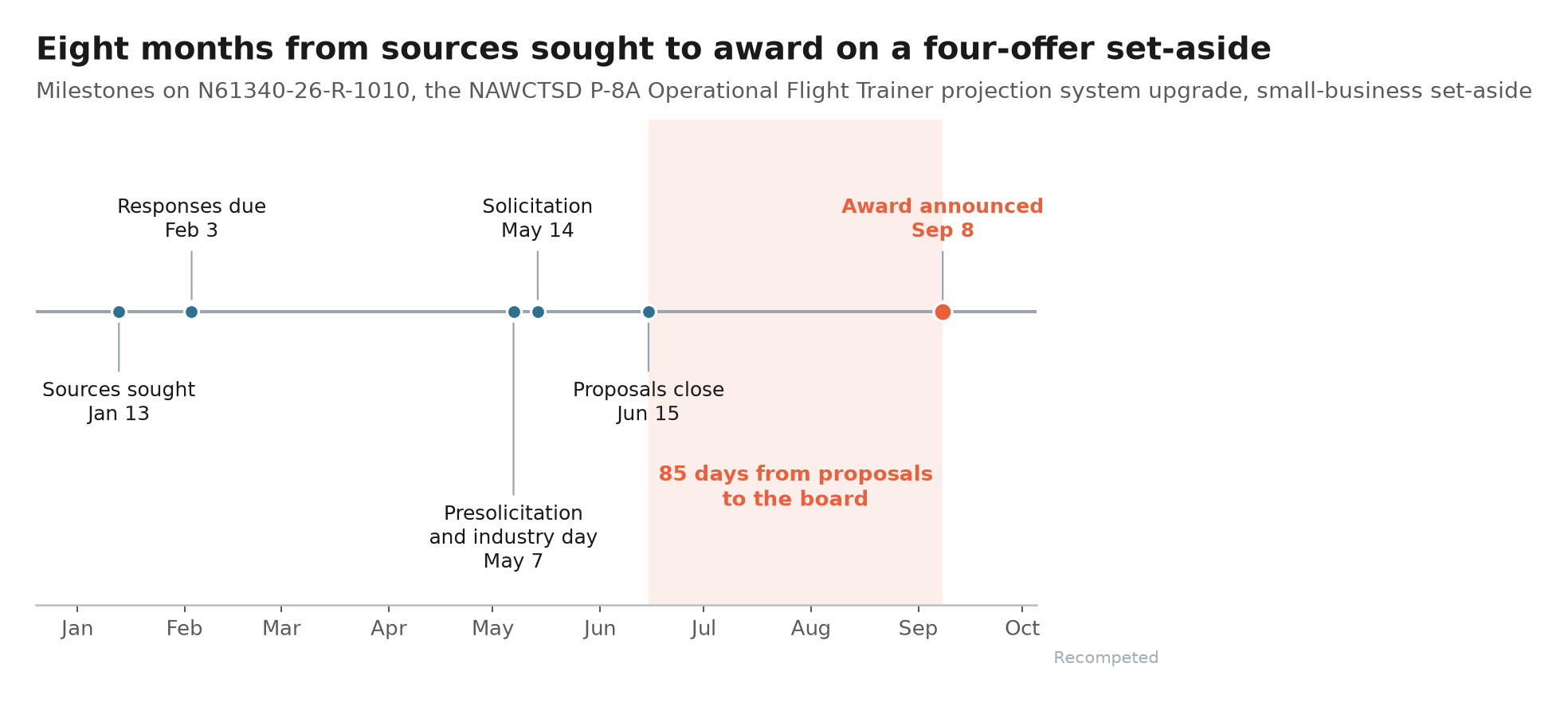
That is 238 days end to end, and 85 days from the close of proposals to the announcement, on a requirement with a foreign partner attached and hardware to install at two naval air stations.
Now, the part that should interest anyone holding a quiet seat somewhere. This was a standalone contract on its own solicitation, restricted to small business, and fair opportunity had nothing to do with it.
The 32 days between the solicitation going up and proposals closing were open to any small business that could build a projection system and price it, seat or no seat.
Final Thoughts
A seat on a multiple-award vehicle is a qualification, and a qualification holds its value whether or not the orders show up behind it. Aerospace Training Systems Partners has spent eleven years holding one alongside the biggest names in military simulation, and the thing that finally moved eight figures was a set-aside RFP from a different service, answered on its own terms.
If your own pipeline has seats on it where the order flow never arrived, that is the useful read. The vehicle gets you qualified and keeps your name in front of a program office. The work still comes from whoever writes the next standalone solicitation, and that one was sitting on SAM.gov, sources sought and all, eight months before the board printed the winner.
Thanks for reading.