 Recompeted
How One Amendment Turns One in Nine Into Two in Five
Every SAM notice carries an amendment count and nobody prices it. We timed 11,687 DoD solicitations and found the whole signal sits at the first amendment: unamended, the live version lands inside the last week 11% of the time, and one amendment takes that to 41%.
Every notice on SAM carries an amendment count, sitting right there in the record, free. Nobody prices it.
So we pulled every Department of Defense solicitation and combined synopsis whose current version posted between September 5 and this morning, 11,687 of them, and timed one thing.
"Is the document on your screen going to still be the live one when offers are due?"
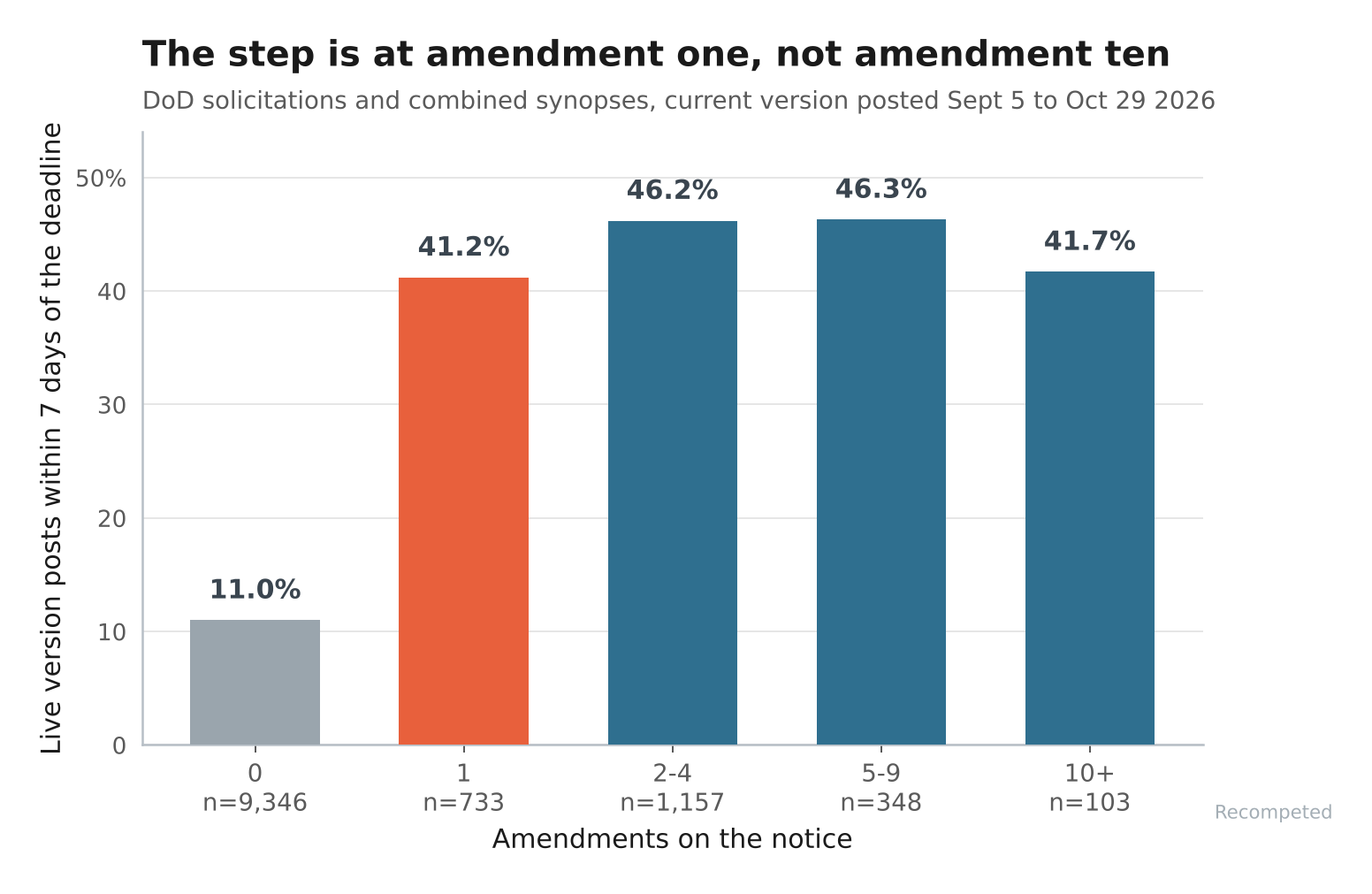
That question has a public answer, and it turns almost entirely on the first amendment (chart below).
One in Nine Becomes Two in Five
On a DoD solicitation nobody has amended, the live version posts within a week of the deadline 11.0% of the time. That is 9,346 notices, and in roughly one in nine you are reading final terms inside the last seven days.
Amend it once and the share goes to 41.2%.
Then it stops moving. Two to four amendments reads 46.2%, five to nine reads 46.3%, ten or more reads 41.7%.
So the field behaves like a switch rather than a dial.
A notice sitting at zero is one you can build a schedule against. The moment it takes its first amendment your assumption about stable drafting time is wrong by close to four times, and its ninth tells you almost nothing its first did not.
Worth knowing what the count means before you lean on it: 40 amendments means 41 versions on the chain, original included. ACC-APG's Marketplace for Acquisition of Professional Services (W15P7T-26-R-A006, NAICS 541330) is carrying exactly that, with proposals due November 12.
The Column That Looks Worse Than It Is
A second number in the same pull climbs the whole way: the share of notices whose current version posted after the deadline had already gone by.
- Never amended: 0.2%
- One amendment: 1.8%
- Two to four: 5.5%
- Five to nine: 10.1%
- Ten or more: 11.7%
Monotone across all five bands. The sharpest case in the cohort is an Army IFB, W912HN26BA017, CMC Greenspace at USACE: twenty-two amendments, the last of them posted five hours and fifty minutes after bids were due.
Now, the catch. A version posted after the deadline is not automatically a change to the terms, and the search index carries no diff, so an award link and a rewritten PWS look the same from outside.
Some of that climb is housekeeping. Read 11.7% as a ceiling.
The seven-day column has no such problem. When the live version posts inside the window, it is live while you are still writing.
Four Buyers, Four Different Habits
The aggregate hides more than it shows, because DLA is 69.0% of the cohort and DLA barely amends anything.
- DLA: 8,063 notices, 3.3% amended, median 10.6 days on the live version
- Navy: 2,193 notices, 48.7% amended, median 28.0 days
- Army: 867 notices, 67.8% amended, median 7.1 days
- Air Force: 464 notices, 76.1% amended, median 5.1 days
The Air Force amends three quarters of what it posts and leaves a median of five days on the final version. 65.5% of its solicitations put the live document inside the last week, against 10.7% at DLA.
Same department, same database, same field.
Some of that is composition rather than culture: DLA's board is NSN parts that post once and close, and the Air Force's is services and systems work that negotiates in public. It still prices your calendar, and it prices it by buyer.
The services end of the board is where it bites hardest. NAVFAC's N6247826R2436 and N6247826R2433, both facility support work under NAICS 561210, sit at 14 and 13 amendments, and the live version of each posted weeks after its stated deadline.
Final Thoughts
None of this tells you what changed. The count is blind to severity, a corrected attachment and a restructured evaluation scheme increment it the same way, and the honest version of this finding is a probability rather than a diagnosis.
What it does do is price a risk you are already carrying for free. Two notices on your board, same agency, same close date, one at zero amendments and one at four: those are not the same bid, and the record told you so before you staffed either of them.
Thanks for reading.