 Recompeted
Who Took the Fifth Seat at Eglin?
Four companies won seats on the 96th Test Wing's range-target powertrain recompete on Monday, and all four already held the work. The fifth notice posted this morning, and it names a New Jersey obsolescence shop with no contract action in that NAICS in eighteen years of trying everything else.
If you count multiple-award seats off SAM award notices, Eglin spent this week demonstrating why the number you write down on Monday is provisional.
Four notices went up Monday afternoon on the 96th Test Wing's Powertrain MAC IDIQ recompete (FA248626RB004), each naming a different company, each carrying the identical ceiling allocation of $4,706,351.30. We covered those Monday and counted the field at four.
A fifth posted this morning at 9:15 Eastern. Same solicitation, same award date of October 13, same $4,706,351.30, contract number FA248627DB005.
The name on it is Parts Life, Inc. of Moorestown, New Jersey, and it is the only one of the five that was not already on the vehicle.
Eight Offers, Six Seats, and None of Them Were This One
The expiring vehicle went out in 2021 as a total small-business set-aside, drew 8 offers, and seated six companies on 2021-10-13: Blane International, Culmen International, ISO Group, MTP Drivetrain, UltraCell and Victory Procurement.
Parts Life is on none of those six contracts. The company's entire federal record says it has never been anywhere near this requirement.
We pulled every FPDS action filed under its UEI, paged to exhaustion: 936 actions across 336 distinct PIIDs, running from August 2008 to July of this year.
Zero of them carry NAICS 336992. Zero of them were written by either of Eglin's two contracting offices.
So a company with eighteen years of DoD work and no history at all in tank and tank-component manufacturing just took a seat on a tank-component vehicle, in a field where everyone else was renewing.
Obsolescence Solved
The company's own site leads with that phrase, and the capability under it explains the fit better than the NAICS code does.
Parts Life sells reverse engineering: scanning and material analysis to "create manufacturable technical data packages" where the original data is gone, then building the part. The bundled version is marketed as the 5R Solution, remanufacture, repair, recertify, replicate and reverse engineer, under an AS9100D quality system.
Now read what Eglin actually asked for. The solicitation says the work is powertrain and component repair parts "(both foreign and domestic parts)" for the 96 RANSS/RNRT target assets, and repeats it: "Powertrain and parts will be for foreign and domestic target assets."
The Air Force shoots at foreign vehicles to test weapons against them. Keeping those vehicles running means sourcing drivetrain parts for hardware whose manufacturer is unreachable, uninterested, or gone.
That is a reverse-engineering problem wearing a manufacturing NAICS, and a company whose entire product is parts nobody makes anymore reads that requirement as a layup.
The Book Behind the Bid
Eglin did not take a flyer on a small shop. It took one on a shop that has quietly become a much bigger small shop.
Parts Life has $97,115,499.21 of prime obligations on USAspending since FY2008, every dollar of it Department of Defense. The shape of that total is what matters (chart below).
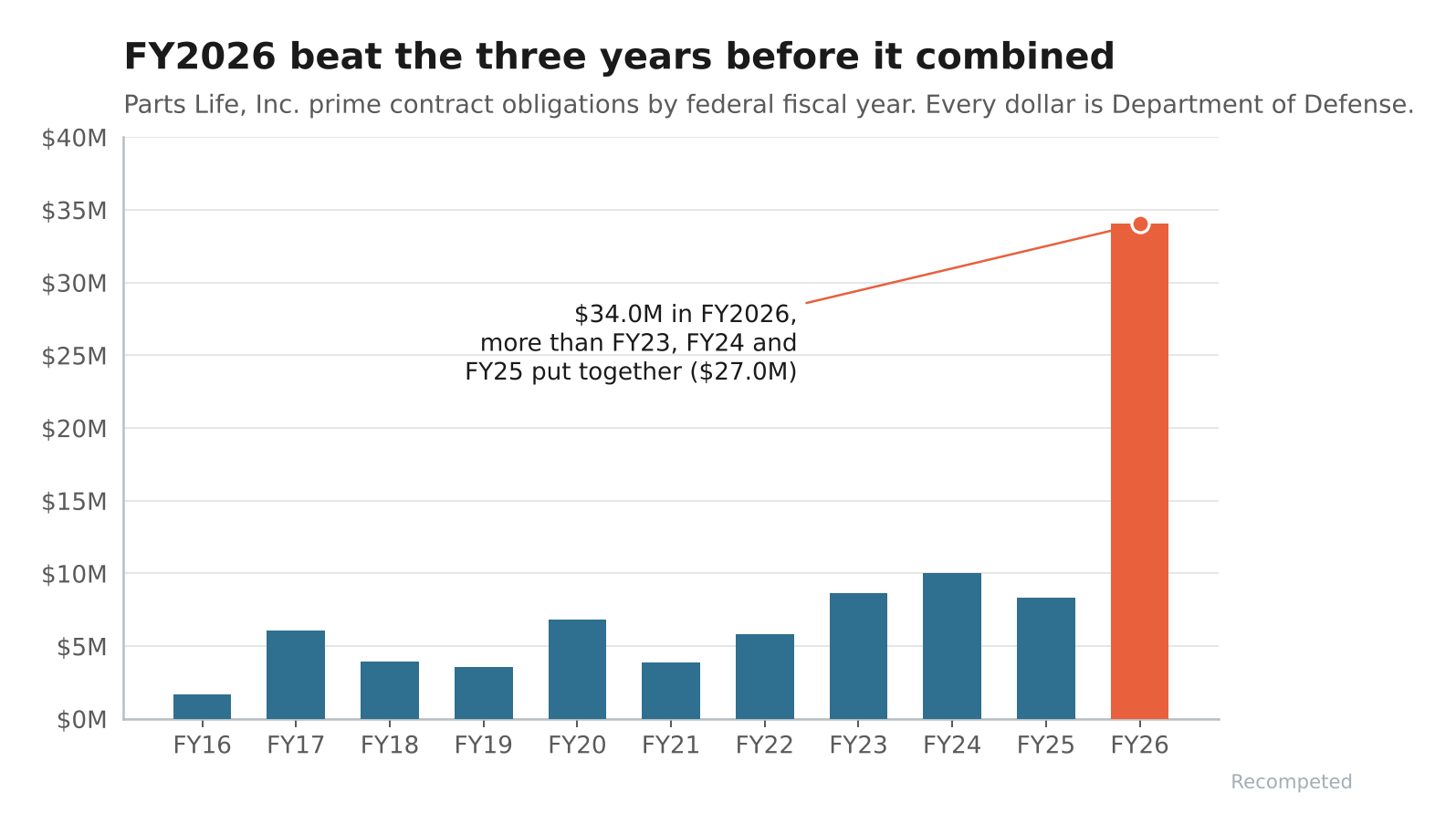
FY2026 closed at $34,033,218.61, which is 4.07x FY2025 and more than FY2023, FY2024 and FY2025 put together.
$29,442,972.14 of that single year came from the Defense Logistics Agency, and the instruments behind it are SBIR Phase III awards: SP470126C0014 at $6,748,846.00 last December, and a $10,886,291.00 modification to SP470125C0082 in February for a fixture stand kit carrying the company's own part number.
Well, that is the whole arc of a Phase III done properly. DLA funded the research, the research produced parts the agency could not otherwise buy, and the sole-source Phase III authority let it keep buying them at scale.
What it also produced is past performance: an AS9100D manufacturer with a $97 million DoD record and a demonstrated habit of delivering hardware for systems the industrial base walked away from.
A Seat Is a License to Bid
The seat itself is worth being precise about, since the number on the notice flatters it.
That $4,706,351.30 is a ceiling allocation on a multiple-award vehicle, and nobody has been promised it. Every delivery order underneath gets competed among the seat holders on lowest price technically acceptable, per line item, and the ordering procedures allow on-ramping and off-ramping mid-term.
So what Parts Life won is standing. Five years of base period and a five-year option, during which it gets to bid work it previously had no door into.
For a company sized against a 1,500-employee small-business standard under 336992, with room to grow for years before that ceiling matters, a decade of at-bats in a new portfolio is a better prize than the ceiling number.
Final Thoughts
Most of what crosses this desk is incumbency defending itself, and Monday's four notices were a clean example of that: same work, same names, next decade.
The fifth notice is the other thing, and it is rarer. A company with no record in the code, no history at the office, and nothing to lean on except a capability that happened to match an unusual requirement, read a 100% small-business set-aside and won a seat on it.
That is what a set-aside is supposed to do, and the record says it worked here.
Thanks for reading.