 Recompeted
How Much of Your FY28 Pipeline Hasn't Shown Up Yet?
We matched our expiring-contract board against its own two-month-old snapshot, contract by contract. The quarter nine months out picked up 121 contracts it didn't have in August. The quarter eighteen months out picked up 16.
Our board says 327 DoD prime contracts over $50M come off period of performance between April and June of 2027.
Two months ago it said 234.
Nothing was announced to close that gap. We refreshed the ledger this morning, pulled the committed snapshot from August 5, and matched the two lists contract by contract on PIID.
Of the 327 rows sitting in that quarter today, 206 were already sitting in it in August. The other 121 arrived in the interval.
So the near end of the expiring board is still being written. The far end is quiet, and that turns out to be the whole finding (chart below).
What Two Months Does to a Quarter
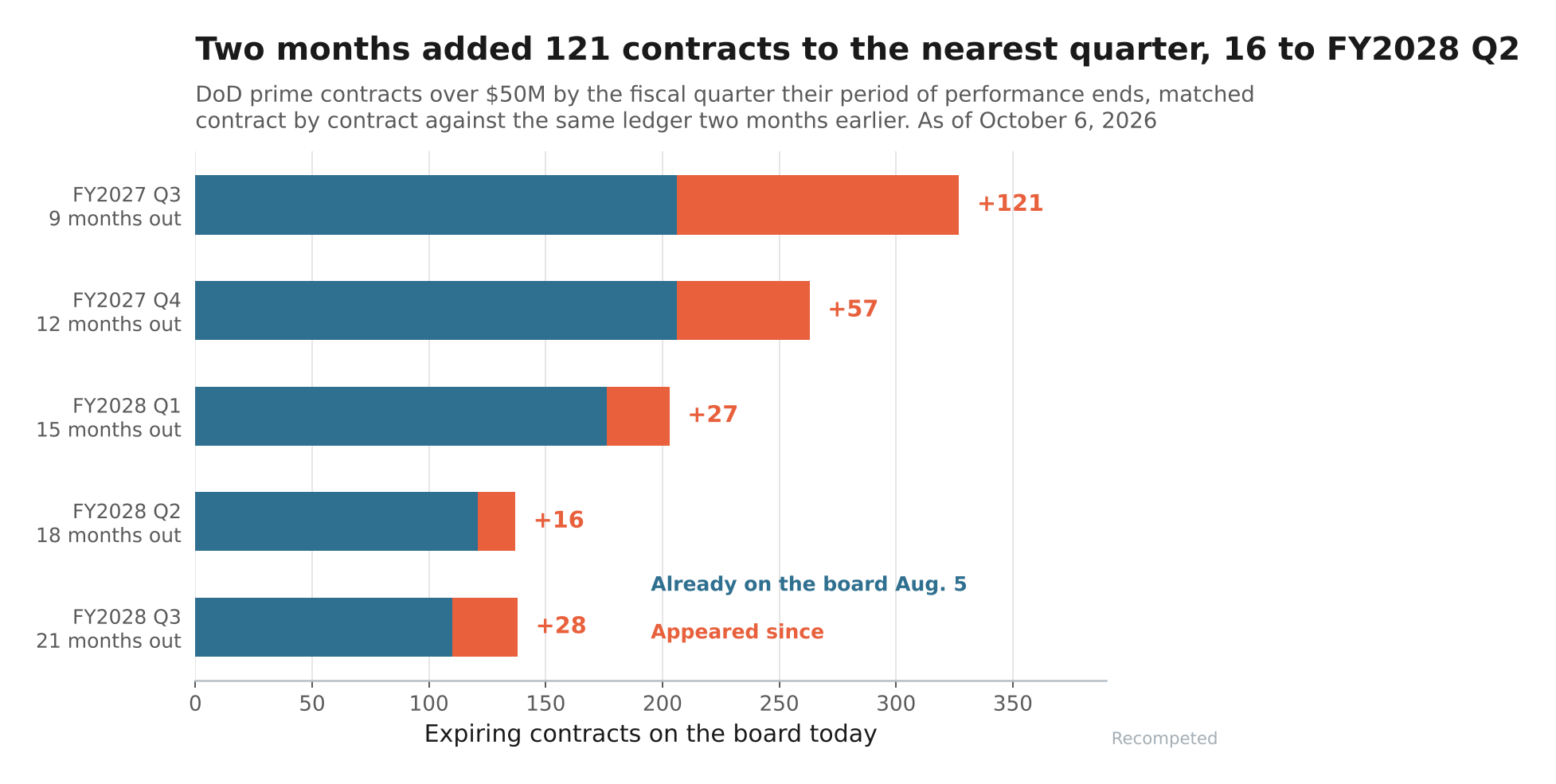
The gradient runs almost cleanly down the horizon. FY2027 Q3, nine months out, kept 63.0% of today's population from August.
FY2027 Q4 kept 78.3%, FY2028 Q1 kept 86.7%, and FY2028 Q2, eighteen months out, kept 88.3% and added sixteen contracts in two months.
In dollars the near quarter moves harder. The rows already sitting in FY2027 Q3 on August 5 carry $36.86B of the $81.95B the quarter shows today, which is 45.0%.
More than half the money now visible in that column was invisible nine weeks ago.
And the window worked against the number. Our sweep runs 6 to 24 months forward, so its near edge walked from February 1 to April 5 over the same period, which chops April 1 through 4 out of FY2027 Q3 entirely.
The quarter grew 39.7% by count while losing four days of coverage.
Attrition is not what's driving it either. Of the 234 rows reading FY2027 Q3 in August, 206 still read FY2027 Q3 today.
Eighty-eight percent of the old list survived, and the new list is that much bigger anyway.
The New Arrivals Are Old Contracts
Here's the part that changes how you read the board.
We expected the fill-in to be fresh awards landing in FPDS on the usual lag. It isn't.
Positions seven and eight of a PIID are the fiscal year the instrument was issued, per FAR 4.1603(a)(2). Across the 114 rows that are brand new to the ledger in that quarter:
- 12 carry an FY25 or FY26 code. Those are the recent awards.
- 56 carry FY22 or FY23. Another twenty carry FY24.
- The rest run back through FY21, FY20 and FY19, with five coded FY18 or earlier and one that will not parse.
We re-pulled five of the largest against the USAspending award API to be sure.
V2X Systems on W52P1J19F0398, $932,057,725.83, started April 2019 and now ends June 12, 2027. SecuriGence on HR001121F0006, $664,457,198.25, started February 2021.
Raytheon on FA880712C0012, $455,376,747.47, started September 2012 and runs to June 18, 2027.
A contract awarded in 2012 did not become news this quarter. Its end date moved, or its obligations finally crossed our floor, and the public record caught up.
That is the channel filling your near quarters, and it runs on modifications to work already in flight.
What That Does to a Pipeline Review
The practical read is narrow and worth the ten minutes:
- Treat the far columns as a floor. FY2028 Q2 shows 137 contracts. On this run rate it will not show 137 when it arrives, and the additions will mostly be contracts already running today that nobody has flagged yet.
- Stop sizing out-year demand off expiring-value charts. Anyone presenting "expiring value by quarter" as a forward market read is showing you record latency shaped like a cliff. The out-years look thin because the record out there is incomplete. The work is already under contract.
- Watch the modification stream. If the near-quarter growth is end-date restatement on live contracts, the signal that a recompete just entered your nine-month window is a mod on somebody's existing award, and it will never appear on a daily contract board.
- Re-pull your own list on a clock. A pipeline built once and reviewed quarterly is a third stale at the exact horizon where capture decisions get made.
Final Thoughts
None of this says the market is growing. The dollars coming off contract in 2028 are real whether or not the record has gotten around to showing them, and the same restatement machinery that adds rows also pushes end dates out and takes them away.
What it does say is that the shape of the board is partly an artifact of when the record gets updated, and the artifact points one direction. The nearer the quarter, the more complete the picture, and the gap between a quarter at eighteen months and that same quarter at nine is roughly a third of its eventual population.
Plan against the floor.
Thanks for reading.