How a Contract Ends Twice
We filled the base-plus-all-options end date on all 1,216 contracts in our expiration pipeline. On 183 of them the date your tracker shows is not the last date the incumbent can hold the work, and services is where the gap concentrates.
M. C. Dean took a task order off an Air Force telecom vehicle on May 25 of this year.
Seven offers, full and open, $160.9M obligated so far, and a period of performance that ends Oct 29, 2027.
The base-plus-all-options end date on the same award record is Apr 30, 2031.
Three months old, and it already carries three and a half years of runway nobody has to compete for.
"When our own pipeline says a contract expires, how often is that actually the last day the incumbent can hold it?"
We finally have the answer across the whole dataset, because we went and got the missing field.
The field the search API doesn't carry
Our expiration pipeline is built off the USAspending award search, which returns the current period-of-performance end date and nothing else. That is the field almost every commercial pipeline product keys on too, because it is the one that comes back cheap and in bulk.
It advances only as options get exercised. The potential end date, the one that reflects the base plus every option the government already bought the right to exercise, lives one layer down on the award endpoint and has to be pulled award by award.
So we pulled it, award by award, for all 1,216 rows. 1,215 came back carrying both dates.
Across the pipeline, 183 contracts show daylight between the two, carrying $36.1B in obligations. That is 15% of the file.
Split it by what the work actually is and the number stops being uniform.
Of 902 non-services rows, mostly platform production and sustainment, 89 have runway, right around 10%. Of 313 services rows, 94 do, a shade over 30% (chart below).
Three times the rate, in exactly the part of the market where our readers do their capture.
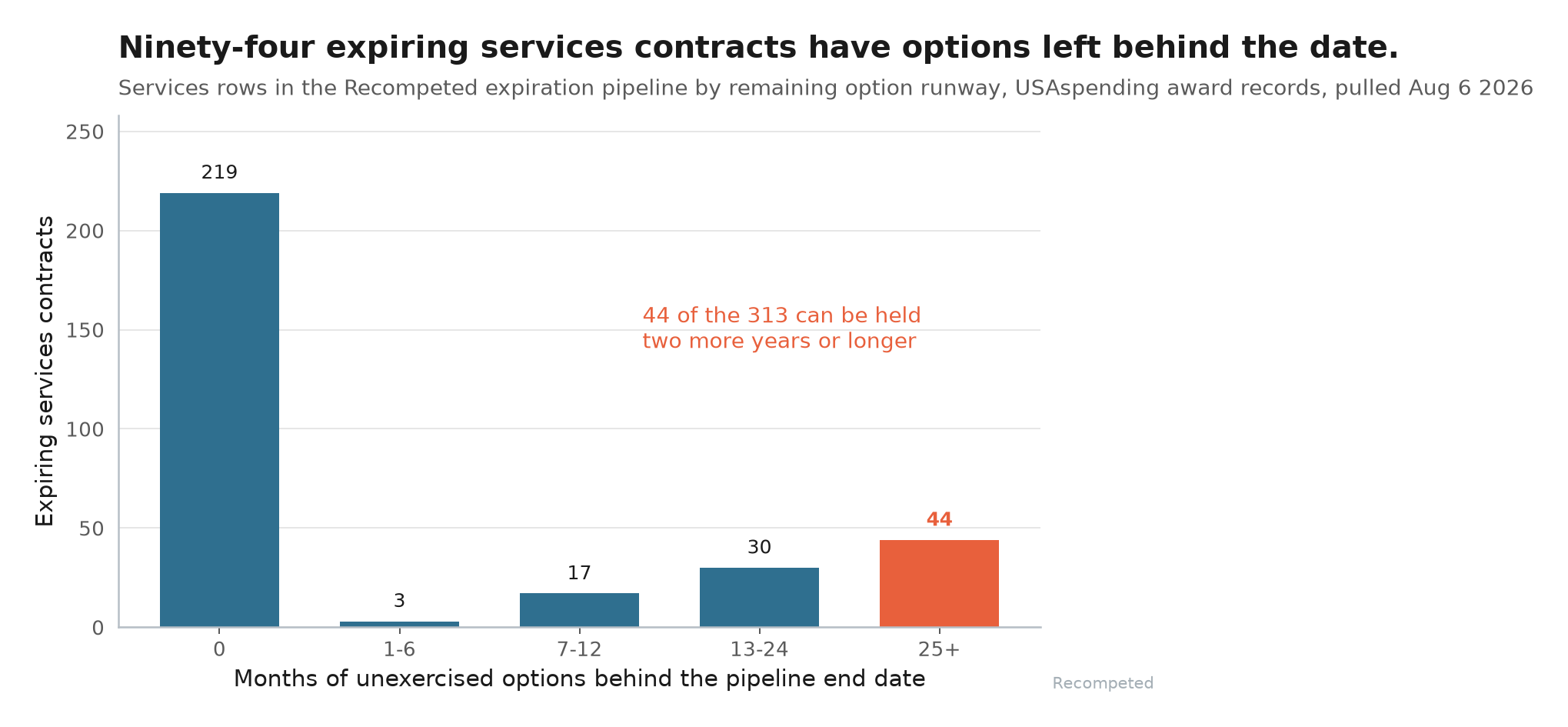
The median runway on those 94 is 645 days. Forty-four of them can be carried two years or more past the date sitting in the pipeline.

The rest of this brief is for subscribers.
The specific solicitations, dockets, and dates to act on sit past this line.
$50 a month, or $500 a year.
Already a subscriber? Sign in