 Recompeted
How a 42-Day Lapse Became a $68 Billion March
DoD put $13.3 billion on contract in October, the smallest month in six years, then cleared $68.6 billion in March once full-year money landed. FY2027 starts October 1 on a continuing resolution neither chamber has enacted.
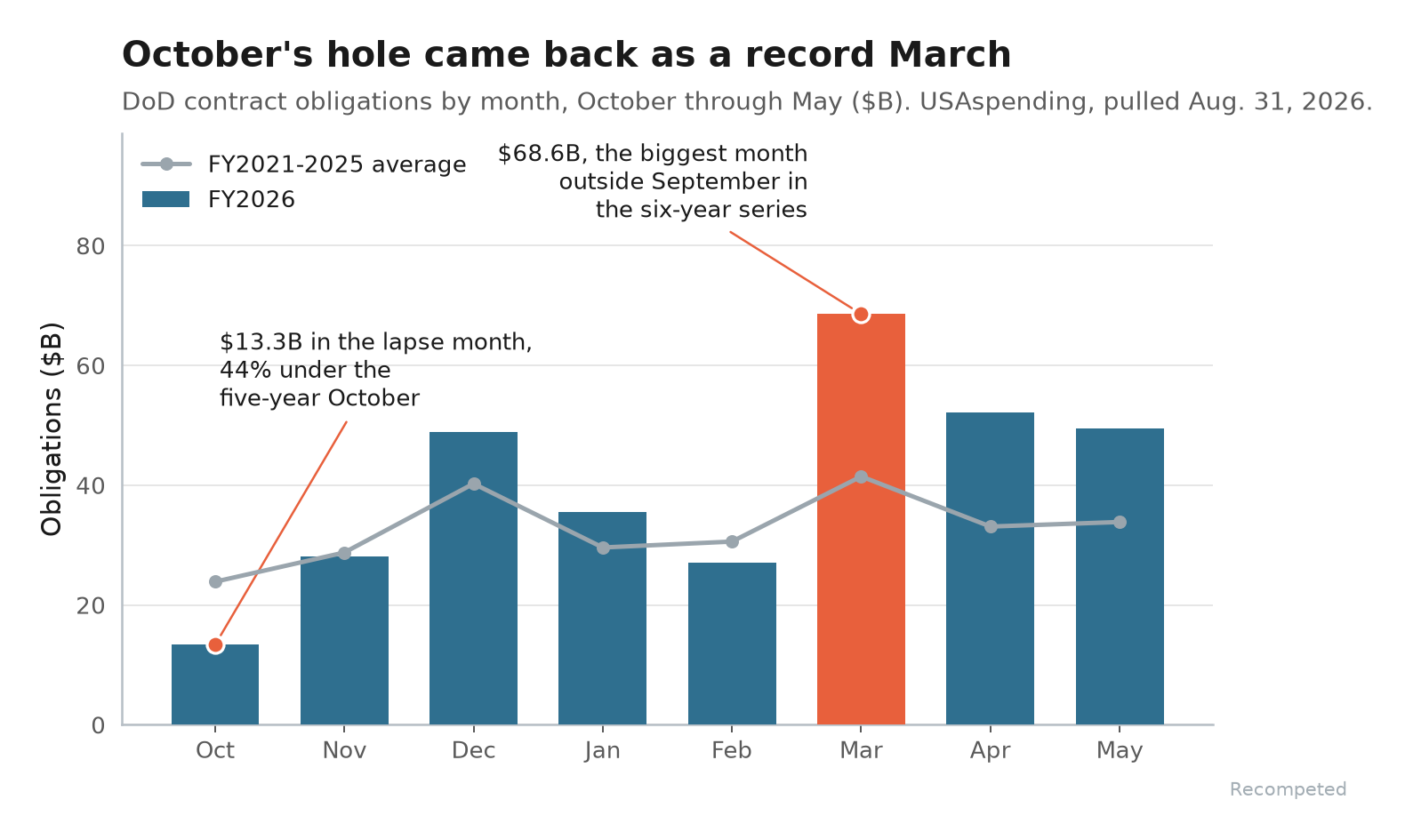
DoD obligated $13.3 billion on contracts in October, the month the appropriations lapse ran. That is the smallest month in the six fiscal years of the series, 44% under the average of the five Octobers before it.
Five months later the department cleared $68.6 billion in a single March (chart below). Largest month outside a September in the whole series, and it wasn't close.
"Does a funding fight kill the awards, or just move them?"
Move them. The useful part is the shape of the move, because FY2027 starts October 1 and Congress has the same fight teed up.
The Hole
The FY2026 lapse ran 42 days, October 1 to November 12, and ended when P.L. 119-37 put the department on a CR through January 30.
October still produced $13.3 billion, which is the tell. DoD opened the year holding $382.4 billion in unexpired, unobligated balances from prior acts, so procurement, shipbuilding, and RDT&E money was there to spend even while the FY2026 accounts sat empty.
What went missing was the new stuff. And the people to write it.
Compare October 2025 against the same month a year earlier, $29.0 billion, and the gap is 54%.
Where It Came Back
December ran $48.9 billion, the biggest December in the series, and reads as the post-lapse backlog clearing on prior-year money.
Then full-year appropriations landed February 3: the Department of Defense Appropriations Act, 2026, Division A of P.L. 119-75, $839.2 billion, $8.4 billion over the request.
February itself was quiet at $27.1 billion. The wave arrived in March at $68.6 billion, held through April at $52.1 billion, and was still running in May at $49.5 billion.
Each of those is the largest of its calendar month in six years, and FY2026 now owns four of the six biggest non-September months on the whole record.
So the ramp lags enactment by roughly four to eight weeks. Budget the gap between the signature and the obligations.
Here's the part that decides whether it's your money: split March by award type.
Definitive contracts came to $37.3 billion against $15.3 billion in March 2025, a 2.4x jump. Delivery orders moved too, $29.2 billion against $20.5 billion, at a fraction of that rate.
The wave was heavier in new contract actions than in orders against vehicles somebody already holds. Award decisions had been sitting in a queue, and they came out in a burst.
One honest caveat: FY2026 got a bigger topline, so not all of the year-over-year rise ($323.0 billion October through May against $273.6 billion) is displaced timing. The month-by-month shape is.
One Month to Run It Again
FY2027 begins October 1 and there is no full-year defense bill in front of either chamber. House Appropriations approved its version June 24 and the House floor hasn't taken it up; the Senate committee has not moved any of the twelve.
What both chambers have passed is a CR, and not the same one.
The House passed H.R. 9770 on July 21 at FY2026 levels through December 4. The Senate passed its own version August 8, 90-6, through December 11.
Neither is law.
Plan against the December CR, then, and against FY2026's precedent for what follows a December CR: full-year money on February 3, awards in March.
For a capture shop that means a few concrete things this month:
- Check option runway on every contract you hold or chase that ends in Q1 FY2027. Anything out of runway gets a bridge in October or November, and that bridge is your next six months of positioning.
- Read a November award slip as a schedule event. The source-selection queue that emptied in March 2026 was full of decisions made months earlier.
- Watch for the compression when it lands. A contracting shop clearing $68 billion in thirty days is a shop where your debriefing, your protest response, and your kickoff all compete with everyone else's.
And you will be reading it late. The USAspending series this chart comes from returns $17.1 million for June 2026 as of today's pull, against $49.5 billion for May.
The record catches up about a quarter behind, which is why the chart stops where it does.
Final Thoughts
None of this is an argument that a shutdown is cheap. Forty-two days of lost contracting capacity is real, and the people who absorbed it are the same ones who ran the March wave.
The money, though, is stubborn. It gets appropriated, it gets obligated, and the fight over when mostly rearranges the calendar you plan against. If FY2027 opens the way FY2026 did, the awards you expect in November are March awards, the incumbents you expect to displace get another two quarters, and the only question worth asking in October is which of your targets has runway and which one needs a bridge.
Thanks for reading.