 Recompeted
How 35 Bidders Produced 34 Winners
Across the 16 multiple-award vehicles the Department of War announced this month, 201 companies bid and 141 came away holding a seat. The Air Force put 34 of 35 bidders on a $3.5 billion environmental MATOC. The Army's National Capital Region solicitation explains why in writing: it deleted price and past performance from the evaluation under a FAR authority that only works if the government promises to award every qualifying offeror.
"How many companies actually lose a multiple-award competition?"
We counted every one the Department of War announced this month. 201 companies bid. 141 came away holding a seat.
Sixty lost. In a month.
Nobody Is Getting Cut
The census is the 16 daily contract boards from Sept. 1 through Sept. 23, 326 announcements, every one of which put two or more companies on the same vehicle and reported how many offers came in. Sixteen vehicles qualify, carrying $9.45 billion of combined ceiling (chart below).
The aggregate admission rate is 70%. The median vehicle sits at 73%. Five of the sixteen turned away nobody at all.
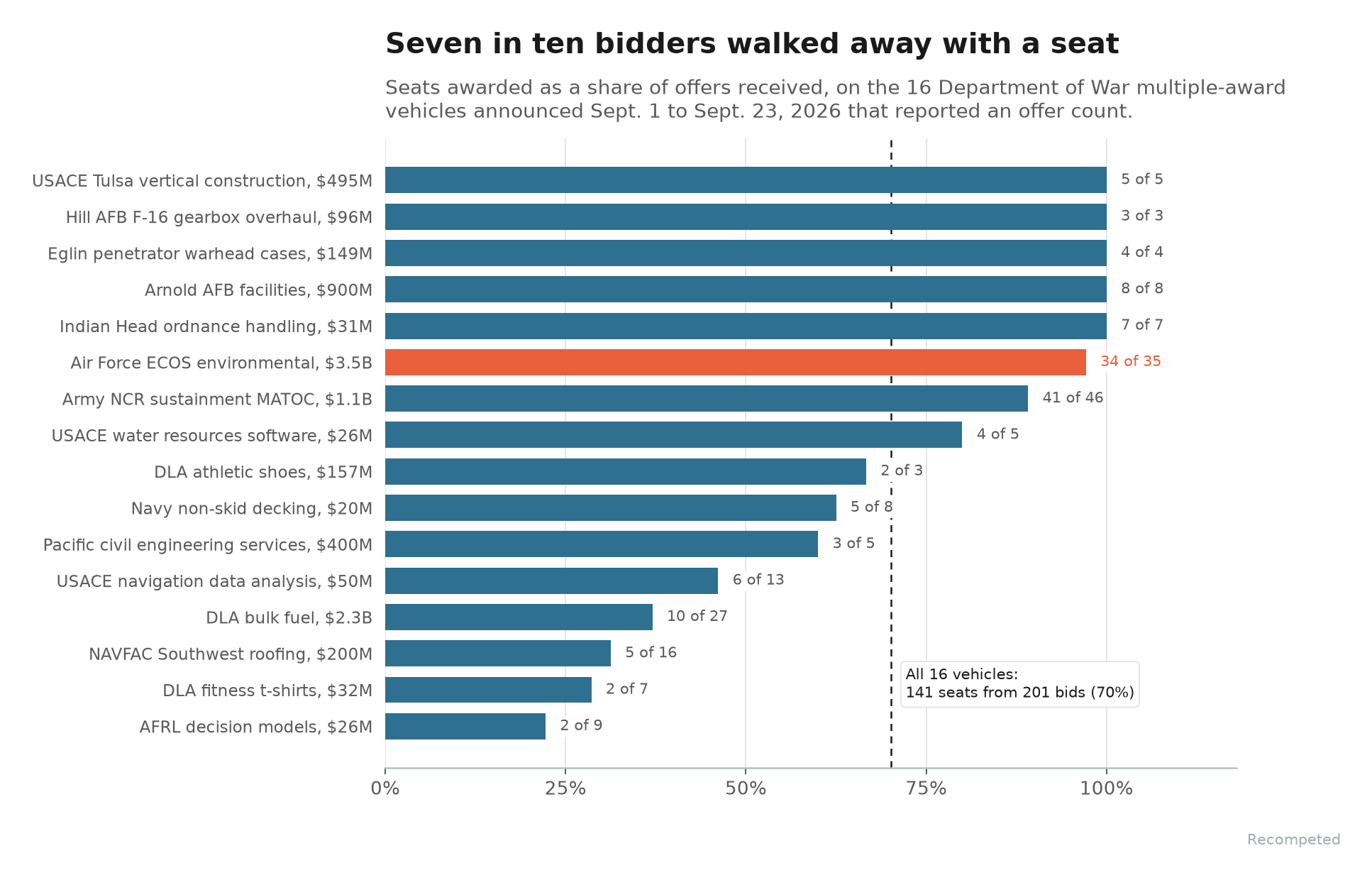
The extreme case ran on Wednesday's board. The Air Force's Environmental Construction Optimization Services MATOC, FA8903-26-D-0055 through -0088, a $3.5 billion ceiling out of the 772nd Enterprise Sourcing Squadron at JBSA Lackland, went to 34 awardees against 35 offers.
One company in the entire field missed.
And the dollars do not explain the spread. That $3.5B environmental vehicle admitted 97% of its bidders, while DLA Energy's $2.3 billion bulk fuel buy admitted 37%.
The Army Wrote the Reason Down
Amendment 0008 to solicitation W51EW7-26-R-A002, the Army's National Capital Region sustainment MATOC, says it in the agency's own words: the source selection methodology "has been revised FROM 'Lowest Price Technically Acceptable' TO 'Technical Acceptability' in accordance with FAR 15.304(c)(1)(ii)(A)."
The same amendment removed the seed project, removed past performance as an evaluation factor, and told offerors to propose the technical factor "without cost/price."
MICC Fort Eustis then awarded 41 seats against 46 bids.
That FAR citation is the mechanism, and it is worth reading closely. Price has to be evaluated in every source selection.
The exception at 15.304(c)(1)(ii)(A) lets a DoD contracting officer drop it only when three conditions hold, and the third one is the tell: the solicitation must state that the government "intends to make an award to each and all qualifying offerors."
So an agency that wants to skip price at the vehicle level has to promise, in writing, to admit everybody who qualifies. Paragraph (B) then requires price to come back as a factor on every order placed under the contract.
The Air Force reached the same place by a different road. ECOS ran a hybrid Highest Technically Rated Offeror evaluation with a Minimum Technical Threshold Rating, which is a bar to clear.
Everyone over the bar gets in.
Price the Bid Accordingly
A vehicle proposal under either method is a compliance exercise, and it should be resourced like one:
- The discriminators you normally spend money on may carry no weight. On the NCR MATOC, past performance was worth zero and so was price.
- Your bid-and-proposal budget for the vehicle buys an option to compete later.
- Your real competitor list is the awardee list. On ECOS that is 34 companies, on a five-year base with a three-year option.
- Price gets evaluated on the order, because 15.304(c)(1)(ii)(B) requires it there.
Read Section M before the capture decision. "Technical acceptability," "minimum technical threshold," or the phrase "each and all qualifying offerors" tells you the seat is cheap.
The work still isn't. We went through the other end of this on the Army's live training vehicle, where eleven seat holders have split $11,000 in the 540 days since award. Cheap to win, and worth what it was cheap for.
Where it gets interesting is the other tail. AFRL admitted 2 of 9. NAVFAC Southwest roofing admitted 5 of 16. DLA's fitness t-shirt buy admitted 2 of 7.
Those are genuine down-selects, and on a commodity requirements contract the logic is obvious: the award is the work, so there is no order-level competition left to push the decision into.
Final Thoughts
The industry still reads a vehicle award as a win, and the trade press still writes it up that way. On seven of the sixteen vehicles announced this month, at least 89% of the field won.
The decision that matters moved downstream.
Asking who won a seat on ECOS tells you very little now, because the answer is nearly everyone who showed up. Asking who takes the first ten task orders against 33 other holders is the question the $3.5 billion actually turns on, and none of us will have an answer until the orders start posting.
Thanks for reading.