 Recompeted
How 3 P.M. in Honolulu Becomes Tomorrow
SAM keeps a solicitation's deadline as a UTC instant and the issuing office's clock as a separate field. We converted one into the other for every DoD solicitation posted last quarter. On 266 of them the two records disagree about what day your proposal is due, and 256 of those disagreements run in the direction that costs you the bid.
A contracting officer at NAVSUP Fleet Logistics Center Yokosuka put a line in the body of solicitation N6264926QH009 that nobody should have to write.
"Please note the due date and time are Japan Standard Time."
The notice was a uniform buy for Joint Region Marianas fire and emergency services, quotes due at 8:00 in the morning on September 30. The machine-readable deadline on that same notice reads 2026-09-29T23:00:00Z.
Same deadline. Two different days.
Where the day goes
SAM carries the deadline twice. responseDate is a UTC instant, and responseTimeZone is the clock the issuing office actually keeps, and they live in separate fields on the record.
Convert one into the other and the calendar date moves whenever the local hour sits far enough from Greenwich.
The Army's Joint Pacific Multinational Readiness Center put eleven quote requests out for the 27-01 rotation last quarter, bus transportation and reefers and light sets around Oahu and Pohakuloa. The body of W91QVP-27-Q-A014 states the deadline in words: "Quotes due: No later than 3:00 PM HST, 26 September 2026."
The field on the same record says 2026-09-27T01:00:00Z.
So the deadline is Saturday in Honolulu and Sunday in UTC, and which of those your pipeline tool shows you depends entirely on which field it read.
FAR 15.208(a) is unambiguous about whose clock governs. Offers must reach the designated office "by the time specified in the solicitation," and where no time is specified the default is 4:30 p.m. local time, for the designated Government office.
The office's clock is the clock. Everything else is a rendering.
266 disagreements in one quarter
We pulled every DoD notice of type Solicitation published between July 1 and September 30: 8,371 records, every one of them carrying a response date.
Then we read the zone beside it. 8,341 carry one.
Thirty carry none at all, and two carry a key no standard time zone library will resolve, Asia/Beijing and Pacific/Wellington, neither of which exists in the IANA database every date library is built on.
On the 8,339 that resolve cleanly, the local due date and the UTC date disagree 266 times, and the rate climbs with distance from Greenwich (chart below).
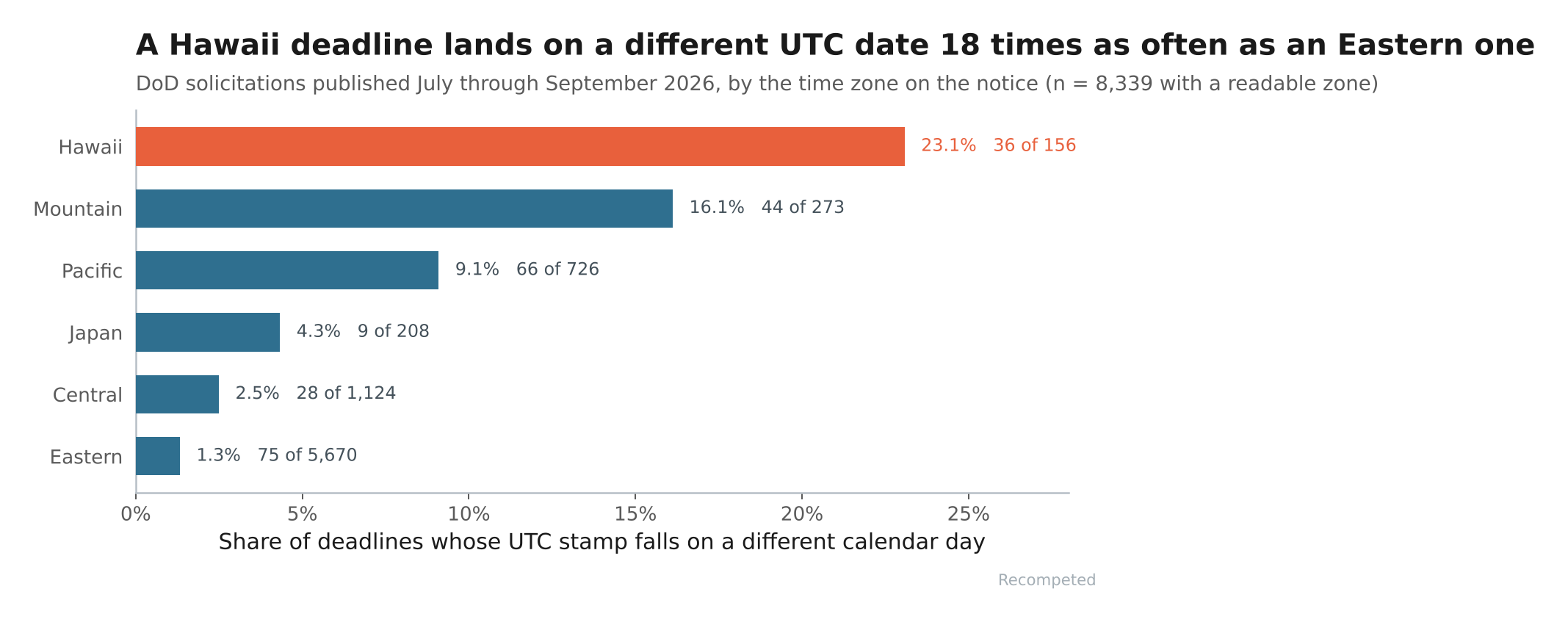
Hawaii notices disagree 23.1% of the time, Mountain 16.1%, Pacific 9.1%. Alaska is the worst rate on the board at 6 of 20, small enough that we would not lean on it.
The direction is the part that matters.
256 of the 266 push the stamp forward a day, so the tool reading UTC shows a deadline later than the real one. Ten run the other way, all of them morning deadlines in Japan and Australia, where the error is harmless because it makes you early.
The late closers do more damage than the Pacific
Here's the catch. The single biggest source of these is the 23:59 close.
121 of the 266 fall a minute before local midnight, which guarantees a next-day UTC stamp anywhere west of Greenwich, and DLA writes most of them. The agency accounts for 106 of the 266 disagreements on its own:
- 37 at DLA Aviation Ogden, 20 at DLA Aviation Oklahoma City, 18 at DLA Maritime Puget Sound
- 72 of the 106 close at 23:59 local, and the 106 sit in five zones: Mountain 35, Eastern 23, Central 20, Pacific 18, Hawaii 10
Which is why Eastern notices are on the chart at all. 58 of Eastern's 75 close at 23:59, and a one-minute-to-midnight deadline at NAVSUP Weapon Systems Support in Mechanicsburg is tomorrow in UTC just as surely as a 3 p.m. deadline in Honolulu.
And it isn't only amendments and re-postings inflating the count. Of the 4,141 records that arrived as first versions rather than amendments, 132 carry the mismatch, the same 3.2% as the full population.
Final Thoughts
Three percent is a small number until you notice which three percent. These are Pacific rotations, DLA Maritime buys at Pearl Harbor and Puget Sound, aviation spares out of Ogden: small, fast, quote-driven buys with short fuses, exactly the work where nobody has budget for a second proposal manager watching the clock.
The record is honest. It gives you the instant and it gives you the zone, and it is only the two of them together that mean anything.
What it will never do is warn you that the field your tool happened to read is a day off, and FAR 15.208(b)(1) calls anything arriving after the exact time specified "late," which is the end of the conversation for a quote submitted at 4:00 p.m. Hawaii time on the day your tracker said it was due.
Thanks for reading.