 Recompeted
Your Seat on the Vehicle Guarantees You $500
NAVFAC put five roofing contractors on a $200 million MACC on Wednesday and obligated $5,000 apiece. Across DoD, 3,214 guaranteed minimums since 2023 have a median of $500, and 433 of them are zero. The ceiling on the press release is not a number anybody owes you.
Wednesday's Navy board put five small businesses on a roofing MACC at NAVFAC Southwest worth $200,000,000 across a two-year base and six option years.
Sixteen firms bid. Five won. The announcement then says exactly what winning bought them:
"Fiscal 2026 operations and maintenance (Navy) funds in the amount of $5,000 for each awardee will be obligated at the time of award to satisfy the minimum guarantee."
So the government wrote $25,000 in enforceable obligations against a $200 million ceiling. Per seat that is $40,000,000 of headline against $5,000 of money, a ratio of 8,000 to 1.
Every capture manager knows this. Almost nobody prices it.
The only number in the award that is actually yours
The guaranteed minimum is the consideration that makes an IDIQ a contract rather than an option to buy. It has to be more than nominal, and in practice contracting officers set it at whatever "more than nominal" can be argued to mean, then fund it with a seed order on day one.
Everything above it is capacity. The ceiling is shared, it is a maximum, and it obligates the government to nothing.
We pulled every DoD order since October 2023 whose description says it exists to fund an IDIQ's guaranteed minimum. That is 3,214 orders across the whole department (chart below).
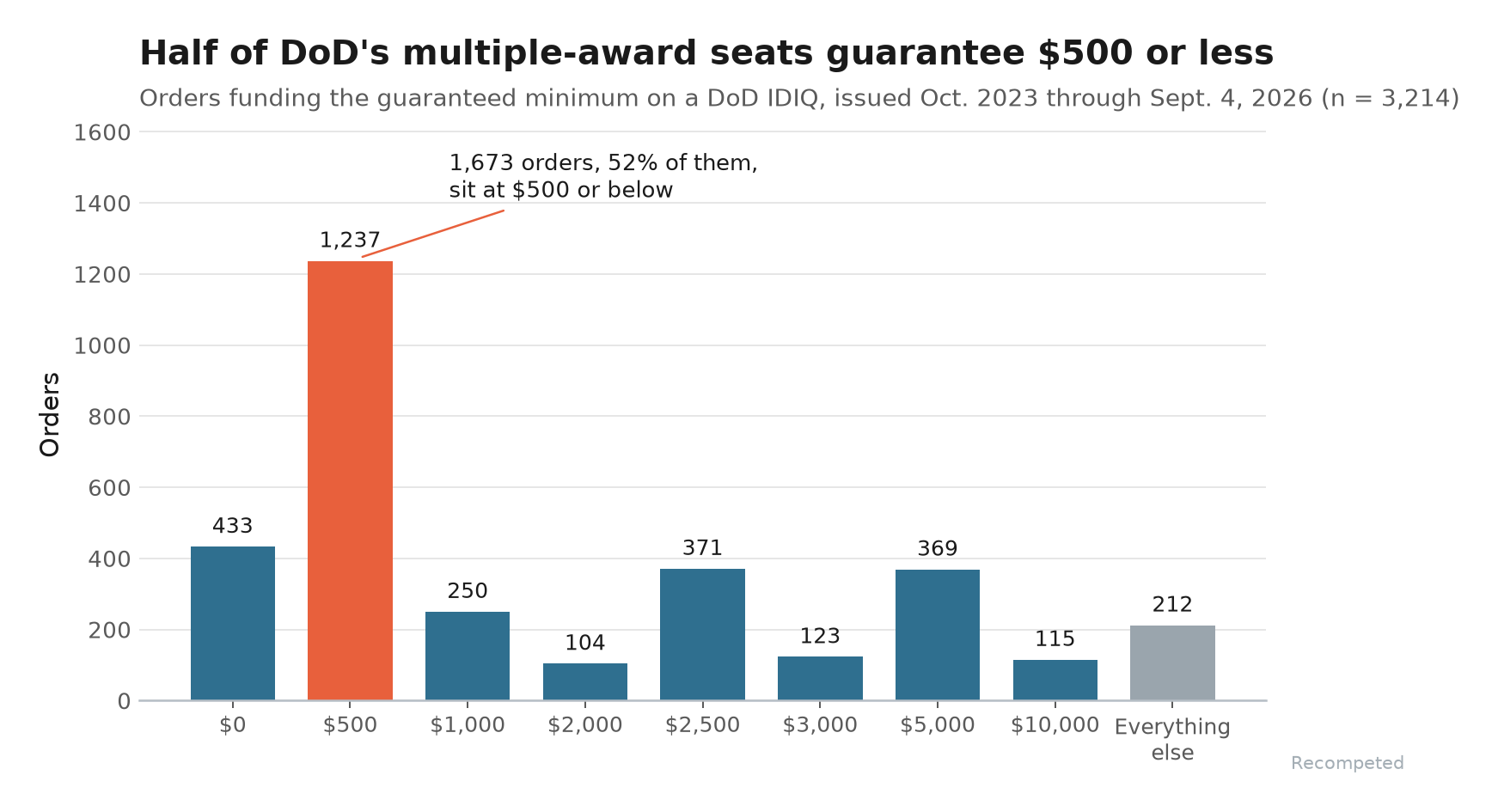
The median is $500.
Half the census, 1,673 orders, sits at $500 or below, and 433 of those are booked at zero.
98% of all 3,214 land at or under $25,000. Six clear $1 million, and those are seats where real work later got written onto the minimum-guarantee order itself.
The clustering is the tell. Four round numbers, $500 and $2,500 and $5,000 and $1,000, account for 2,235 of the orders.
Nobody computed these. Somebody picked them.
And a fair number of them buy nothing you would recognize as work.
Fourteen orders in the census run through one Army Corps architect-engineer seat set, W912DW25F2004 through -F2044, at $2,500 each. AECOM, Burns & McDonnell, HDR, Jacobs and WSP are all in there.
What the government bought for its $35,000, per the orders themselves: proof of anti-terrorism Level 1 training, iWATCH and TARP training, E-Verify screenings for key personnel, and attendance at the IDIQ kickoff meeting.
The consideration is the onboarding.
Add all 3,214 together and DoD has guaranteed $84,377,646 in three fiscal years. That is less than half the ceiling on the single roofing MACC announced Wednesday.
Where it gets expensive
The Navy runs 1,777 of these, the Army 1,230, the Air Force 128.
That split tracks who buys through multiple-award construction and services vehicles, which is exactly the ground the services mid-tiers compete on.
Now, the seat is still worth having. You cannot bid the task orders without it, and on a well-fed vehicle the orders are the whole point.
Here's the catch: the bid you just wrote was priced as a competition for $200 million, and it was a competition for standing. The real competition starts after award, against four firms who cleared the same bar you did, on orders nobody has scoped yet.
Which turns the seat into a question about the vehicle rather than the ceiling:
- What did the predecessor actually order? Obligations against the old vehicle, not its ceiling, are the only forecast worth having. A MACC that ran at 20% of ceiling will do it again.
- How many seats, and how many are on-ramps? Five firms splitting a real pipeline is a business. Ten firms splitting the same pipeline is a marketing expense with a CAGE code.
- Is the guarantee funded with expiring money? The NAVFAC $5,000 is fiscal 2026 O&M that dies Sept. 30. Money written to expire in three weeks tells you the seed order is paperwork.
- What is the fair-opportunity practice at this office? An office that competes every order behaves differently from one that rotates them, and neither shows up in the ceiling.
None of that is in the announcement. All of it is in the incumbent's obligation history.
Final Thoughts
The ceiling exists to give the contracting officer ordering authority. It then gets repeated into a press release, into a win announcement, into somebody's pipeline at full value, and by the time it reaches a board deck the $200 million has been quietly divided by nobody.
Ten firms took seats on a NAVFAC EXWC petroleum engineering vehicle last week worth $145,000,000 over five years. Read as capacity, that is $2.9 million a year each before a single task order competes.
Read as a win, it is $145 million, and that is the number that will get said out loud.
The board tells you who got standing. The obligation record tells you what standing has been worth at that office, on that kind of work, to the firm that held it last.
One of those is free to read and takes ten minutes.
Thanks for reading.