Who Signs the Next Sole Source?
NSWC Crane extended a Teledyne FLIR sensor contract by two years, three days before it stopped taking orders, and posted the justification today. The document says the Navy has no plans to compete this work again, and a DoD rule nobody reads turns that sentence into a higher signature on the next one.
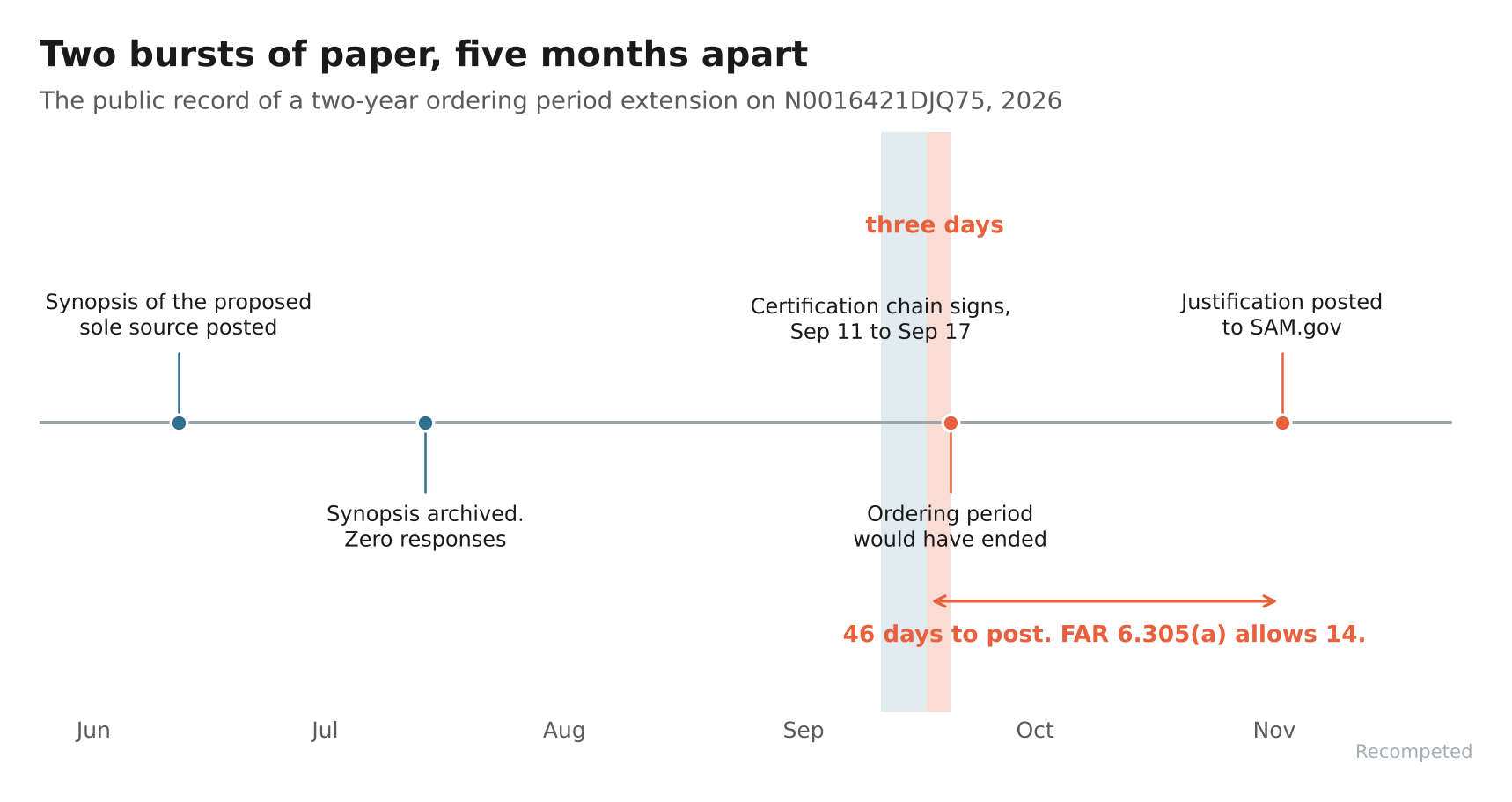
The ordering period on NSWC Crane's shipboard sensor contract ran out on September 20. The competition advocate approved the two-year extension that saved it on September 17, at 5:01pm Eastern.
Three days.
That approval went public today. Crane posted the justification to SAM at 16:32 Zulu, 46 days after the modification was signed.
It is the frankest document the desk has read this quarter. The barriers-to-competition section says the Navy has no plans to compete this work again.
"So who has to sign the next one?"
Somebody more senior than the man who signed this one, and the rule that says so is worth the ten minutes.
What the Extension Bought
Contract N0016421DJQ75 is a single-award IDIQ that NSWC Crane gave FLIR Surveillance, now Teledyne FLIR Defense, on September 21, 2021. Electro-optic sensor systems and everything that hangs off them: SEA STAR SAFIRE III, BRITE Star II, TacFLIR 380-HD, Maritime SeaFLIR 380-HD, hand control units, spares, test-teardown-and-evaluation, field repairs, engineering services.
FPDS carries it at $43,937,783 base and all options, PSC 5855, NAICS 334511, and codes it not competed: only one source, one offer received. The 2021 award was already sole source before any of this started.
Modification P00003, signed September 17, adds two years. That takes the vehicle to seven total years of performance, into September 2028.
Now look at what has actually ridden on it. Across every FPDS action referencing the vehicle, 45 orders and 105 contract actions, the Government has obligated $8,314,974.96 in five years.
That is 19% of what the contract was sized for. The last order went out on June 24, four months ago.
What the Extension Owed in Paper
An ordering period extension is not an option exercise, and Crane treated it right. The two added years buy ordering authority nobody competed for, so they need their own statutory authority and their own justification, the same as a fresh sole-source award.
Here is the full set of paper that obligation generates, and the dates this one hit:
- The synopsis. Posted June 12, auto-archived July 14, 32 days on the street. Section 6 of the justification records the yield in one sentence: "No responses have been received to date."
- The statutory citation. This one cites 10 U.S.C. 3204(a)(1), only one responsible source, and never names a FAR paragraph anywhere in the document. Readers will know the pattern from the justifications we censused on October 31.
- The certification chain. Contracting officer September 11 at 15:22, branch manager September 15 at 10:32, division manager eighteen minutes later, counsel September 15 at 14:02, competition advocate September 17 at 17:01.
- The posting. FAR 6.305(a) gives an agency 14 days after award to put the justification on SAM. This one took 46, and the regulation's own proprietary-screening paragraph says that screen "must not prevent or delay the posting" (chart below).
And one detail matters more to your pipeline than all of that.
FPDS still shows three actions on this vehicle: the 2021 award, a 2023 clause insertion, a 2025 administrative mod. All three carry a last date to order of 2026-09-20.
P00003 is not in there. USAspending agrees, reporting a period of performance that ended September 20, 2026 and no potential end date at all.
Screen this contract tonight and your tooling tells you it died six weeks ago. It runs to 2028.

The rest of this brief is for subscribers.
The specific solicitations, dockets, and dates to act on sit past this line.
$50 a month, or $500 a year.
Already a subscriber? Sign in