Where a Joint Venture Still Earns Its Paperwork
USACE put 39 of its last 114 engineering awards into a joint venture and none of its last 133 services awards. Same command, same year, same test. The split lives in FAR subpart 36.6, and it tells you which recompetes on your board are worth standing up an entity for.
USACE put 39 of its last 114 engineering award notices into the hands of a joint venture. Over the same thirteen months the same command posted 133 services award notices, and the joint-venture count among them is zero.
Same buyer. Same calendar. Same test.
Yesterday we ran that test on engineering work alone and found six commands that had never once awarded to a joint venture, which read like a systems-command fact.
Run the identical census on services and the form nearly disappears everywhere, including at the two commands that lean on it hardest.
The census
Every DoD award notice on SAM.gov published between Oct. 1, 2025 and Nov. 7, 2026, in two NAICS sets: 541330 engineering services (337 notices) and the five services codes this desk follows, 541512, 541611, 541715, 518210 and 561210 (452 notices).
All 789 carry an awardee name, and a notice counts as a joint venture when the awardee's registered name says so.
Engineering: 61 of 337, or 18.1%. Services: 3 of 452, or 0.7% (chart below).
And those three are two companies. KTH Services JV took base operations at a naval station and at Fort Carson, and ARCTEC Alaska JV took the Alaska radar system.
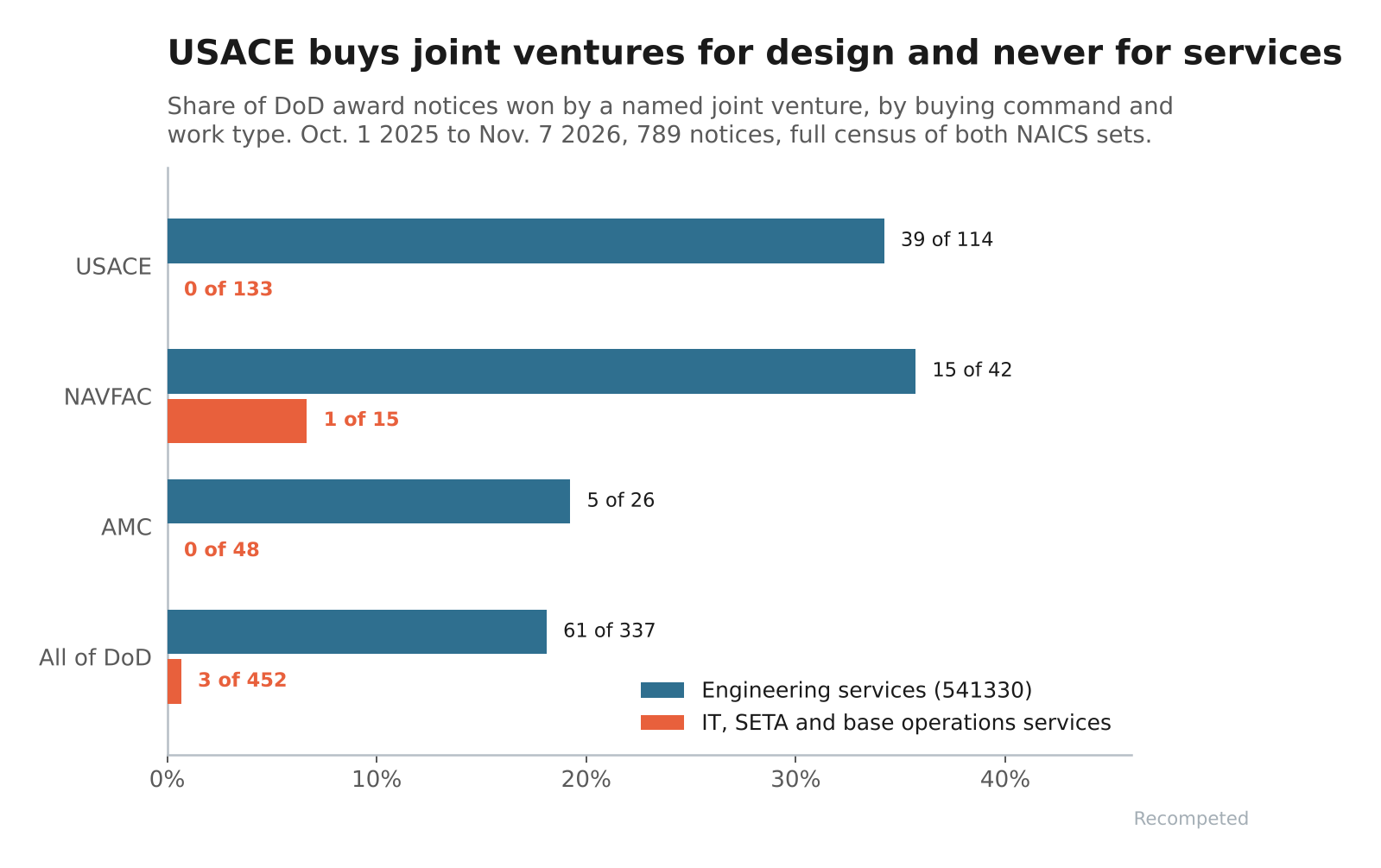
The set-aside explanation dies on contact. 165 of the 452 services notices were set aside for small business in some form, exactly where a mentor-protege joint venture is supposed to live, and one of them went to a joint venture.
Why the design side plays by other rules
A-E work never reaches parts 13, 14 or 15. FAR 36.601-3(b) routes it to subpart 36.6, and 36.602-1 fixes what the evaluation board is allowed to score: professional qualifications, specialized experience and technical competence, capacity to accomplish the work in the required time, past performance, and location. Price appears nowhere on that list. The contracting officer opens the fee discussion with the most preferred firm only after the selection is made (36.606(a)).
Here's the catch. Under 36.606(e) subcontracting is a negotiation topic, and the clause at 52.244-4 then locks your subs to those "specifically identified and agreed to during negotiations." A partner you carry as a sub arrives after the board has already ranked you.
So getting a partner's experience and capacity onto the selection sheet means putting the partner inside the offeror. That is what a joint venture buys, and it is worth real money.
Part 15 gives you the same credit for free. FAR 15.305(a)(2)(iii) directs the evaluator to take into account past performance of "subcontractors that will perform major or critical aspects of the requirement."
Your teammate is already on the sheet. The entity adds a registration, an operating agreement, a CAGE code and a work-share rule, and adds nothing to your score.

The rest of this brief is for subscribers.
The specific solicitations, dockets, and dates to act on sit past this line.
$50 a month, or $500 a year.
Already a subscriber? Sign in